
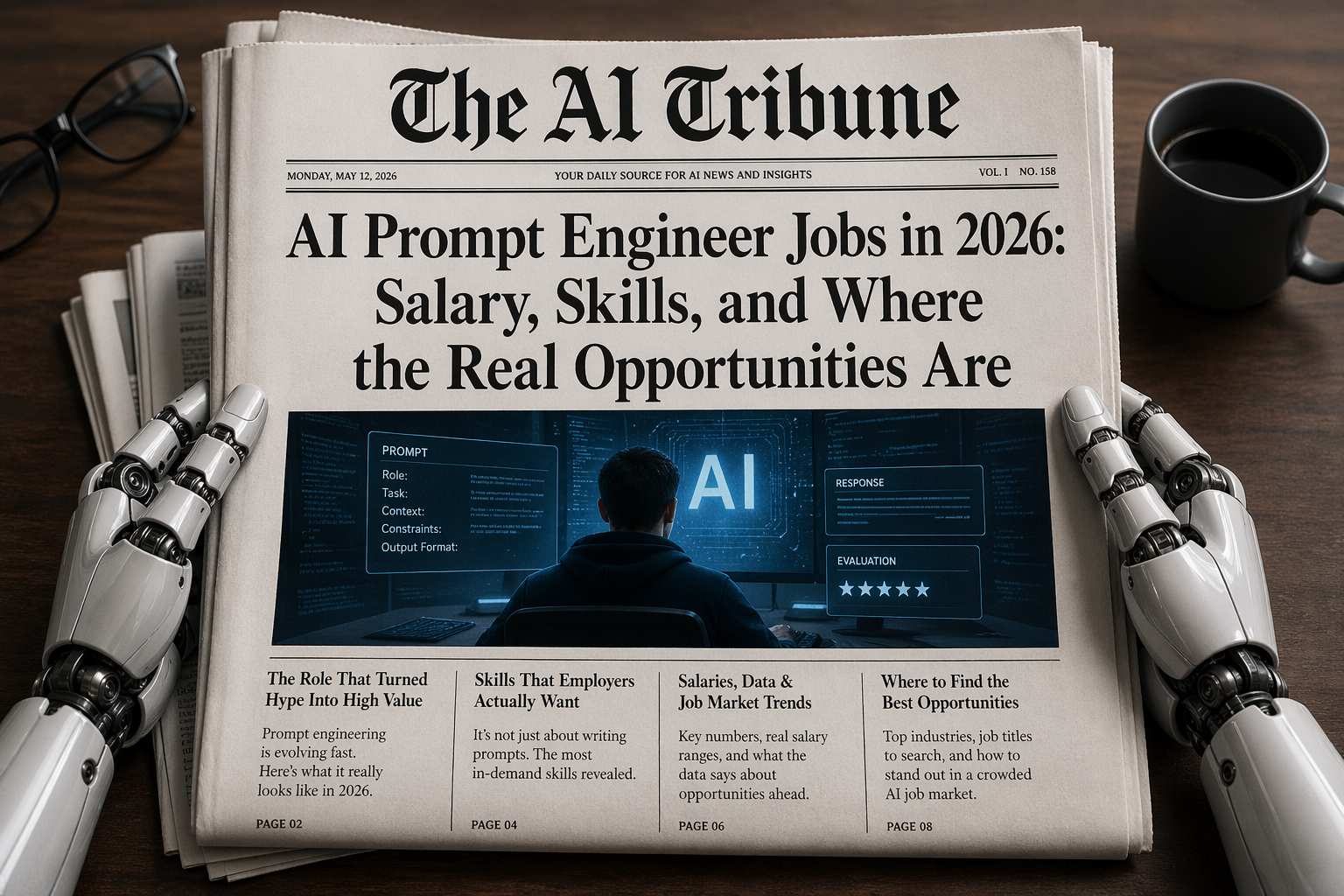
If you search for AI prompt engineer jobs today, you can still find the term. But the market is more nuanced than the hype cycle made it sound. The strongest takeaway from current labor and hiring data is this: prompt engineering is still valuable, but it is increasingly being absorbed into broader AI roles instead of living on its own as a glamorous standalone title. (arXiv)
That actually makes this a better career story, not a worse one. Companies still need people who can structure instructions well, test outputs, improve reliability, reduce hallucinations, and turn messy business needs into repeatable AI workflows. They just do not always call that person a “prompt engineer.” In many cases, they call them an AI trainer, conversation designer, LLM specialist, AI product analyst, automation consultant, or applied AI engineer. (arXiv)
What AI prompt engineer jobs really look like now
One of the most useful reality checks comes from a 2026 research paper that analyzed 20,662 LinkedIn AI job postings and found only 72 listings explicitly labeled for prompt engineers. That does not mean the skill is unimportant. It means the job title itself is relatively rare compared with the broader market for AI-enabled work. (arXiv)
In plain English, employers are not usually paying for “clever wording” alone. They are paying for people who can make AI more useful inside a workflow. That might mean designing prompts for customer support, building response-evaluation rubrics, testing edge cases, defining tone and style rules, or pairing prompts with retrieval, tools, or automations. OpenAI and Anthropic both publish extensive prompting guidance now, which is another signal that prompt engineering is becoming a standard professional capability rather than a mysterious niche art. (OpenAI Help Center)
A practical example helps here. A hospital system may not hire someone with the title “AI Prompt Engineer,” but it may absolutely need someone who can build safe prompting workflows for note drafting, claims summaries, or patient-facing chat tools. The same goes for recruiting teams, compliance teams, sales teams, and internal knowledge teams. If you want to see how this shows up in a recruiting context, this AI Tribune piece on integrating mock interview AI with ATS recruitment systems is the kind of adjacent use case that quietly creates real demand for prompt-heavy work.
Is demand for AI prompt engineer jobs actually growing?
The honest answer is yes for the skill, but only selectively for the title. The World Economic Forum says AI and big data are the fastest-growing skills category through 2030, and AI and machine learning specialists are among the fastest-growing roles. The same report says 63% of employers view skills gaps as a major barrier, and 77% plan to upskill workers in response to AI-driven change. (World Economic Forum)
PwC’s 2025 Global AI Jobs Barometer makes the picture even sharper. It found that skills in AI-exposed jobs are changing 66% faster than in other jobs, and workers with AI skills command a 56% wage premium, up from 25% a year earlier. PwC explicitly mentions AI skills such as prompt engineering in this premium. That is a strong sign that employers will pay for AI fluency, even if they wrap it inside broader roles. (PwC)
At the same time, the pure “prompt engineer” label appears to have cooled from its 2023 hype peak. Reporting that cites Indeed data says searches for prompt engineer roles surged after ChatGPT launched, then settled down, and executives like Nationwide’s CTO have argued that prompt engineering is becoming a capability inside jobs rather than a job title by itself. That is exactly why job seekers should widen their search terms instead of obsessing over one title. (Salesforce Ben)
So the market is not dead. It is maturing. And mature markets usually reward people who can connect AI to measurable outcomes: lower support costs, faster research, cleaner documentation, safer outputs, better lead qualification, fewer QA misses. If you only sell yourself as “good at prompts,” you will sound generic. If you show that your prompting improves a business process, you become much easier to hire.
The skills employers actually care about
The strongest candidates in this space usually combine six things: model literacy, structured writing, evaluation skill, domain knowledge, workflow thinking, and enough technical comfort to work with tools. That mix matters because prompting is rarely isolated from the rest of the stack anymore. It sits next to retrieval, tool use, APIs, guardrails, testing, analytics, and human review. (Claude Platform)
That is also why domain context is such a force multiplier. Someone who understands legal review, healthcare documentation, industrial operations, recruiting, or compliance can often outperform a generic “prompt expert” because they know what a good output actually looks like. If you’re interested in that kind of domain-specific angle, you will love a piece like how to use AI to support integrated ISO audits, because that is where prompt work becomes less about tricks and more about structured business value.
There is also a misconception that prompt engineers do not need technical depth. Some do not. But the better-paid roles increasingly expect more than prompt-writing alone. They want people who can build evaluation sets, compare outputs across models, define failure cases, write clearer system instructions, and sometimes plug everything into actual products or workflows. If you can pair prompting with Python, SQL, no-code automation, analytics, UX writing, or QA thinking, your odds improve significantly. (Claude Platform)
In my view, this is the most important mindset shift for readers: stop treating prompt engineering as a magic trick and start treating it as AI operations plus communication plus judgment. That framing is simply closer to how employers buy talent now.
Salary: what AI prompt engineer jobs pay, and why salary headlines can mislead
The headline numbers are still attractive. Glassdoor currently estimates average U.S. pay for a Prompt Engineer at $129,435, with a typical range of about $101,938 to $166,237, and reported top earners at the 90th percentile around $206,830. Those figures explain why the keyword gets so much attention. (Glassdoor)
But there is a catch: that estimate is based on a small sample of reported salaries, and it reflects U.S.-leaning compensation. It also misses a big share of the real market because many companies bury prompt-heavy work under different job names. In other words, the salary story is real, but the keyword can be misleading. Some of the best-paying prompt-related work may be hiding inside AI product, solutions, consulting, or automation roles. (Glassdoor)
Online worker reviews also show a split between premium full-time roles and gig-style entry points. DataAnnotation currently shows 4.1/5 on Glassdoor and 4.1/5 on Indeed, with many reviewers praising flexibility. Outlier shows 3.2/5 on Glassdoor, and recent Indeed reviews describe the work as interesting and sometimes well-paid, but inconsistent in task availability. That does not make those platforms useless. It just means readers should see them as stepping stones, side-income channels, or portfolio builders rather than guaranteed long-term careers. (Glassdoor)
Recent reporting on AI training work points in the same direction: some workers find it intellectually engaging and occasionally lucrative, but many describe it as unstable, gig-like, and hard to rely on as a primary income source month after month. That is a healthy corrective to the fantasy that everyone can become a six-figure prompt engineer overnight. (The Guardian)
Where to find the real opportunities
If you are job hunting, do not search only for “AI prompt engineer jobs.” Search for adjacent titles too: AI trainer, LLM evaluator, conversation designer, AI content strategist, AI product operations, AI QA specialist, prompt designer, AI solutions consultant, and applied AI specialist. That broader strategy fits the evidence that the market values the capability more than the exact label. (arXiv)
It is also smart to separate your targets into three buckets. The first is frontier labs and major AI companies. The second is enterprise teams quietly embedding AI into recruiting, support, sales, compliance, and operations. The third is contract or training platforms that can help you build a portfolio while you move toward something more stable. If you are aiming at the first bucket, our guide to OpenAI careers in 2026 is a must, because if you’re interested in “prompt engineer jobs” you’re really trying to figure out how to land work at top AI employers.
A simple portfolio beats a fancy resume here. Show three or four real case studies. For example: a customer-support prompt library that reduced escalation noise, a recruiting assistant workflow that standardized candidate summaries, a compliance workflow that improved document consistency, or a model-evaluation sheet that exposed failure modes. Employers trust evidence far more than self-appointed titles.
How to avoid hype, fake jobs, and expensive mistakes
This corner of the market is attractive enough that scammers have noticed. The FTC says reports about job scams tripled from 2020 to 2024, while reported losses jumped from $90 million to $501 million. The FTC also warns that anyone asking you to pay to get a job is a scam. (Consumer Advice)
For AI-related job seekers, the warning matters even more because AI buzzwords make fake opportunities sound credible. Be cautious with recruiters who message you out of nowhere, platforms that promise guaranteed pay before screening, or listings that push you into Telegram, WhatsApp, or payment requests too quickly. The safest move is still the boring one: verify the company site, confirm the recruiter, and never pay for access to work. (Consumer Advice)
That is another reason objectivity matters in this niche. Some “AI prompt engineer jobs” are real and worthwhile. Some are just low-quality task farms with unstable workflows. Some are outright scams. The smart reader does not reject the whole space, but does treat every listing like something to verify before getting emotionally invested.
FAQ: AI prompt engineer jobs
Are AI prompt engineer jobs real, or was it just hype?
They are real, but the standalone title is rarer than the hype suggested. The underlying skill remains valuable and is increasingly embedded inside broader AI roles. (arXiv)
Do I need to know code?
Not always, but technical fluency helps a lot. The market increasingly rewards people who can combine prompting with evaluation, workflows, data handling, or automation. (Claude Platform)
Can beginners break in through AI training platforms?
Yes, but expectations should stay realistic. Reviews and reporting suggest these platforms can be flexible and useful for experience, while also being inconsistent and gig-like. (Glassdoor)
Is this a good long-term career?
The better long-term bet is not “prompt engineer” as an isolated identity. It is becoming the person who can make AI work reliably inside a business function. That path is more durable because it ties your value to outcomes, not hype. (World Economic Forum)
Final verdict
The best way to think about AI prompt engineer jobs in 2026 is this: the flashy title may be narrower than people expected, but the underlying opportunity is broader than ever. Businesses still need people who can turn AI into something useful, repeatable, safe, and commercially relevant. What changed is the packaging.
That is why I would not tell readers to chase the title blindly. I would tell them to chase the capability. Learn how to structure instructions. Learn how to test outputs. Learn how to build evals. Learn one industry deeply enough to know what “good” looks like. Then show your work. That is where the real edge is.
And if you are already applying, I would love to know what you are seeing: are you finding actual “prompt engineer” listings, or are most of the opportunities showing up under broader AI job titles? Drop your experience in the comments, because this is one of those markets where real reader feedback is often more useful than the hype.


Leave a Reply