
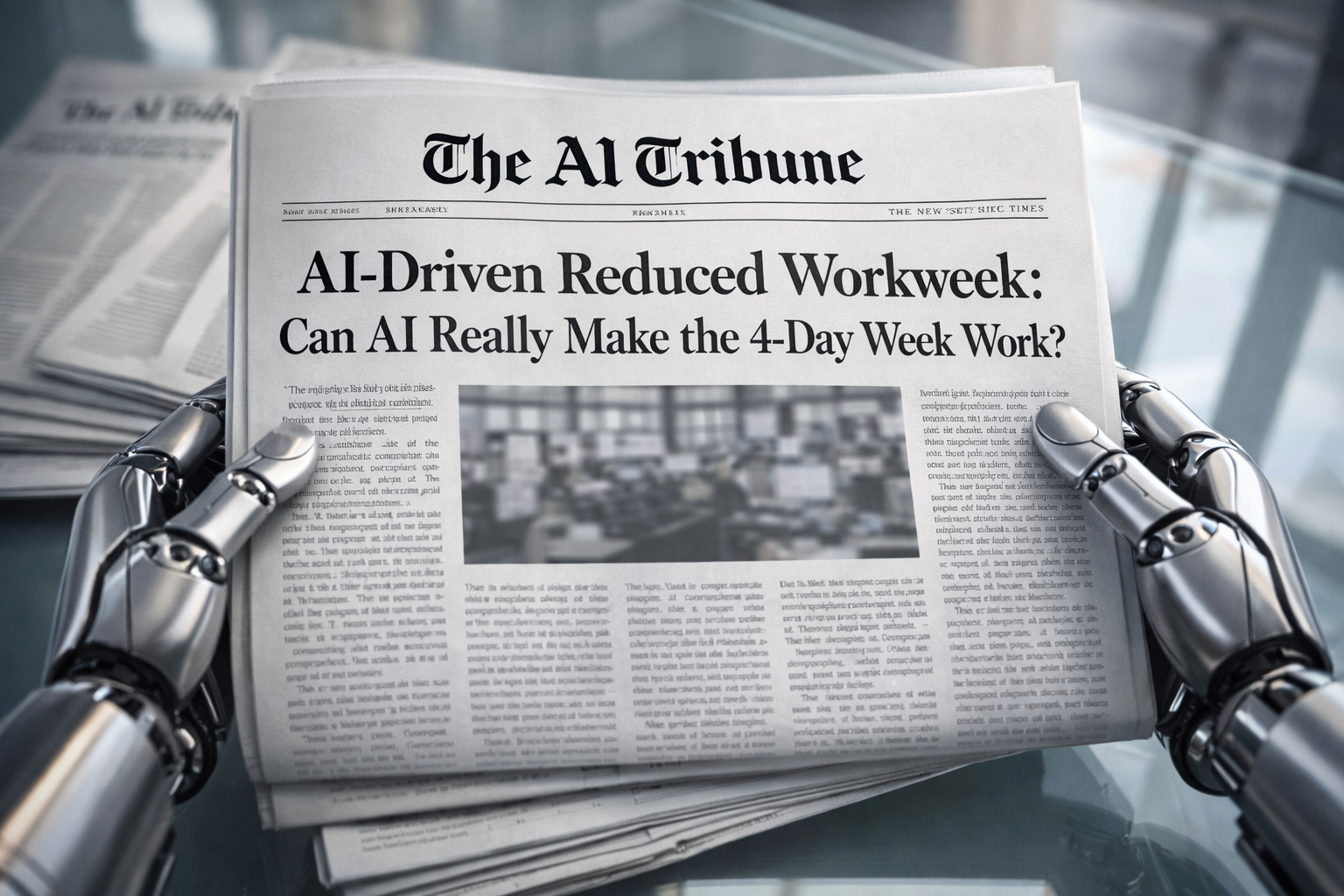
The idea behind an AI-driven reduced workweek is simple and very appealing: if artificial intelligence can remove enough repetitive work, people should be able to work fewer hours without taking a pay cut. In 2026, that idea moved closer to the mainstream when OpenAI suggested time-bound 32-hour or four-day workweek pilots as an “efficiency dividend,” meaning companies could turn AI productivity gains into actual time back for workers instead of just extracting more output. (OpenAI)
That does not mean every company is suddenly ready for a three-day weekend. But it does mean the conversation has changed. The question is no longer whether AI can speed up some tasks. It clearly can. The real question is whether businesses will use those gains to reduce burnout and hours, or simply raise expectations. That distinction matters a lot for leaders, HR teams, and employees trying to understand where work is heading next. (NBER)
What an AI-driven reduced workweek actually means
An AI-driven reduced workweek is not supposed to mean squeezing five chaotic days into four more exhausting ones. The smarter version is this: AI handles part of the routine load, teams redesign how work gets done, and the saved hours are turned into a shorter schedule while pay and service levels stay intact. That is very close to the model OpenAI described in its recent policy paper. (OpenAI)
Think about a fairly normal office team. A recruiter uses AI to summarize interviews, draft outreach, and clean up notes. An operations manager uses AI to prep weekly reports, organize meeting takeaways, and flag bottlenecks. A support rep gets AI help on repetitive answers. None of that sounds magical on its own. But stacked together, it can shave meaningful time off the week. That is why this idea feels more realistic today than it did even two years ago.
This is also where strategy matters more than hype. If AI time savings are real but invisible, employees usually just get assigned more work. If those savings are measured and protected, then a reduced schedule becomes possible. That is one reason this topic connects so well with broader people-and-process questions, including how companies are rethinking talent strategy in AI in HR in 2026.
The data says AI can save time, but not automatically
There is real evidence that AI improves performance on certain tasks. In a large NBER study of more than 5,000 customer support agents, access to a generative AI assistant raised productivity by nearly 14% on average, with gains especially strong for less experienced workers. In another widely cited study published by Science, people using ChatGPT-style assistance finished writing tasks about 40% faster and produced output judged 18% higher in quality. (NBER)
The effects are not limited to writing and customer support. MIT Sloan highlighted research showing that developers with GitHub Copilot increased the share of time spent on core coding by 12.4% while cutting the share spent on project management tasks by 24.9%. Junior developers saw the biggest lift, which is a useful reminder that AI often changes task mix before it changes headcount. (MIT Sloan)
Adoption is also no longer niche. Gallup reported in April 2026 that, for the first time, half of employed American adults say they use AI in their role at least a few times a year. Daily use reached 13%, and 28% said they use AI a few times a week or more. Among employees in organizations that have implemented AI, 65% said AI improved their productivity and efficiency. (Gallup.com)
But this is where the story gets more honest. Gallup also found that only 12% strongly agree AI has transformed how work gets done in their organization. In the same report, Gallup said a recent NBER executive survey found 89% of leaders reported no impact from AI on their company’s labor productivity over the past three years, even though they still expect gains ahead. That is the core tension of the whole reduced-workweek debate: personal task savings are real, but organization-wide redesign is much harder. (Gallup.com)
What four-day week pilots already tell us
If you want to know whether shorter schedules can work, the four-day-week pilots are worth taking seriously. In the UK pilot highlighted by 4 Day Week Global, businesses reported a 35% average increase in revenue, a 57% decrease in attrition, and a 71% decrease in employee burnout, with 92% planning to continue. In the long-term US and Canada pilot report, burnout fell 69%, attrition dropped 32%, revenue rose 15%, and 95% of employees said they wanted to continue. Germany’s follow-up results published in 2026 found that 70% of participating organizations were still using some form of reduced working time. (4 Day Week Global)
What makes this more relevant to AI is that many of these pilots were not just about cutting hours. They were about redesigning workflows, reducing wasted meetings, improving autonomy, and deploying technology better. In South Africa’s pilot, nearly half of employees reported increased productivity, leaders rated productivity impact 7.5 out of 10, and the report noted that organizations often used better automation and existing tech to support the shorter week. Feedback from participants was revealing too: some described better work ethic and a happier team, while others warned that a shorter week does not magically fix old organizational problems. That is probably the most realistic “online review” of the whole idea I found. (4 Day Week Global)
Microsoft Japan is still one of the most talked-about case studies, but it is also a good lesson in nuance. Microsoft reported very strong satisfaction scores for its 2019 trial, including 92.1% positive feedback on the four-day system and 94% positive feedback on the initiative overall. It also became famous for a roughly 39.9% labor-productivity figure. But Microsoft later clarified that this number reflected multiple factors and should not be treated as a pure effect of the shorter week alone. Honestly, that caveat makes the case study more credible, not less. (Source)
Where an AI-driven reduced workweek is most realistic
The clearest path to an AI-driven reduced workweek is in jobs where the biggest time drains are digital and repeatable: customer support, back-office operations, recruiting, documentation, basic analysis, internal reporting, scheduling, compliance prep, and parts of software development. That is where the strongest evidence currently lives. (NBER)
It is less straightforward in coverage-heavy environments like factories, hospitals, logistics hubs, retail floors, or field service. That does not mean it is impossible. It means the reduced week probably shows up through staggered shifts, fewer low-value admin tasks, smarter scheduling, and better planning rather than a neat “everyone gets Friday off” model. That is also why it helps to understand how industrial AI differs from traditional AI. In many physical workplaces, AI improves coordination and uptime more than it simply erases a day of labor.
A fair inference from the research is that AI creates the most immediate scheduling room where work is already bottlenecked by email, meetings, drafting, handoffs, and repetitive digital tasks. Where the job depends on physical presence, real-time coverage, or regulatory staffing minimums, AI can still help, but the benefit is more likely to be lower stress, fewer errors, and better staffing flexibility than an instant four-day week. (NBER)
The biggest reason this could fail
The biggest risk is simple: companies use AI to intensify work instead of reduce it.
Microsoft’s 2025 Work Trend Index said 80% of the global workforce lacks enough time or energy to do its work, and workers are interrupted every two minutes during the day, adding up to 275 interruptions. If AI is layered on top of that mess without changing meetings, approvals, and communication habits, people may get faster at tasks while still feeling crushed by work. (Microsoft)
Gallup points to another problem: manager behavior. Employees are far more likely to report meaningful AI value when systems are integrated into actual workflows and when managers actively support how teams use the tools. In fact, employees with strong manager support were 8.7 times as likely to strongly agree that AI had transformed how work gets done in their organization. That is a huge clue. A reduced week is not just a tech project. It is a management project. (Gallup.com)
There is also a trust issue. Gallup found that 18% of U.S. employees think it is somewhat or very likely their job will be eliminated in the next five years because of automation or AI, rising to 23% in organizations where AI has already been implemented. If workers think AI is mainly a downsizing tool, they are much less likely to believe a shorter week is being offered in good faith. (Gallup.com)
And yes, execution failures are common. That is why this conversation should include rollout discipline, not just futuristic promises. That is also why execution matters so much. A company that struggles with adoption, weak rollout, or unclear ownership is far less likely to make a reduced-hours model work, which is exactly why so many leaders are paying attention to the growing enterprise AI failure rate.
How to test an AI-driven reduced workweek the smart way
The most sensible approach is a pilot, not a grand announcement.
Start by auditing work for four to six weeks. Measure where time actually goes: email handling, status meetings, documentation, report generation, ticket triage, manual data entry, quality review, and after-hours coordination. Then apply AI to the most repetitive parts first. Track hard metrics like turnaround time, error rate, customer satisfaction, revenue per employee, burnout, sick days, attrition, and after-hours messages. Only after that should a company test fewer hours. That is basically the logic behind both the major four-day-week pilots and OpenAI’s latest recommendation. (OpenAI)
A good pilot also needs rules. No cutting pay. No silently raising quotas. No pretending the model works while dumping hidden overtime into evenings. If output or service levels collapse, the test failed. If performance holds and people are healthier, then the company has evidence. Not vibes. Evidence.
That is the part I think readers should watch most closely in 2026. The winning companies probably will not be the ones making the loudest claims about replacing people. They will be the ones using AI to remove nonsense work, protect focus time, and give back hours in a measurable way.
Final thoughts
The AI-driven reduced workweek is no longer just a feel-good internet fantasy. There is now enough evidence to say it is plausible in some roles and some organizations. AI can save time. Four-day-week pilots can work. Workers often respond well when the model is designed carefully. But none of that guarantees a shorter week by itself. It only guarantees an opportunity.
The real fork in the road is this: will companies turn AI efficiency into better jobs, or just more compressed ones?
That is where the debate gets interesting. If your team is already using AI tools, has it actually reduced your workload, or has it just changed what you are expected to deliver? Drop your experience in the comments. I think that real-world answer matters more than any hype cycle.


Leave a Reply