
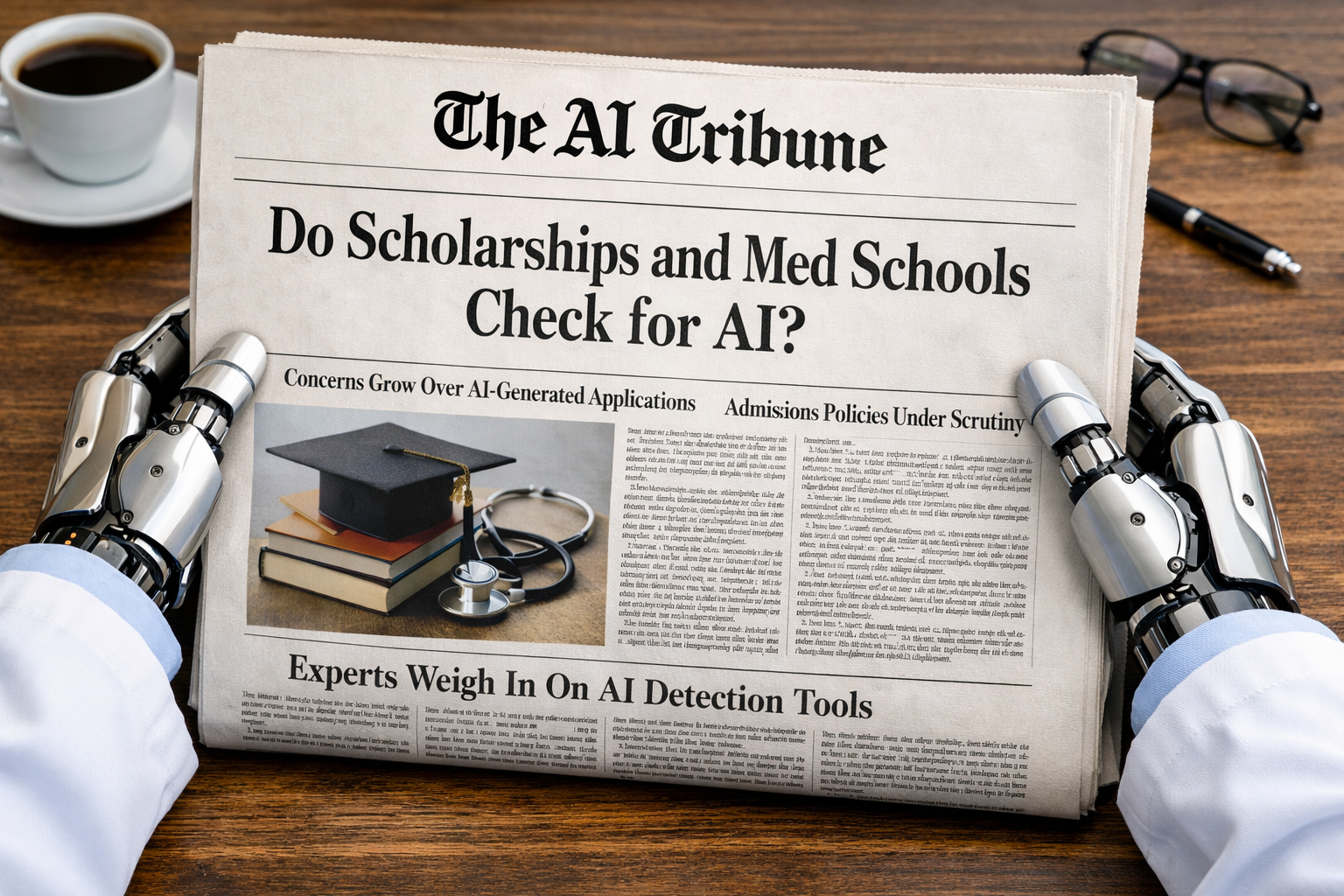
If you’re asking “do scholarships check for AI” or “do med schools check for AI,” you’re not paranoid—you’re just living in 2026. Students are using AI to brainstorm, polish, and (sometimes) fully write essays, and schools/scholarship committees are reacting in a mix of policy updates, tech tools, and human judgment.
Here’s the truth: the biggest risk usually isn’t an AI detector. It’s violating a policy—or submitting something that feels generic and inauthentic.
The quick answer (for people speed-scrolling)
- Some scholarships absolutely check for AI and may disqualify AI-generated essays if their policy says so. (Delta College)
- Med school applications (AMCAS/AAMC context) allow limited AI use (brainstorming, proofreading, editing), but you must affirm the final submission is your own work and reflects your real experiences. (AAMC)
- AI detection is not courtroom-level proof. Even universities have paused/disabled detectors due to reliability and fairness concerns. (Vanderbilt University)
Why AI “detection” is messy (and why committees don’t fully trust it)
A lot of people imagine a perfect scanner that screams “THIS IS CHATGPT.” Real life doesn’t work like that.
Detectors can be wrong—and the consequences are high
Jisc (UK higher-ed edtech) has repeatedly warned that AI detectors can produce false positives, and that those mistakes are especially serious in education settings. (Artificial intelligence)
Major institutions have stepped back from AI detectors
Vanderbilt publicly disabled Turnitin’s AI detector, citing concerns around reliability and student impact. (Vanderbilt University)
Even “low” false-positive rates can still hurt lots of people
When thousands of essays are involved, “rare” errors still create real damage—especially for students who write formally or are non-native English speakers (a fairness concern that’s been raised in multiple higher-ed discussions). (Vanderbilt University)
Bottom line: Many reviewers treat detection tools as a signal, not a verdict.
Do scholarships check for AI
Yes—some scholarships explicitly check and disqualify
Some scholarship programs clearly state that AI-generated essays can be disqualified. Example: Delta College’s scholarship essay policy says any essay determined to be AI-generated will be disqualified (and may be referred to student conduct). (Delta College)
Other organizations publish “allowed vs not allowed” guidelines. College Success Foundation, for example, warns against copy-pasting AI-written essays and notes it may lead to disqualification (and that software may identify AI-generated work). (College Success Foundation)
What “checking” usually looks like in practice
Most scholarship committees don’t publish their internal playbook, but common enforcement patterns look like this:
- Policy enforcement first
- If the rules say “no AI-written essays,” they may disqualify based on policy and evidence they consider credible. (Delta College)
- Spot checks + tools (not always universal screening)
- Some programs use similarity/plagiarism systems and may add AI indicators as an extra filter (with limitations). (Vanderbilt University)
- Human “voice” screening
- This is the underrated one. One reporting example: Scholarships360 said many AI-assisted essays felt formulaic and “sterile,” and when they ran roughly 1,000 essays through GPTZero, they estimated about 42% had signs of AI involvement. (The Hechinger Report)
A concrete metric to keep in mind
That ~42% figure (from Scholarships360’s own test) doesn’t prove “AI detection is perfect.” It proves something else: a lot of applicants are trying AI, which makes committees more suspicious, and pushes them toward stricter policies and stronger enforcement. (Scholarships360)
Do Med schools check for AI
What the AAMC says (this is the part you should actually follow)
The AAMC’s guidance is straightforward:
- AI is acceptable for brainstorming, proofreading, or editing application writing.
- You must affirm the final submission represents your own work and your real experiences. (AAMC)
That language matters, because medical admissions is ultimately about professional integrity—not just writing style.
So are med schools running AI detectors on your essays?
The AAMC’s materials emphasize applicant responsibility and authenticity; they don’t frame med school admissions as “auto-reject by detector.” (AAMC)
But med schools can still “check” for AI indirectly:
- Consistency across your application (activities, secondaries, personal statement)
- Interview alignment (does your speaking match your writing?)
- Specificity and credibility (details that feel lived-in vs. generic)
The reputational risk is higher in medicine
Even if a detector never flags you, a med school may see heavy AI-writing as a character signal: “If the essay isn’t authentically yours, what else won’t be?” That’s why the AAMC explicitly ties AI use to your certification/attestation. (Students & Residents)
What reviewers actually reject (even when you’re not “caught”)
This is the part people hate hearing, but it’s real:
- Generic “leadership” language with no scenes
- Perfectly polished paragraphs that say nothing specific
- A story arc that feels mass-produced (hook → struggle → growth → “I want to help people”) with no unique fingerprints
One reason this matters: Kaplan’s 2025 survey found 50% of admissions officers reported an unfavorable attitude toward GenAI in admissions essays (with fewer favorable). (kaplan.com)
So even when AI use is technically allowed, overusing it can still hurt you because it flattens your voice.
How to use AI safely (without risking disqualification)
Step 1: Follow the strictest rule in your stack
- If the scholarship says “no AI-generated essays,” treat that as “don’t have AI write the essay.” (Delta College)
- For AMCAS/med apps, stick to what the AAMC says is acceptable: brainstorming, proofreading, editing—and make sure it stays true to you. (AAMC)
Step 2: Use AI like a coach, not a ghostwriter
Safe prompts that usually stay within “your work” territory:
- “Ask me 10 questions that will help me write this essay with specific details.”
- “Point out where I sound vague and suggest what kind of detail to add.”
- “Fix grammar and clarity without changing my tone.”
Risky prompts (common disqualification territory):
- “Write my scholarship essay.”
- “Outline my personal statement and write it in a compelling voice.”
- “Make my story sound more impressive” (this is how people slide into exaggeration)
Step 3: Keep evidence you wrote it
If anyone questions your authorship, the best defense is boring:
- Google Docs version history
- drafts and notes
- timestamps of revisions
A simple pre-submission checklist
- ✅ Did I read the scholarship/school AI policy and follow it exactly? (Delta College)
- ✅ Does this essay include specific moments (names, tasks, outcomes, “what I actually did”)?
- ✅ Does it sound like how I talk and write, not like a corporate press release?
- ✅ If I used AI, was it limited to brainstorming/editing in a way the policy allows? (AAMC)


Leave a Reply