
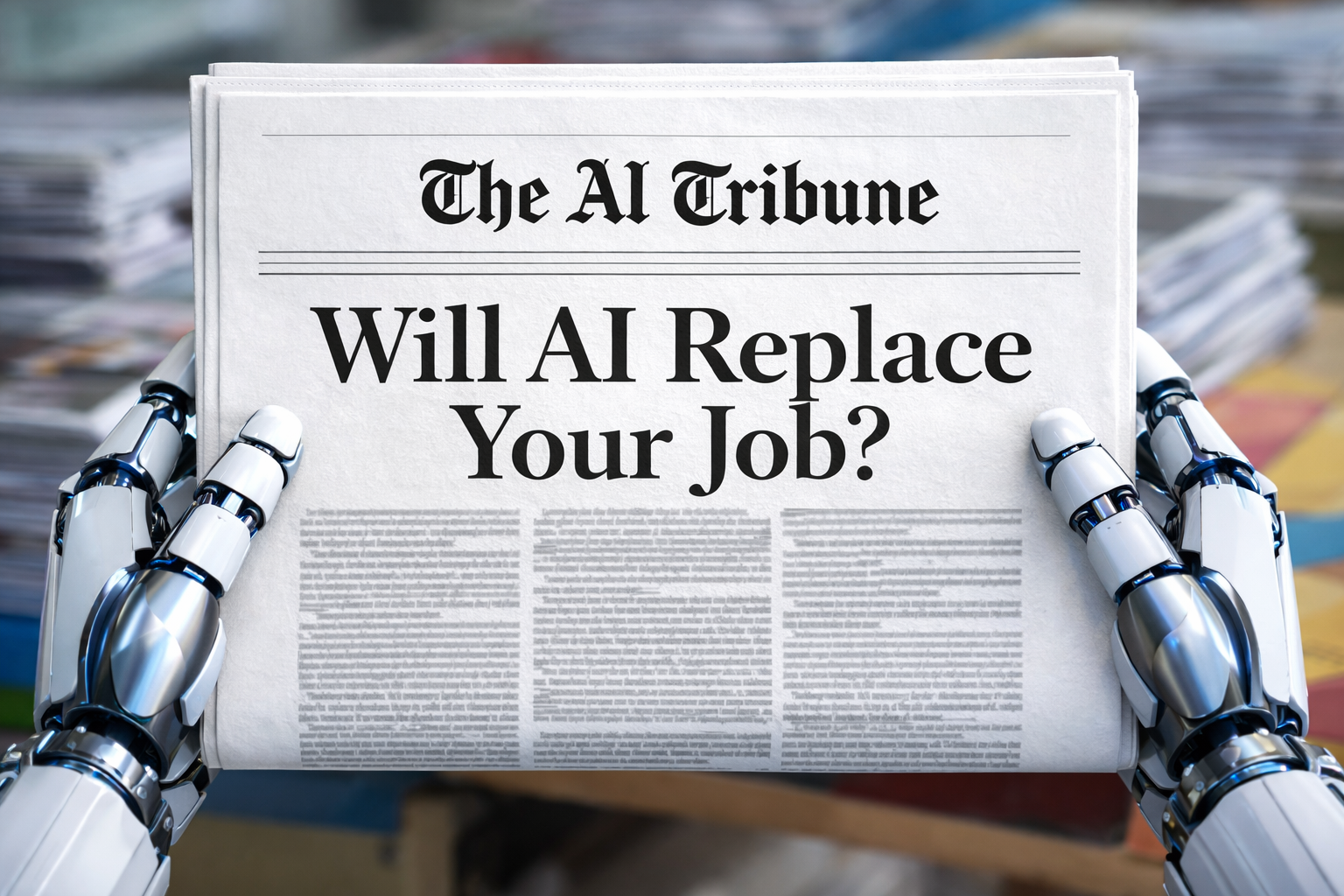
If you’ve typed “will AI replace…” into Google at 1:00 a.m., you’re not alone.
But here’s the honest truth: AI rarely replaces whole jobs overnight. It replaces tasks first. And when enough tasks get automated, the job either:
- becomes smaller (fewer people needed),
- becomes different (new tools, new workflows),
- or becomes more valuable (humans focus on the highest-stakes parts).
Big-picture numbers explain why this question won’t go away:
- Research often cited from Goldman Sachs estimates generative AI could affect the equivalent of 300 million full-time jobs globally through automation/exposure of tasks. (Goldman Sachs)
- The OECD estimates 14% of jobs are highly automatable, while many more are likely to change significantly rather than vanish. (OECD)
- McKinsey has estimated generative AI could automate a large share of work activities/time across the economy as tools mature.
So instead of fear-based predictions, this article answers the question the useful way:
A quick way to judge “Will AI replace this job?”
When people ask “replace,” they usually mean: “Will a machine do most of what I do, so employers stop hiring humans?”
To evaluate that, look at 4 filters:
- Environment: Is the job in a clean digital space (easy) or a messy physical world (hard)?
- Stakes & liability: If the AI makes a mistake, can it kill someone or trigger a lawsuit?
- Regulation: Are there strict licensing rules, audits, and accountability?
- Human trust: Does the work depend on empathy, negotiation, persuasion, or bedside manner?
Now let’s apply that—profession by profession—objectively.
Will AI replace construction workers?
Short answer: AI will not replace construction workers as a whole soon—but it will replace/reshape specific tasks (especially repetitive finishing, measurement, and progress tracking).
What AI is already doing on job sites
Think of AI in construction as two categories:
1) Robotics doing repetitive physical tasks
Drywall finishing is a great example. Canvas (a drywall finishing robot) has been reported to reduce cycle times and improve dust recapture in real-world deployments. (constructiondive.com)
A robotics case story also reports large schedule/labor reductions for drywall finishing workflows (company-reported). (universal-robots.com)
2) “Eyes and brains” (computer vision + analytics)
Drones, site cameras, and scanning robots are used to track progress, detect rework, and compare build status to plans (this is where AI scales fast because it’s largely digital sensing). (WIRED)
What the data says (why this job isn’t disappearing)
Construction has a long productivity challenge—one research paper estimates U.S. construction labor productivity fell about ~1% per year (1970–2020). That’s exactly why automation is attractive. (Becker Friedman Institute)
And studies of construction robotics show potential for large reductions in repetitive/hazardous site work (while noting tradeoffs). (PMC)
Why humans are still hard to replace here
Construction is the definition of a messy physical environment:
- changing conditions, weather, site surprises
- coordination across trades
- constant micro-decisions (what fits today, not what fits in CAD)
My practical take (a “real world” scenario)
Imagine a robot that can finish drywall perfectly—great. But who:
- preps the space,
- resolves framing surprises,
- coordinates electricians/plumbers,
- and gets inspections passed?
That’s why the likely future is crews + machines, not crews or machines.
How to future-proof in construction:
- learn layout tech (laser scanning, BIM coordination basics)
- specialize in high-judgment work (finish quality, custom builds, problem-solving)
- become the person who can run the automation, not compete with it
Will AI replace social workers?
Short answer: AI will not replace social workers, but it will absolutely reduce the admin burden and change documentation workflows.
What AI is already doing
In social work and social services, the biggest opportunity is paperwork:
- intake notes, summaries, referral letters
- eligibility checklists
- resource matching (“find services near me”)
- scheduling and follow-ups
Healthcare has a preview of what happens when “documentation AI” becomes normal. Large-scale evaluations of ambient AI tools have reported significant documentation-time savings (example: large health system reporting thousands of hours saved). (American Medical Association)
And there’s active research on generative AI in social service practice—especially around administrative burdens and decision support. (ACM Digital Library)
What the labor data suggests
The U.S. BLS projects social worker employment growth and substantial annual openings—hardly a “replacement” picture. (Bureau of Labor Statistics)
What AI struggles with (the core of social work)
Social work is built on:
- trust
- crisis judgment
- ethical boundaries
- cultural nuance
- relationship-building under stress
AI can draft a plan. It cannot be accountable in the human way social work requires.
How to future-proof as a social worker:
- become excellent at high-stakes communication (de-escalation, family mediation)
- learn to supervise AI outputs safely (bias checks, hallucination checks)
- specialize (clinical, healthcare navigation, crisis response, policy/program design)
Will mechanical engineers be replaced by AI?
Short answer: Mechanical engineers won’t be “replaced,” but engineering workflows are being rebuilt around AI-assisted design, simulation, and documentation.
What AI is already doing in mechanical engineering
- Generating design options (generative design)
- Automating repetitive CAD tasks and drawing production
- Drafting test plans, reports, specs
- Helping with scripts (Python/MATLAB), calculations, and troubleshooting logic
A widely cited generative-design example: Airbus used generative design to create a “bionic partition” concept reported as 45% lighter than a traditional part in a proof-of-concept. (Autodesk News)
What the job outlook says
BLS projects mechanical engineering growth and significant annual openings. (Bureau of Labor Statistics)
Why AI won’t replace MEs (but will raise the bar)
Mechanical engineering is not just “drawing parts.” It’s:
- safety margins
- manufacturability
- failure modes
- compliance
- supply chain realities
- integration with real-world systems
AI can propose. Humans must verify, validate, sign off, and own the consequences.
How to future-proof as a mechanical engineer:
- get strong at verification (testing, FMEA, tolerance stack-ups)
- learn AI-augmented simulation workflows
- become the engineer who can translate messy requirements into buildable constraints
Will real estate agents be replaced by AI?
Short answer: AI will replace parts of the job (marketing, lead handling, paperwork), but not the entire role—especially for complex transactions.
What AI is already doing in real estate
- Listing descriptions, photo enhancement, virtual staging
- Chatbots answering buyer questions 24/7
- Automated comps and pricing suggestions
- Faster document prep (with human review)
The clearest metric: buyers and sellers still use agents
NAR reports that 88% of buyers used an agent/broker and 90% of sellers used an agent, while FSBO was at a historic low of 6%. (nar.realtor)
That’s not “agents disappearing.” That’s consumers paying for:
- negotiation
- local judgment
- risk reduction
- emotional reassurance on the biggest purchase of their life
What the job outlook says
BLS projects employment growth around the overall average and tens of thousands of openings annually. (Bureau of Labor Statistics)
How to future-proof as an agent:
- lean into negotiation + deal-making (AI can’t “read the room”)
- become a local expert (zoning, schools, neighborhood trends)
- use AI to respond faster and follow up better than competitors
Will electrical engineers be replaced by AI?
Short answer: No—electrical engineers will be augmented, and demand remains strong in many areas.
What AI is automating first
- drafting documentation and requirements
- PCB layout assistance and error checks
- coding firmware “first drafts”
- test planning templates
What the job outlook says
BLS projects electrical/electronics engineering growth and strong annual openings. (Bureau of Labor Statistics)
Why AI won’t replace EEs
Electrical engineering involves:
- physical constraints, noise, heat, interference
- compliance and safety
- hardware/software integration
- accountability (often regulated)
AI can accelerate iterations. It can’t be the legally responsible engineer.
How to future-proof as an EE:
- specialize (power systems, RF, controls, embedded safety)
- become excellent at validation and troubleshooting
- learn to use AI for faster prototyping while maintaining rigor
Will AI replace pilots?
Short answer: Commercial aviation will likely see more automation and possibly crew model changes, but “pilotless passenger airliners everywhere” is not the near-term reality.
What’s true today
Modern aircraft already use advanced autopilot systems, but pilots handle:
- abnormal situations
- decision-making under uncertainty
- communication with ATC
- accountability for safety-critical outcomes
What regulators and research signal
There has been serious research into reduced-crew concepts, but aviation regulators have been cautious. EASA’s work on reduced-crew operations has had shifting momentum, and reporting indicates regulators have paused or stepped back from certain single-pilot ambitions amid safety concerns.
NASA has also researched single-pilot and highly automated operations concepts, reflecting ongoing exploration—not deployment.
What the job outlook says
BLS projects continued demand and large annual openings (much of it replacement/retirement). (Bureau of Labor Statistics)
How to future-proof as a pilot:
- deepen automation management skills (monitoring, intervention, crew resource management)
- stay sharp on abnormal scenario training
- consider niches: cargo, medevac, firefighting, instruction—areas where adaptability matters
Will ultrasound techs be replaced by AI?
Short answer: AI is transforming ultrasound—but it’s more likely to raise productivity and standardize quality than remove ultrasound techs entirely.
What AI is already doing in ultrasound
- guiding probe placement (especially for non-experts)
- improving image quality and reducing artifacts
- auto-measurements and structured reporting
- triage flags (potential abnormalities)
There are FDA-cleared tools aimed at guiding image acquisition—pushing ultrasound closer to “easier to perform correctly,” which changes workflows.
What the job outlook says
BLS projects 13% growth for diagnostic medical sonographers (much faster than average). (Bureau of Labor Statistics)
Why the role remains human-heavy:
Ultrasound is not just clicking a button. It’s:
- patient positioning
- real-time technique adjustments
- clinical context and communication
- capturing the right views under imperfect conditions
How to future-proof:
- master complex scans (echo, vascular, OB high-risk)
- learn AI-assisted protocols and QA
- become the tech who ensures consistency across the department
Will AI replace anesthesiologists?
Short answer: AI will assist anesthesia with monitoring, prediction, and closed-loop support—but replacing anesthesiologists is extremely unlikely soon because of liability + high-stakes judgment.
Where AI can help (and already is)
- predicting hypotension risk and complications (decision support)
- optimizing dosing suggestions
- automating parts of charting and postoperative notes (documentation AI is growing fast) (American Medical Association)
- research/clinical systems exploring closed-loop anesthesia delivery (automation with supervision) (PMC)
Why the human stays in the loop
Anesthesia is a live control problem with:
- unpredictable patient responses
- airway emergencies
- surgical surprises
- ethical accountability
Even if AI becomes excellent, the question becomes: Who is responsible when it fails? In medicine, that answer stays human for a long time.
How to future-proof as an anesthesiologist:
- become elite at crisis management and complex cases
- learn AI monitoring tools (and their failure modes)
- lead safety governance for automation in your hospital
Will AI replace electricians?
Short answer: No. This is one of the safest categories from “full replacement,” because it’s physical, variable, and regulated.
And yes—people also search “will electricians be replaced by ai” (so let’s answer it directly): electricians will be augmented by AI tools, not replaced.
What AI changes first for electricians
- smarter troubleshooting via AR + AI manuals
- automated code checks and faster permitting paperwork
- prefabrication workflows (more work moves offsite, but still needs skilled install)
What the job outlook says
BLS projects 9% growth and about 81,000 openings per year for electricians. (Bureau of Labor Statistics)
Why AI doesn’t replace electricians:
Homes and buildings are inconsistent. Panels are messy. Retrofits are weird. And safety is non-negotiable.
How to future-proof:
- specialize (EV chargers, solar, smart panels, industrial controls)
- learn to work with diagnostic tech and digital schematics
- move up: foreman, estimator, inspector, project lead
Will AI replace sonographers?
Short answer: AI will change scanning and reporting—but sonographers aren’t going away, especially with healthcare demand rising.
Will sonography be replaced by AI?
Very unlikely—but sonography will become more standardized and productivity-focused.
What AI is already changing
- automated measurements
- quality scoring (“did you capture the correct view?”)
- guided acquisition for less experienced operators (FDA-cleared tools exist for guidance)
What the job outlook says
BLS projects strong growth for diagnostic medical sonographers (again: 13%). (Bureau of Labor Statistics)
Why AI won’t replace sonographers:
Because getting a diagnostic-quality scan is still a hands-on skill—especially with:
- obese patients
- pain-limited positioning
- unusual anatomy
- time pressure
How to future-proof:
- expand modalities/specialties
- become strong at QA + protocol optimization
- learn to validate AI outputs (catch false positives/negatives)
The most honest conclusion
The question isn’t “Will AI replace this profession?”
It’s “Which tasks will AI take, and what will humans be paid more for afterward?”
Across the jobs in this article, the pattern is consistent:
- Digital/admin tasks are most exposed (notes, scheduling, drafting, first-pass analysis).
- Messy physical work + regulated high-stakes work is much harder to replace end-to-end.
- Many roles will shift into supervision, verification, and customer trust.
Tell us which job you’re personally worried about and we’ll run a risk analysis on them as well.


Leave a Reply