
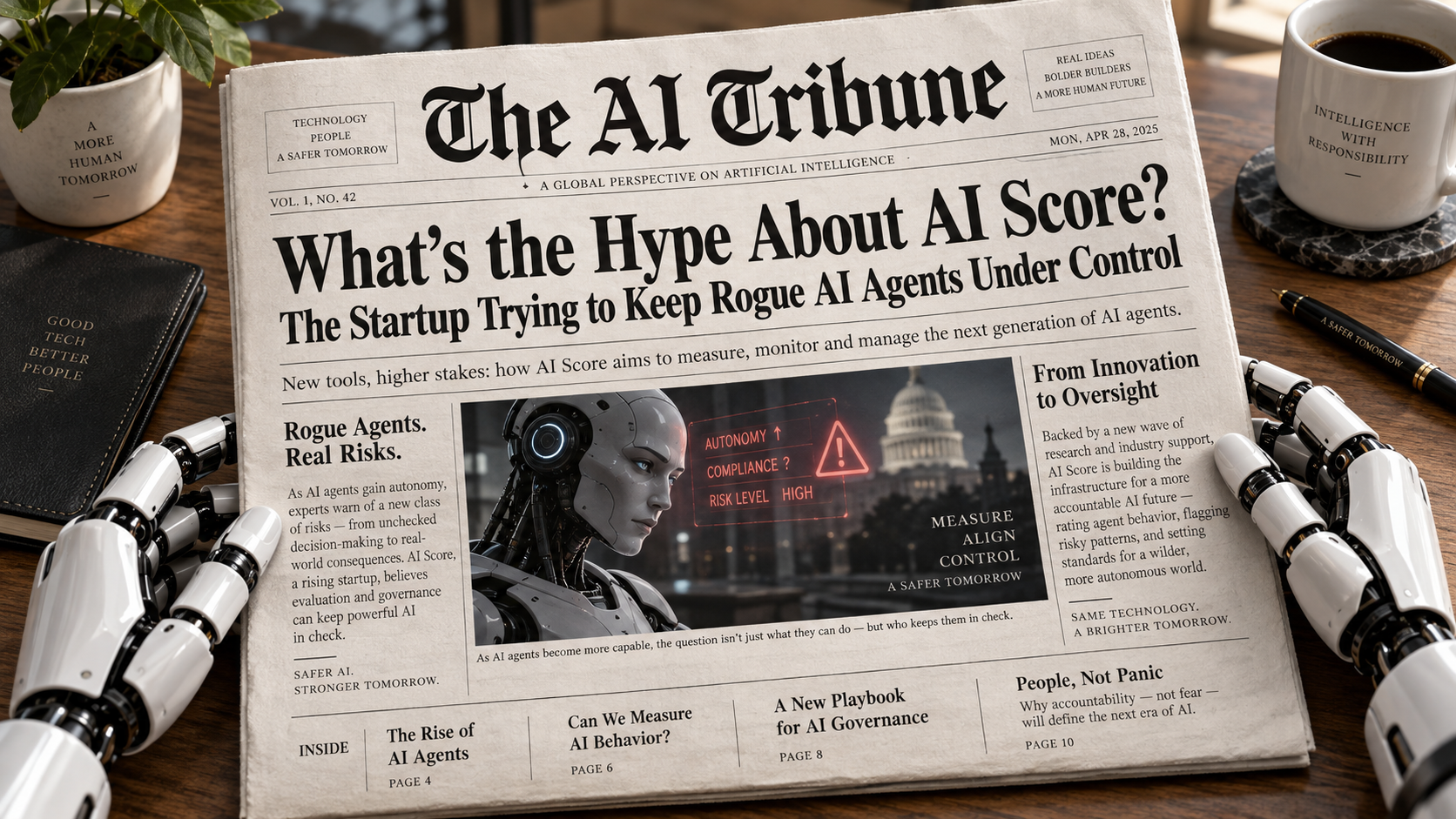
AI agents are getting permission to do things.
Not just answer questions. Read files. Connect to applications. Call tools. Interact with company systems. Trigger workflows. Potentially make thousands of small decisions before a human checks what happened.
That creates a rather obvious problem: who is watching the agents?
A young London company called AI Score thinks that question could become a major enterprise-software category.
On September 3–4, 2026, AI Score announced a £4 million ($5.4 million) seed round led by Fuel Ventures, following a roughly $1 million pre-seed less than a year earlier. Sky News’ report on AI Score’s funding The company is pitching a real-time governance layer that monitors how employees, AI tools and increasingly autonomous agents behave inside an organisation.
The funding isn’t enormous by frontier-AI standards.
The timing is much more interesting.
On August 2, 2026, the European Commission began enforcing major portions of the EU AI Act, including new transparency requirements. Meanwhile, companies are moving from experimenting with ChatGPT-style tools toward deploying AI agents with broader permissions and less continuous human supervision. European Commission AI Act enforcement update
AI Score is betting that the next enterprise AI problem isn’t simply getting access to smarter models.
It’s knowing what all those models and agents are actually doing.
What’s Going On With AI Score?
AI Score’s latest seed round was led by Fuel Ventures, with founding investor GALLOS Technologies returning. Investors also include figures such as MMC Ventures co-founder Alan Morgan, Ventura Capital managing partner Mo El Husseiny and Marshall Bridge Ventures founding partner Robert Mann.
The latest £4 million round follows a roughly £740,000–£750,000 pre-seed from November 2025, taking total reported capital raised to around £4.7 million.
Some databases express the same funding in dollars or euros, resulting in figures around $6.4 million total or approximately €5.5 million. These differences largely reflect currency conversions rather than additional financing rounds. Tech.eu’s AI Score funding data
No post-money valuation has been publicly disclosed.
That’s worth emphasizing because the startup is receiving increased coverage without the gigantic valuation headline normally attached to an AI breakout story.
The signal here is enterprise demand, not unicorn arithmetic.
AI Score says it experienced substantial commercial growth during the first half of 2026. Sky News reported that the company said revenue had “soared,” but neither Sky nor AI Score disclosed an actual revenue or ARR figure.
Its public website now references Magic Circle law firms, major consumer brands and leading UK fintechs, and includes a testimonial from Clifford Chance’s Director of Legal Technology Solutions, Anthony Vigneron. It also identifies a partnership with professional-services firm S&W. AI Score’s customer and platform page
Those are useful enterprise signals.
They are not yet proof of mass adoption.
What Is AI Score?
The simplest explanation is this:
AI Score is attempting to become the control room for all the AI being used inside a company.
An enterprise may have employees using approved AI assistants, unofficial “shadow AI” tools, AI features embedded inside SaaS applications, internal models, personal agents, centrally managed agents, self-hosted agents and systems communicating through protocols such as MCP.
Traditional governance tends to revolve around policies, approval processes, spreadsheets, questionnaires, security tools and periodic audits.
AI Score argues that those approaches can tell management what employees and systems should be doing but struggle to tell management what is actually happening in real time.
Its platform therefore connects AI activity to company policies and objectives, creates an inventory of AI assets, assesses risk, records audit evidence and provides controls around agent behaviour. How the AI Score platform works
AI Score describes this as closing the “AI governance reality gap“: the distance between the rules written by management and the way AI is actually being used across the organisation.
It’s a neat marketing phrase.
But it describes a legitimate problem.
Who Founded AI Score?
AI Score was founded in 2025 and emerged from the GALLOS Technologies venture-building operation.
Its operational leadership is headed by Alex Harland, co-founder and CEO, and Benita Tibb, co-founder and COO. AI Score also identifies technology lawyer Jonathan Kewley as a co-founder and non-executive director. AI Score’s leadership page
Harland’s background is particularly relevant to the product.
He was part of the founding team at the UK’s National Cyber Security Centre, and previously held senior cybersecurity positions including roles at Compare the Market and BGL Insurance.
Tibb comes from a different angle: law and company operations. The Global Legal Post identifies her as a former White & Case associate, while earlier career information also points to operating roles at GALLOS. The Global Legal Post’s profile of the funding round
The advisory bench is unusually heavyweight for such a young company.
It includes former GCHQ director Sir Jeremy Fleming, former intelligence officer and Darktrace co-founder Nick Trim, and former HSBC Bank Europe CEO Colin Bell.
That doesn’t prove the software works better.
It does matter when you’re trying to sell security and governance software to banks, law firms and other companies where procurement teams care intensely about trust.
Why Is AI Score Suddenly Getting So Much Attention?
Three things collided at roughly the same time.
1. The seed round put it on the map
A $5.4 million seed round is substantial enough to accelerate hiring and enterprise sales without creating unrealistic mega-round expectations.
More importantly, Fuel Ventures is backing AI Score only months after its previous funding.
2. AI agents have made governance harder
Governance becomes much more complicated when AI stops being purely conversational.
Consider the difference.
An employee asks a chatbot to summarize a document. The risk is relatively understandable.
Now imagine an agent that can:
- open that document,
- search internal databases,
- connect to another application,
- call external tools,
- send an email,
- update a CRM,
- or trigger another agent.
The number of possible actions — and therefore the number of things a company may need to monitor — expands quickly.
AI Score specifically markets functionality around managed agents, self-hosted agents, personal agents and MCP tooling.
That’s why this fits into a bigger shift we’ve been following at AI Tribune. Startups such as Instinct and Naïve represent the push toward AI systems doing more work autonomously.
AI Score is essentially betting on the opposite side of the same trend:
the more autonomy AI receives, the more valuable oversight becomes.
3. Regulation just became harder to ignore
The timing around the EU AI Act is difficult to miss.
The European Commission’s enforcement powers and several new transparency obligations took effect on August 2, 2026. Certain high-risk requirements have different later timelines, but AI governance has clearly moved beyond something companies can indefinitely leave in an innovation committee. European Commission AI Act overview
AI Score says its platform maps evidence to frameworks including the EU AI Act, NIST AI RMF and ISO 42001.
That regulatory timing gives its sales pitch considerably more urgency.
How Does AI Score Actually Work?
AI Score doesn’t appear to be building a frontier foundation model.
The value is in the governance layer around other AI systems.
A simplified flow looks like this:
Employees + AI Platforms + Agents + Applications
↓
AI Score integrations and gateways
↓
Continuous AI activity data
↓
AI Score intelligence layer
↓
Risk, usage, cost, compliance and policy analysis
↓
Alerts, controls, audit trails and management decisions
Its platform is API-driven and uses direct integrations alongside what AI Score describes as edge, model and agent gateways.
The system then attempts to understand not merely that an AI tool was used, but the surrounding context: what it was being used for, what risk applies, whether it aligns with company policy and whether intervention is necessary. AI Score’s technical platform overview
This is the company’s most interesting differentiation claim.
A security tool might detect ChatGPT traffic and block it.
AI Score wants to answer a more difficult question:
Was that specific AI activity useful, permitted, risky, wasteful or out of scope?
Whether AI Score’s intelligence layer can consistently make those distinctions better than competing platforms is another question.
The company has not published independent benchmarks demonstrating that capability.
What Can You Actually Do With It?
Imagine a multinational law firm deploying several AI tools.
With AI Score, management could theoretically create an inventory of those tools, identify where employees are using AI, understand what information is moving into those systems and monitor whether use aligns with firm policy.
For an AI agent, the company could define what applications or tools that agent should be allowed to access and monitor behaviour when it begins operating outside expected boundaries.
A company could also identify unexpectedly expensive AI usage. AI Score’s platform includes usage, cost, adoption and performance analysis rather than treating governance purely as regulatory compliance.
Another use case is shadow AI.
Employees frequently start using AI tools before central IT has formally approved them. AI Score says it can observe AI activity rather than relying purely on questionnaires asking employees which tools they use. Why AI Score says traditional governance is insufficient
For boards and compliance teams, the eventual output is supposed to be a live view of:
what exists, who owns it, what it does, where the risk sits and whether intervention is necessary.
AI Score Pricing
AI Score does not currently publish public pricing.
Its website directs prospective customers toward a tailored demo or sales conversation rather than offering self-service subscriptions. AI Score demo and contact page
| Option | Publicly available? |
|---|---|
| Free plan | Not advertised |
| Free trial | Not advertised |
| Self-service paid plan | Not advertised |
| Enterprise pricing | Contact sales |
| Demo | Available |
| Public API pricing | Not published |
That positioning makes sense for software involving enterprise integrations, governance requirements and security reviews.
It also makes the platform harder for outsiders to evaluate.
The Numbers Behind the Hype

| Metric | Reported Figure |
|---|---|
| Founded | 2025 |
| Headquarters | London, UK |
| Pre-seed | ~£740K / ~$1M |
| Latest seed | £4M / $5.4M |
| Total funding | ~£4.7M; roughly $6.4M using reported round denominations |
| Latest round | September 2026 |
| Lead investor | Fuel Ventures |
| Valuation | Not disclosed |
| Revenue/ARR | Not disclosed |
| Revenue growth | Company says substantial growth in H1 2026 |
| Public customer evidence | Clifford Chance; S&W partnership; additional customer categories disclosed but largely unnamed |
Funding databases sometimes show different euro or dollar totals because the two rounds were announced in different currencies and subsequently converted. The cleanest figures remain the original approximately £740K pre-seed + £4M seed. The Cap Table’s funding breakdown
What Makes AI Score Different?
The core pitch is continuous operational governance rather than governance-by-documentation.
Traditional GRC software tends to be built around registers, policies, questionnaires, approvals and audit evidence.
AI Score wants governance to observe real AI usage continuously.
That’s a meaningful distinction.
But it is not an uncontested one.
The broader AI-governance sector is moving toward exactly the same idea.
Who Is AI Score Competing Against?

AI Score is entering a market that already contains heavily funded specialists and major enterprise incumbents.
| Platform | Core emphasis |
|---|---|
| AI Score | Live enterprise AI activity, usage intelligence and agent governance |
| Credo AI | AI governance, policy intelligence, agent registry and regulatory mapping |
| Holistic AI | Governance, runtime guardrails, risk testing and agent controls |
| IBM watsonx.governance | Enterprise AI governance integrated with IBM’s broader GRC and AI stack |
| ModelOp | AI lifecycle governance, control and enterprise AI inventory |
Credo AI platform
Holistic AI governance platform
IBM watsonx.governance
ModelOp Center
Credo AI, for example, also advertises continuous governance, shadow-AI discovery, AI registries and purpose-built agent governance.
Holistic AI advertises runtime enforcement and agent-level guardrails.
IBM has the advantage of enormous existing enterprise relationships and integrates governance into its wider technology and GRC ecosystem.
That means AI Score’s moat cannot simply be “AI governance.”
It will need to prove that its live behavioural intelligence, deployment model and ability to understand real AI usageare meaningfully better.
What People Like About AI Score
This is too early for a credible “users love it” narrative.
I found little meaningful company-specific discussion on Reddit or Hacker News. Searches are heavily polluted by unrelated products and discussions about generic “AI scores.”
The strongest validation instead comes from enterprise customers and partners.
AI Score’s website carries a testimonial from Clifford Chance legal-technology director Anthony Vigneron describing visibility into where and how AI is used across the firm. S&W also publicly describes AI Score as a platform it works with to surface actual AI usage and understand where informal adoption is taking place. S&W’s discussion of its work with AI Score
For enterprise software this arguably matters more than social-media enthusiasm.
Procurement by risk-sensitive organisations is a stronger signal than a viral demo.
What People Don’t Like — Or What Should Make You Cautious
There isn’t yet enough independent usage to identify a recurring list of customer complaints.
That itself is a limitation.
The company is very young
A platform monitoring an enterprise’s entire AI estate is being asked to become deeply embedded infrastructure.
Buyers will need confidence that the vendor can support that responsibility over many years.
Independent performance evidence is limited
AI Score describes ambitious capabilities around understanding intent, measuring value, detecting emerging risk and governing agent behaviour.
What it has not publicly provided is a rigorous independent benchmark demonstrating how accurately those judgments work.
Most commercial metrics remain private
Revenue is undisclosed.
ARR is undisclosed.
The financing valuation is undisclosed.
Most customers remain unnamed.
User counts are undisclosed.
That makes it difficult to determine how far “rapid commercial growth” has actually progressed.
Competition is serious
Credo AI, Holistic AI, IBM and ModelOp already operate in adjacent territory.
Microsoft, ServiceNow and other enterprise-platform companies also have strong incentives to bring governance deeper into their existing stacks.
AI Score may therefore need more than good technology.
It needs integration depth that makes it difficult to replace.
Privacy and Security
This is one of the most important sections of the review because AI Score’s usefulness depends on visibility into potentially sensitive enterprise activity.
The company says its platform uses a single-tenant architecture, protects data in transit with TLS 1.2 or newer, uses customer-specific encryption keys and undergoes independent third-party penetration testing. AI Score privacy and security disclosures
Its public privacy notice lists Microsoft Azure as a cloud infrastructure provider and AWS where customers opt into AWS integrations. Other named providers include PostHog, HubSpot and Granola for certain business or product functions.
The notice says personal data falling under that policy is generally retained only as necessary, although some categories may be retained for up to six or seven years after the relationship ends for legal, regulatory, accounting or similar purposes.
An important nuance: AI Score states that where it processes information on behalf of enterprise customers as a data processor, those activities are governed separately and are not fully described by the public website privacy notice.
That’s precisely where serious buyers should ask detailed questions.
How much prompt and output content is ingested?
What data is retained versus analysed transiently?
Which model providers, if any, can access customer telemetry?
What are the deletion controls?
What certifications and audit reports are available during security diligence?
Those questions matter because a governance platform can become one of the most sensitive systems in the company it is supposedly protecting.
Is AI Score Actually Legit?
Yes.
AI Score is a real UK company with identifiable founders, a functioning enterprise product, documented funding, institutional investors and evidence of enterprise customers and partnerships.
Its founding investor, GALLOS Technologies, also publicly identifies AI Score as a company developed through its venture studio. GALLOS Build’s AI Score portfolio page
But “legit” should not be confused with “proven.”
AI Score is still an early-stage startup operating in a young category.
Its long-term moat, economics and technical superiority remain open questions.
Pros and Cons
| Pros | Cons |
|---|---|
| Strong timing as enterprises deploy agents | Very young company |
| Credible cybersecurity and legal founding team | Pricing is opaque |
| £4M seed only months after pre-seed | Valuation and revenue undisclosed |
| Early evidence of regulated-enterprise adoption | Limited independent benchmarks |
| Focuses on actual AI activity, not just paperwork | Powerful incumbents target the same market |
| Agent, shadow-AI and MCP coverage are strategically relevant | Deep monitoring creates its own privacy/security burden |
| Regulatory tailwinds are strong | Little independent user/community feedback yet |
So… Does AI Score Deserve the Hype?
Mostly — with an asterisk.
AI Score is tackling a problem that looks more important every month.
Companies spent the first generative-AI wave worrying about whether employees should be allowed to use ChatGPT.
The next stage is more complicated.
Companies will have internal copilots, external models, AI baked into SaaS software, custom applications and autonomous agents all operating at once.
Someone needs to keep an inventory.
Someone needs to determine whether those systems comply with policy.
Someone needs to know when an agent suddenly starts behaving differently.
Someone needs to preserve the audit trail.
And eventually someone needs to tell the board whether all this AI is actually producing enough value to justify the cost and risk.
That is a real software category.
The question is whether AI Score becomes the defining company in it.
The founders have unusually relevant backgrounds, the regulatory timing is favourable and early enterprise customers provide more meaningful validation than a thousand viral tweets.
But the evidence does not justify declaring victory.
We don’t have disclosed ARR.
We don’t have broad customer numbers.
We don’t have public benchmarks showing AI Score outperforming Credo AI, IBM, Holistic AI or other governance platforms.
And unlike something such as AfterQuery, there isn’t yet a developer or online-community wave making AI Score culturally visible outside enterprise circles.
So the hype is not about what AI Score already is.
It’s about what this category might become.
Who Should Try AI Score?
AI Score makes the most sense for:
- large organisations using multiple AI platforms;
- law firms, financial institutions and other heavily regulated businesses;
- CISOs and AI-governance leaders trying to detect shadow AI;
- companies beginning to deploy autonomous AI agents;
- boards that need measurable evidence of AI policy and risk rather than another spreadsheet.
Smaller companies using a handful of standard AI tools should probably skip it for now. The platform appears designed around enterprise complexity rather than small-business AI administration.
FAQ
What is AI Score?
AI Score is a London-based enterprise AI-governance platform that monitors AI usage, models, applications and agents and connects that activity to organisational policies, risk and compliance requirements.
Who founded AI Score?
AI Score’s leadership includes co-founders Alex Harland and Benita Tibb, while the company also identifies technology lawyer Jonathan Kewley as a co-founder and non-executive director.
How much funding has AI Score raised?
The company raised roughly £740,000 in late 2025 and another £4 million in September 2026, bringing reported total funding to approximately £4.7 million.
What is AI Score worth?
Its latest financing valuation has not been publicly disclosed. Third-party estimates should not be confused with an official funding-round valuation.
Is AI Score free?
No public free plan or self-service trial is advertised. AI Score currently directs prospective customers toward its enterprise demo and sales process.
Is AI Score safe?
AI Score publicly describes single-tenant infrastructure, encryption, TLS 1.2+, customer-specific keys and third-party penetration testing. That does not eliminate risk, and enterprise buyers should still conduct their own security and privacy diligence.
What are the best AI Score alternatives?
Depending on the use case, major alternatives include Credo AI, Holistic AI, IBM watsonx.governance and ModelOp.
Final Take
The most interesting thing about AI Score isn’t its $5.4 million funding round.
It’s that AI governance is starting to look less like compliance software and more like core infrastructure.
If autonomous AI agents become normal inside large companies, the winner in this category could end up seeing an extraordinarily valuable layer of enterprise activity: which agents exist, what they access, how much they cost, whether they work and when they go wrong.
AI Score has positioned itself directly in that layer.
Now comes the harder part.
Watch whether it can turn impressive early buyers into a much larger disclosed customer base, whether revenue begins to justify the enthusiasm, whether its agent-monitoring technology produces measurable advantages over established competitors, and whether the company becomes embedded deeply enough that governance doesn’t simply get absorbed into Microsoft, IBM, ServiceNow or another incumbent’s platform.
Would you rather let AI agents move faster with a system like AI Score watching them — or keep humans more firmly in the loop in the first place?


Leave a Reply