
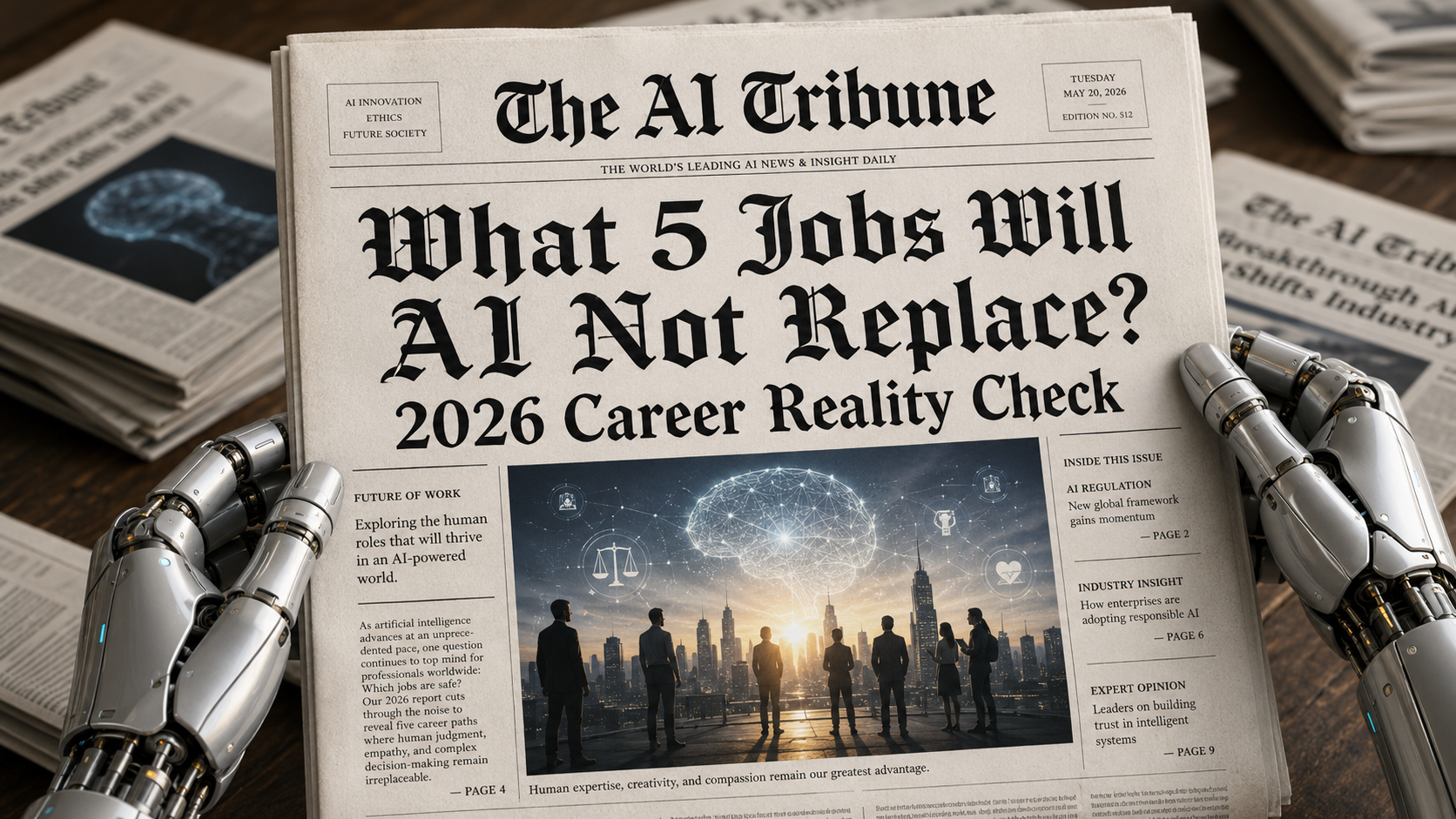
The Better Question Is Not “Will AI Replace Jobs?”
“What 5 jobs will AI not replace?” is one of the most searched career questions right now, and it makes sense. AI tools can write emails, summarize documents, generate images, analyze data, answer customer questions, and even help with coding. For many workers, students, and parents, the fear is simple: am I training for a job that could disappear?
The honest answer is this: AI will replace some tasks, reduce demand for some roles, and completely reshape many careers. But it is unlikely to fully replace jobs that require physical presence, emotional trust, real-time judgment, responsibility for human safety, and complex social interaction.
At AI Tribune, we’ve tested and covered AI tools across business, writing, coding, research, customer support, and workplace productivity. The pattern is clear: AI is very strong when the work is digital, repeatable, text-based, and rule-driven. It is much weaker when the work happens in messy real life, with people, bodies, emotions, emergencies, unpredictable environments, and legal or ethical responsibility.
So instead of promising that any career is “100% AI-proof,” this article gives a more useful answer: the five jobs AI is least likely to fully replace, why they are safer, how AI will still change them, and what skills you should build if you want long-term career security.
If you want a broader overview, you can also read AI Tribune’s related guide: What Jobs Are Safe From AI?
Quick Answer: What 5 Jobs Will AI Not Replace?
The five jobs AI is least likely to fully replace are:
- Nurses and hands-on healthcare workers
- Electricians and skilled tradespeople
- Mental health counselors and social workers
- Teachers and human educators
- Emergency responders, including EMTs, paramedics, and firefighters
These jobs are not safe because AI is useless. They are safer because the human part of the job is not a small detail; it is the job.
AI can support these workers. It can assist with paperwork, scheduling, diagnostics, lesson planning, research, simulations, documentation, and training. But it cannot easily replace the human being who comforts a patient, repairs wiring in an unpredictable building, calms a person in crisis, manages a classroom, or makes life-or-death decisions at an emergency scene.
Why These Jobs Are Harder for AI to Replace
A job becomes harder to automate when it includes several of these factors:
- Physical work in changing real-world environments
- Emotional intelligence and trust
- Human touch, care, and communication
- Ethical judgment and responsibility
- Unstructured problem-solving
- Live decision-making under pressure
- Legal accountability
- Relationship-building over time
This is why many office jobs are being disrupted faster than many hands-on or care-based jobs. AI can generate a report. It cannot safely rewire a house by itself. AI can suggest a therapy exercise. It cannot fully replace the therapeutic relationship. AI can create a lesson plan. It cannot read the mood of 25 children in a classroom and adjust emotionally in real time.
This does not mean white-collar work is doomed. It means that jobs with routine digital tasks are more exposed. We explored that difference in more detail in this AI Tribune article: Will AI Replace Blue-Collar Jobs Before White-Collar?
1. Nurses and Hands-On Healthcare Workers
Healthcare is one of the strongest answers to the question, “What 5 jobs will AI not replace?” Nurses, nurse practitioners, physical therapists, occupational therapists, caregivers, medical assistants, and many other healthcare workers perform tasks that require human presence, trust, physical assistance, and emotional support.
AI is already entering healthcare. It can help with medical note-taking, appointment scheduling, triage support, imaging analysis, patient monitoring, and administrative work. In some cases, AI can help clinicians move faster and reduce documentation burden.
But healthcare is not just information processing. A nurse does not simply “know” what to do. A nurse observes a patient’s breathing, notices discomfort, speaks with family members, administers medication, responds to sudden changes, and provides reassurance when someone is scared.
That human connection matters. A patient may accept AI as a tool, but when they are in pain, confused, elderly, anxious, or seriously ill, they usually want a trained person in the room.
Why AI will not fully replace nurses
AI struggles to replace nurses because nursing involves:
- Physical care
- Patient observation
- Emotional reassurance
- Ethical judgment
- Family communication
- Emergency response
- Medication administration
- Coordination with doctors and other staff
The demand data also supports healthcare resilience. Registered nurses remain a large and growing occupation, and healthcare overall is expected to keep expanding due to aging populations, chronic illness, and rising demand for care.
How AI will change healthcare jobs
AI may reduce some paperwork and help nurses prioritize patients, but it will also raise expectations. Future healthcare workers may need to understand AI-powered monitoring systems, electronic health records, predictive alerts, and automated documentation tools.
The safest healthcare workers will not be the ones who ignore AI. They will be the ones who use AI while keeping the human care element strong.
Career tip
If you are considering healthcare, build both technical and human skills. Learn basic AI literacy, but also strengthen communication, patience, bedside manner, teamwork, and crisis judgment. Those are the skills AI cannot easily copy.
2. Electricians and Skilled Tradespeople
Electricians, plumbers, HVAC technicians, mechanics, welders, construction workers, and other skilled tradespeople are among the strongest examples of jobs AI will not replace quickly.
This is because trade work happens in the physical world, and the physical world is messy. Every house, building, machine, pipe system, wire, panel, crawl space, roof, and repair situation can be different.
AI can explain how to diagnose a problem. It can help generate estimates. It can assist with training. It can analyze building plans. But it cannot easily crawl into a tight space, identify a hidden wiring issue, safely replace components, deal with old infrastructure, and take legal responsibility for the final repair.
This is why skilled trades are becoming more valuable in the AI era, not less. Ironically, the AI boom itself depends on physical infrastructure: data centers, power grids, cooling systems, energy projects, and construction. Those systems need electricians, technicians, and skilled workers.
Why AI will not fully replace skilled trades
Skilled trades are resistant to AI because they require:
- Physical dexterity
- On-site troubleshooting
- Safety judgment
- Real-world adaptation
- Tool use
- Licensing and accountability
- Customer trust
- Experience with unpredictable conditions
A robot may eventually help with some construction tasks, but widespread replacement is much harder than replacing a repetitive digital task. The cost, safety risks, liability, and physical complexity are much higher.
Online sentiment check
Across career forums and online discussions, skilled trades come up again and again as “AI-resistant” careers. The common argument is simple: AI may write code, summarize documents, or generate ads, but it cannot show up at your home and fix a dangerous electrical fault on its own.
That does not mean trade work is easy. Many people online also point out the downsides: physical strain, safety risks, apprenticeships, licensing requirements, and sometimes unpredictable schedules. So the realistic view is this: skilled trades may be safer from AI replacement, but they still require discipline, training, and physical effort.
Career tip
If you want an AI-resistant career without a traditional office path, consider electrical work, HVAC, plumbing, industrial maintenance, solar installation, or data center infrastructure. Add digital skills like smart-home systems, energy software, building automation, and AI-assisted diagnostics, and you become even harder to replace.
3. Mental Health Counselors and Social Workers
Mental health counselors, therapists, addiction counselors, social workers, and crisis support professionals are also among the jobs AI is least likely to fully replace.
AI chatbots can provide general emotional support, journaling prompts, mindfulness exercises, and basic coping strategies. Some people already use AI tools when they feel lonely, anxious, or overwhelmed.
But mental health care is not just “saying supportive words.” It involves trust, boundaries, professional ethics, risk assessment, confidentiality, cultural understanding, family context, trauma awareness, and the ability to respond when someone is in danger.
A chatbot can sound empathetic. A licensed counselor is accountable.
That difference matters.
Why AI will not fully replace counselors and social workers
These jobs are difficult to automate because they require:
- Deep listening
- Trust-building
- Human empathy
- Professional ethics
- Crisis judgment
- Understanding family and social context
- Long-term relationship-building
- Legal and clinical responsibility
AI may help counselors write notes, summarize sessions, organize treatment plans, or provide between-session exercises. But replacing the counselor entirely is a much bigger leap, especially in high-risk situations involving trauma, addiction, abuse, self-harm, family conflict, or severe mental illness.
Online reviews and public reaction
Online discussions about AI therapy are mixed. Some users say AI tools help them reflect, organize thoughts, or feel less alone. Others are uncomfortable relying on a machine for deeply personal problems. The strongest recurring theme is that AI may be useful as a support tool, but people still value real human connection when the situation is serious.
That is a helpful distinction for readers: AI may become a mental health assistant, but not a complete replacement for trained human care.
Career tip
If you are entering mental health, social work, or counseling, do not ignore AI. Learn how it may support documentation, client resources, appointment workflows, and education. But your strongest long-term advantage will still be human trust, ethical judgment, and the ability to sit with someone through difficult moments.
4. Teachers and Human Educators
Teachers are not safe from AI because nothing will change. Education is already changing quickly. AI can generate lesson plans, grade some assignments, create quizzes, translate text, tutor students, explain math problems, summarize readings, and help with personalized learning.
But teaching is not only content delivery.
A teacher manages a room, motivates students, notices confusion, builds confidence, handles conflict, supports different learning styles, communicates with parents, protects student wellbeing, and creates structure. Those human responsibilities are difficult to automate.
This is especially true for younger students, special education, language learning, career training, and any environment where students need encouragement, discipline, mentorship, and social development.
Why AI will not fully replace teachers
Teachers are difficult to replace because education requires:
- Classroom management
- Emotional awareness
- Motivation
- Mentorship
- Adaptability
- Child development knowledge
- Trust with families
- Real-time feedback
- Moral and social guidance
AI can explain a topic. It cannot fully replace the human adult responsible for guiding a student’s growth.
What AI will change in education
AI will likely become a normal part of teaching. Teachers may use AI to create drafts of lesson plans, adapt materials for different reading levels, generate examples, support students with tutoring tools, and reduce administrative workload.
But AI also creates new problems: cheating, overreliance, misinformation, student privacy, and unequal access. That means teachers will be needed not only to use AI, but also to teach students how to use it responsibly.
For more on the wider job-market reality, AI Tribune has a deeper guide here: Will AI Replace Your Job? 2026 Reality Check
Career tip
The safest educators will be those who combine human teaching skills with AI literacy. Learn how to use AI for planning and personalization, but focus even more on mentorship, communication, classroom culture, and critical thinking.
5. Emergency Responders: EMTs, Paramedics, and Firefighters
Emergency responders are another strong answer to “What 5 jobs will AI not replace?” EMTs, paramedics, firefighters, rescue workers, and similar roles operate in fast-moving, dangerous, unpredictable environments.
AI can support emergency work. It can help dispatchers prioritize calls, analyze traffic routes, support medical decision-making, predict wildfire risks, and improve training simulations. Drones and robots may assist in dangerous environments.
But when someone is trapped, injured, unconscious, panicking, or in immediate danger, human responders are still essential.
Emergency work requires physical courage, teamwork, judgment, communication, and the ability to act under pressure when the situation is incomplete and changing by the second.
Why AI will not fully replace emergency responders
These jobs are resistant to full automation because they require:
- Physical rescue
- Medical intervention
- Fast judgment under pressure
- Team coordination
- Human reassurance
- Scene safety assessment
- Adaptation to unpredictable environments
- Public trust
AI can help responders make better decisions, but it cannot easily replace the person who enters the scene, carries equipment, treats the patient, communicates with bystanders, and takes responsibility in the moment.
Career tip
If you are interested in emergency services, expect more technology in the field. Future responders may use AI-assisted dispatch, wearable sensors, drones, predictive risk systems, and digital medical tools. The best path is to become both physically capable and technologically comfortable.
The Common Pattern: AI Replaces Tasks, Not Entire Human Roles
The biggest mistake in AI career advice is treating jobs as one single thing.
A job is actually a bundle of tasks.
AI may replace some tasks inside a job while leaving the role itself intact. For example:
- A nurse may use AI for documentation, but still provide patient care.
- An electrician may use AI for diagnostics, but still perform the repair.
- A teacher may use AI for lesson planning, but still guide students.
- A counselor may use AI for notes, but still build the therapeutic relationship.
- A paramedic may use AI-supported tools, but still respond physically to emergencies.
This is why the smartest career strategy is not “avoid AI.” It is “choose work where AI helps you more than it replaces you.”
Jobs That Are More Exposed to AI
To stay objective, we also need to mention the other side. Some jobs are more exposed to AI because they include repetitive digital tasks.
Higher-risk task categories include:
- Basic data entry
- Simple content writing
- Routine customer support scripts
- Basic bookkeeping
- Document summarization
- Repetitive graphic design
- Simple translation
- Low-complexity coding tasks
- Administrative scheduling
- Standard report generation
This does not mean every person in these fields will lose their job. But it does mean workers in these areas should move up the value chain.
For example, a basic content writer may be more exposed, but a content strategist who understands SEO, audience psychology, brand positioning, editing, interviews, original research, and distribution is much harder to replace.
A junior coder may be more exposed, but an engineer who understands systems, security, architecture, product requirements, debugging, and user needs remains much more valuable. AI Tribune covered this topic in more detail here: Is Computer Engineering Being Replaced by AI?
What Makes a Job More AI-Resistant?
If you are choosing a career, do not only ask whether AI can perform some tasks. Ask whether the job depends on things AI struggles with.
A job is more AI-resistant if it includes:
1. Human trust
People want humans when the stakes are personal, emotional, medical, legal, or dangerous.
2. Physical work
AI software cannot easily replace hands-on work in unpredictable real-world environments.
3. Accountability
When something goes wrong, society usually needs a licensed, responsible human professional.
4. Complex judgment
AI can suggest options, but humans are still needed when decisions involve ethics, context, risk, and uncertainty.
5. Relationship-building
Long-term trust between people is still one of the strongest forms of job security.
6. Adaptability
Jobs that change every day are harder to automate than jobs that follow the same repeatable process.
How to Future-Proof Your Career in 2026
Even if you choose one of these AI-resistant jobs, you should not assume you are safe without adapting. AI may not replace the whole role, but it will change expectations.
Here is a practical future-proofing plan:
Learn AI basics
You do not need to become a machine learning engineer. But you should understand how to use AI tools for research, writing, planning, analysis, and productivity.
Build human skills
Communication, empathy, leadership, negotiation, teaching, listening, and conflict resolution will become more valuable as routine tasks become automated.
Choose work with real-world complexity
The more your work depends on unpredictable human or physical situations, the harder it is to replace.
Get licensed or certified
Licensing creates a barrier that AI cannot simply bypass. Nursing, electrical work, counseling, education, and emergency response often require formal credentials.
Use AI as an assistant
The safest workers will not compete against AI. They will use AI to become faster, better organized, and more effective.
Keep learning
The World Economic Forum has warned that many workers will need reskilling by 2030. That means career safety is no longer about picking one job and staying still. It is about continuous adaptation.
So, What 5 Jobs Will AI Not Replace?
The five strongest answers are:
- Nurses and hands-on healthcare workers
- Electricians and skilled tradespeople
- Mental health counselors and social workers
- Teachers and educators
- Emergency responders
These jobs are not magically protected. AI will affect all of them. But they are safer because they depend on human presence, trust, ethics, physical action, care, and real-time judgment.
The future of work is not simply humans versus AI. The more realistic future is humans with AI, especially in jobs where technology can support the work but not replace the person.
If you are planning your career in 2026, the best move is to choose a path where AI becomes your tool, not your competitor.
FAQs About Jobs AI Will Not Replace
What jobs are safest from AI?
The safest jobs from AI are usually hands-on, care-based, emergency-based, or relationship-based. Examples include nurses, electricians, therapists, teachers, firefighters, paramedics, plumbers, caregivers, and skilled technicians.
Will AI replace nurses?
AI may help nurses with documentation, monitoring, scheduling, and clinical decision support, but it is unlikely to fully replace nurses because nursing requires physical care, emotional support, patient trust, and real-time judgment.
Will AI replace electricians?
AI is unlikely to fully replace electricians soon. Electrical work requires physical skill, safety knowledge, licensing, on-site troubleshooting, and responsibility for real-world systems.
Will AI replace teachers?
AI will change teaching, but it is unlikely to fully replace teachers. AI can support tutoring and lesson planning, but teachers provide mentorship, classroom management, emotional support, and human guidance.
Will AI replace therapists?
AI may provide basic mental health support tools, but licensed therapists and counselors are unlikely to be fully replaced because therapy depends on trust, ethics, professional judgment, crisis assessment, and human connection.
Are blue-collar jobs safer from AI than white-collar jobs?
Many blue-collar jobs are safer from software-based AI because they require physical work in unpredictable environments. However, robotics and automation may still affect some physical jobs over time.
What skills will matter most in the AI era?
The most valuable skills will include AI literacy, communication, critical thinking, emotional intelligence, leadership, adaptability, technical comfort, and real-world problem-solving.
Join the Conversation
Which job do you think AI will never fully replace? Are you already using AI in your work, or are you worried about what it means for your career?
Share your thoughts in the comments below. Your experience may help another reader make a smarter career decision in 2026.


Leave a Reply