
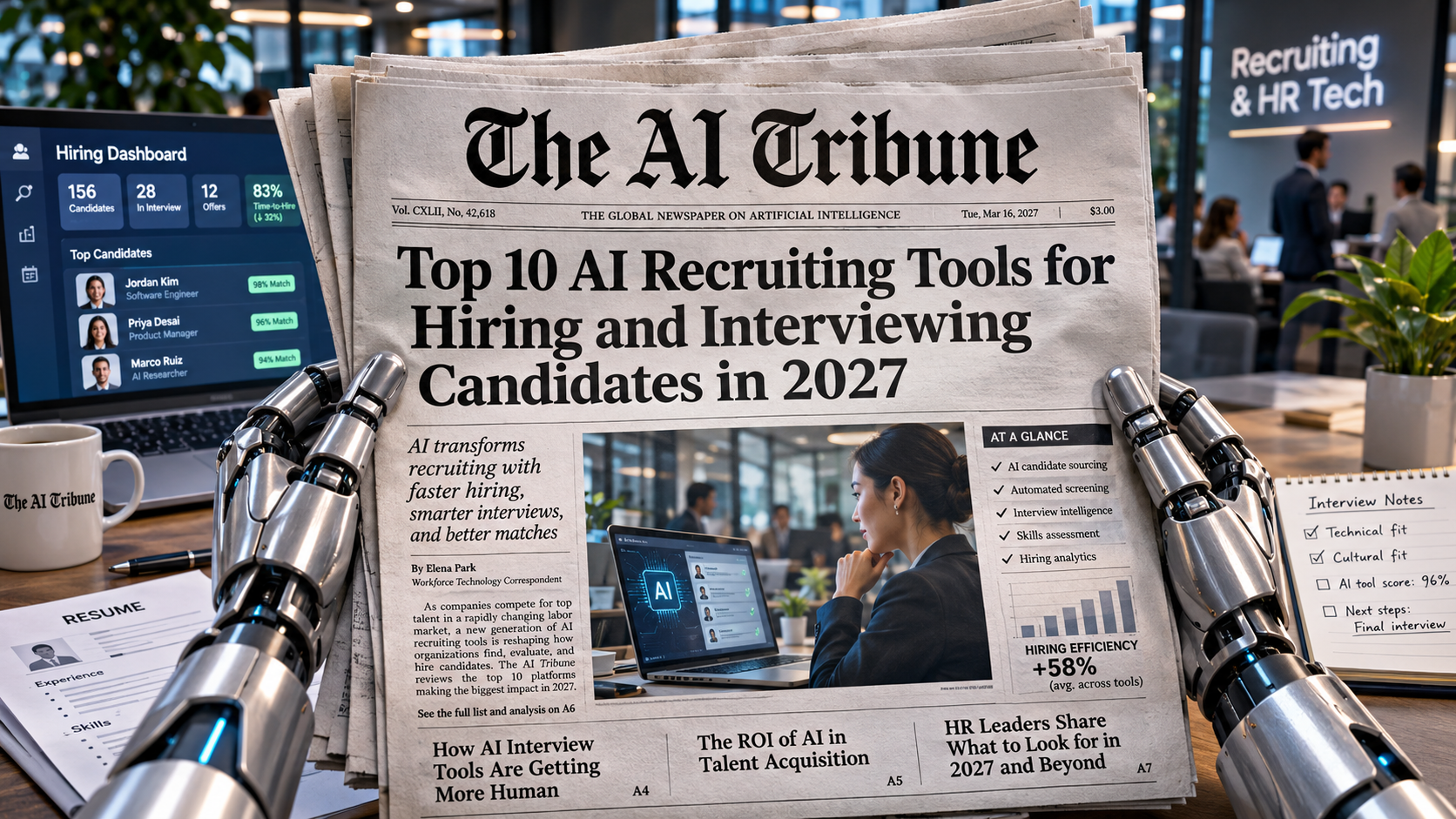
The best AI recruiting tools for 2027 include Workable for end-to-end hiring, Manatal for affordable applicant tracking, Juicebox for candidate sourcing, Metaview for interview notes, and HireVue for enterprise interviewing. Other strong options include Zoho Recruit, Ashby, hireEZ, Paradox, and Eightfold AI.
These platforms solve different problems. Some find qualified candidates, others screen applications or conduct AI interviews, while full recruiting systems manage the entire process. The right choice depends on your hiring volume, existing software, budget, and how much control you want humans to retain over hiring decisions.
Best AI Recruiting Tools in 2027: Quick Comparison
Not every AI hiring tool deserves a place in the same comparison. An AI sourcing platform cannot replace an applicant tracking system (ATS), and an interview transcription tool cannot automatically manage job applications.
The following table compares ten products by their primary purpose rather than treating them as interchangeable solutions.
| AI recruiting tool | Best for | Main function | Public starting price | Biggest limitation |
|---|---|---|---|---|
| Workable | Small and growing businesses | ATS, AI sourcing, screening, automation | $299/month, annual billing, 1–20 employees | Advanced AI agents consume additional credits |
| Manatal | Small recruiting teams and agencies | AI matching, ATS, candidate management | $15/user/month, billed annually | Advanced integrations and AI interviews may cost extra |
| Zoho Recruit | Budget-conscious employers | ATS, AI matching, recruitment workflows | Free plan; paid from $25/recruiter/month annually | Key AI matching features require higher tiers |
| Ashby | Growth-stage companies | ATS, sourcing CRM, analytics, interviews | From $400/month | Higher entry cost; AI Notetaker is extra |
| Juicebox | Recruiters sourcing passive talent | Natural-language candidate search and outreach | Free plan; paid from $99/seat/month annually | ATS integrations require a higher-tier plan |
| hireEZ | Recruiting agencies and sourcing teams | AI sourcing, screening, outreach agents | Solo plan from $494/month | Significant entry cost; enterprise features vary |
| Metaview | Teams conducting frequent interviews | AI interview notes, sourcing, application review | Free Notes plan; paid Notes from $60/user/month | Different AI functions have separate prices |
| Paradox | High-volume hourly and frontline hiring | Conversational screening and scheduling | Contact sales | Enterprise-oriented implementation and pricing |
| HireVue | Large organizations conducting interviews at scale | AI interviews, video interviewing, assessments | Contact sales | More platform than occasional hiring requires |
| Eightfold AI | Enterprise talent acquisition | Skills intelligence, matching, AI recruiting agents | Contact sales | Complexity and limited pricing transparency |
Prices are in USD and reflect publicly available vendor information reviewed November 8, 2026. Annual-billing rates are identified where applicable. Entry prices do not necessarily include every AI feature, integration, implementation service, or usage allowance.
Our Top Picks: Which AI Recruiting Software Is Worth Considering?
If you’re narrowing down a shortlist, these are the strongest starting points for different needs:
- Best all-in-one option for growing employers: Workable. A practical choice when you need applicant tracking, sourcing, screening, and recruiting automation within one system.
- Best affordable AI recruiting software: Manatal. Particularly attractive to smaller teams and recruitment agencies managing multiple candidate pipelines.
- Best low-cost starting point: Zoho Recruit. Its free plan and relatively affordable paid subscriptions make it accessible, although more advanced AI functionality requires upgrading.
- Best for AI candidate sourcing: Juicebox. Useful when finding qualified people is harder than processing applications.
- Best for interview documentation: Metaview. Helps recruiters capture conversations and produce structured interview notes.
- Best for high-volume conversational hiring: Paradox. Designed to reduce administrative work in applicant communication, screening, and scheduling.
- Best for enterprise AI interviewing: HireVue. Combines structured interviews, assessments, AI interviewing, and governance features.
These are editorial recommendations based on documented product capabilities, publicly available pricing, intended customers, and practical trade-offs—not hands-on performance test results.
How We Selected These AI Recruitment Tools
AITribune reviewed the published capabilities of more than 15 recruiting products, including Workable, Manatal, Zoho Recruit, Ashby, Juicebox, hireEZ, Metaview, Paradox, HireVue, Eightfold AI, SeekOut, Gem, Greenhouse, Breezy HR, and Pin.
The ten selected products represent different hiring needs rather than the ten platforms with the largest marketing budgets.
We considered five questions:
- Does the product solve a real recruiting problem? Candidate discovery, matching, screening, interview scheduling, assessment, or hiring workflow management.
- Are its AI capabilities sufficiently documented? We prioritized identifiable features over vague promises of intelligent automation.
- Can buyers understand what they will pay? Transparent pricing, add-ons, usage limits, and contract requirements all matter.
- Will it fit an existing recruiting process? ATS connectivity, collaboration, reporting, and candidate communication are important.
- Can humans supervise consequential decisions? Explainable recommendations, review controls, privacy safeguards, and accessible candidate alternatives are important evaluation criteria.
Products such as SeekOut, Gem, and Greenhouse are credible alternatives. Their omission is not a judgment that they perform worse than every included product. The final selection emphasizes a useful mix of pricing models, recruiting functions, and customer sizes.
Vendor documentation establishes what a product claims to offer. It does not independently prove better hiring outcomes, reduced bias, or a specific return on investment.
1. Workable — Best All-in-One AI Recruiting Tool for Growing Businesses
Workable is a recruiting and HR platform combining applicant tracking, candidate sourcing, interview coordination, reporting, and administrative workflows.
Its appeal is straightforward: a company can manage much of its recruitment process without purchasing separate software for every hiring stage.
What makes Workable’s AI useful?
Workable has expanded beyond basic AI-assisted recruiting into agent-based automation.
Its Workable Agent includes capabilities for:
- Creating structured job briefs from hiring requirements.
- Searching for potential candidates.
- Reviewing incoming applications against job criteria.
- Engaging relevant candidates through automated communication.
- Producing candidate recommendations for recruiter review.
The platform describes four agents: Job Brief, Sourcing, Screening, and Engagement.
For example, a growing software company recruiting three developers could use Workable to advertise vacancies, receive applications, identify promising applicants, and coordinate interviews within the same system.
That reduces the need to move information between spreadsheets, sourcing tools, and separate recruiting databases.
Advantages and limitations
Why consider it: Workable offers a relatively complete recruitment workflow, publicly listed prices, and a single ATS for managing candidate records. Its AI recommendations include explanations, and the platform provides controls over automated actions.
What to watch: Its agent features should not be confused with features automatically included in the base subscription. The Job Brief Agent is included, while the Sourcing, Screening, and Engagement agents use AI credits.
Recruiters still need to check whether the generated candidate criteria are appropriate and whether recommended applicants genuinely meet the role’s requirements.
Workable pricing and integrations
According to Workable’s official pricing page, the Standard plan starts at $299 per month, billed annually, for companies with 1–20 employees.
The pricing page also lists 3,000 complimentary AI credits with ATS plans, while additional AI activity and optional features may increase costs. Video interviewing, assessments, and texting can carry separate charges under Standard.
Workable offers third-party integrations through its recruiting ecosystem, alongside its built-in ATS and HR tools.
Who should choose Workable? Employers hiring regularly who want a central recruiting platform and prefer not to assemble several disconnected tools.
Who should skip it? Businesses hiring one or two people per year, or teams with an existing ATS that only need a specialized interview recorder.
Verdict: Workable is one of the most practical starting points for companies looking to modernize their complete hiring process—not just add an AI feature.
2. Manatal — Best Affordable AI Recruiting Software for Small Teams and Agencies
Manatal is a cloud-based applicant tracking and recruitment CRM platform designed for in-house recruiters and staffing agencies.
It is particularly interesting because its entry-level pricing is substantially lower than many full recruiting suites.
AI matching without an enterprise contract
Manatal combines candidate records, recruitment pipelines, sourcing tools, and AI-assisted recommendations.
Its capabilities include AI candidate recommendations, resume parsing, profile enrichment, and candidate sourcing.
One practical use case is a recruitment agency working with several clients. Rather than repeatedly searching a large database manually, a recruiter can use matching recommendations to identify existing candidates whose backgrounds align with a new vacancy.
The platform also offers an AI Interviewer, which supports asynchronous interviews with recruiter-defined questions and evaluation criteria.
That feature is an add-on available upon request, not a standard entitlement in the cheapest subscription.
Where Manatal stands out
Advantages: Low published entry price, candidate pipeline management, agency-oriented CRM functionality, and AI matching within the recruiting workflow.
Manatal also supports Google Workspace, Microsoft 365, and other applications listed in its integration directory.
Limitations: Advanced workflows, API access, and some third-party automation require more expensive subscriptions. The AI Interviewer is separately activated, and its evaluation output still requires human verification.
For example, Manatal’s Zapier integration depends on API access, which its documentation identifies as included in Enterprise Plus.
Pricing
Manatal’s published plans include:
- Professional: $15 per user/month, billed annually.
- Enterprise: $35 per user/month, billed annually.
- Enterprise Plus: $55 per user/month, billed annually.
A 14-day free trial is available.
Professional includes usage restrictions, including limits on active jobs and stored candidates, so buyers should compare their actual hiring workload against the plan allowances.
Who should consider it? Independent recruiters, boutique agencies, and small HR departments that want AI-supported recruiting without enterprise pricing.
Who should avoid it? Organizations requiring extensive custom integrations at the lowest possible subscription cost or a fully included autonomous interviewing platform.
Verdict: Manatal offers a compelling combination of accessible pricing and useful recruiting functionality. Its biggest strength is affordability, not necessarily the sophistication of every individual AI feature.
3. Zoho Recruit — Best Budget-Friendly ATS With AI Hiring Features
Zoho Recruit is an applicant tracking platform offering recruitment management for both corporate HR teams and staffing agencies.
Its biggest advantage is flexibility. Employers can start with basic candidate tracking and expand into more advanced recruitment automation as requirements grow.
What can Zoho Recruit’s AI do?
Zoho’s AI assistant, Zia, supports candidate-to-job matching and several other recruiting workflows.
The company’s AI recruitment documentation describes:
- AI-powered candidate matching.
- Candidate profile summaries.
- Assistance with job descriptions and recruiter communications.
- Candidate engagement chatbots.
- Interview transcripts and summaries.
- Recruitment assessments and workflow automation.
In October 2026, Zoho also announced enhancements to Zia Matches and additional interview insight functionality.
A small consulting business could use Zoho Recruit to collect applications and schedule interviews, then upgrade when it needs more advanced matching or automation.
The important pricing distinction
Zoho Recruit’s free version is useful for basic recruitment administration, but it should not be described as a free, fully featured AI screening platform.
On its corporate pricing page, Zoho lists:
| Corporate plan | Published price | Relevant consideration |
|---|---|---|
| Free | $0 | Basic candidate management; one active job per recruiter license |
| Standard | $25/recruiter/month annually | Broader sourcing and recruiting workflows |
| Enterprise | $50/recruiter/month annually | AI candidate matching and advanced automation |
Zoho also lists video interviewing as an optional paid service.
Its corporate and staffing-agency editions have different plan structures and allowances, so agencies should review the applicable edition rather than assuming the corporate prices cover their requirements.
Advantages, integrations, and trade-offs
Zoho Recruit is particularly useful for organizations already working with Zoho products.
Its documented integrations include Zoho applications, Microsoft Teams, Google Meet, and other services through its integrations marketplace.
The main trade-off is feature availability. Some of its most attractive AI capabilities require higher-priced editions or add-ons. Setup and customization can also become more involved as workflows expand.
Who should choose it? Small employers, Zoho users, and businesses that want a low-cost ATS with a gradual upgrade path.
Who should avoid it? Teams expecting extensive AI matching and interviewing on the free plan, or organizations seeking a dedicated high-volume sourcing engine.
Verdict: Zoho Recruit is one of the more accessible ways to introduce structure into recruitment before committing to a larger AI hiring budget.
4. Ashby — Best for Data-Driven Hiring Teams That Want One Recruiting System
Ashby combines an applicant tracking system, recruiting CRM, interview scheduling, reporting, and candidate management.
Its strongest appeal is to companies that treat recruiting as an operational process requiring good data, consistent evaluation, and visibility into hiring performance.
More than an AI resume screener
Ashby’s platform supports AI-assisted candidate searches, application reviews, outreach personalization, and interview documentation.
Recruiters can use natural-language instructions to create candidate searches or define criteria for reviewing applications.
Ashby also offers an AI Notetaker that records, transcribes, and summarizes interviews, helping interviewers draft feedback.
Consider a growing technology company hiring across engineering, sales, and operations. Different hiring managers need consistent scorecards, recruiters need scheduling automation, and leadership wants visibility into recruiting bottlenecks.
Ashby’s combination of ATS functionality, analytics, and structured hiring processes is designed for that kind of environment.
What works, and what does not
Strengths: Extensive recruiting workflow functionality, structured interviews, reporting, candidate sourcing CRM, and AI features embedded in candidate management.
Its scheduling tools support calendar-based booking, candidate availability, interview reminders, and panel coordination.
Limitations: The starting subscription is considerably more expensive than some smaller-team alternatives. Its AI Notetaker is a paid add-on, and full implementation may require more process design than a simple ATS.
Ashby also includes application rules capable of automatically archiving applicants when configured conditions are met. Employers should carefully validate such rules rather than assuming that any automated rejection is fair or appropriate.
Pricing and integrations
Ashby’s official pricing page lists its All-in-One Foundations plan from $400 per month for companies with up to 100 employees, with a discount available for annual commitments.
Larger organizations receive tailored pricing.
Ashby documents integrations across its recruiting workflow, including calendar connections and its broader partner ecosystem. Buyers should confirm the exact integrations and data synchronization requirements for their chosen plan.
Who should choose it? Growth-stage companies, structured talent acquisition teams, and employers that need ATS functionality and recruiting analytics together.
Who should avoid it? Very small employers with occasional vacancies or recruiters who only need candidate search.
Verdict: Ashby makes the strongest case when better recruitment operations and reporting matter as much as the AI itself.
5. Juicebox — Best AI Recruiting Tool for Finding Passive Candidates
Juicebox takes a different approach from ATS-centered platforms.
Rather than primarily managing incoming applicants, Juicebox focuses on discovering people who may be suitable for a position but have not applied.
Its PeopleGPT search product allows recruiters to describe the talent they need in natural language.
Finding candidates beyond traditional keyword searches
Imagine recruiting an engineer who has worked with Python, distributed systems, and financial technology infrastructure.
A traditional sourcing process might require several Boolean searches and manual profile reviews.
With Juicebox, a recruiter can describe the combination of qualifications in ordinary language, refine the search, and review matching profiles.
The platform offers AI-assisted filters, contact information tools, email outreach, and candidate shortlists.
Juicebox also sells agents designed to conduct ongoing searches and support outreach workflows.
This makes it particularly attractive for hiring managers and recruiters working on difficult-to-fill roles.
The limitations buyers should understand
Juicebox is not a full replacement for an applicant tracking system.
Its main value lies in sourcing and outreach. Candidate evaluation, formal interview management, and final hiring decisions still need an appropriate process.
The company advertises access to a large global profile database, but database size is a vendor claim—not a guarantee that every profile will be current, reachable, or suitable.
Contact-data credits also matter. A low subscription price does not mean unlimited access to personal contact details.
Juicebox pricing
The official pricing page lists:
- Free: Limited searches and basic features.
- Starter: From $99 per seat/month with annual billing.
- Growth: From $179 per seat/month with annual billing.
- Business: Custom pricing.
- Juicebox Agents: $199 per agent/month.
The page also shows higher prices for monthly billing.
Juicebox lists ATS integrations including Greenhouse, Lever, Ashby, Workday, and other systems, but the Business plan is the relevant option for built-in ATS or CRM integrations.
Gmail and Outlook integrations support recruiting outreach.
Who should consider it? Recruiters who regularly search for specialized talent, boutique executive-search firms, and employers struggling to attract sufficient qualified applicants.
Who should avoid it? Companies that already receive plenty of suitable applications and primarily need help processing them.
Verdict: Juicebox is a strong example of where purpose-built AI can improve the sourcing workflow. However, its value depends on whether finding candidates—not managing applicants—is the real problem.
6. hireEZ — Best for AI-Assisted Sourcing and Recruiting Automation at Scale
hireEZ has developed from a sourcing-focused platform into a broader recruiting automation product.
Its offering includes candidate discovery, engagement, applicant review, and agent-driven recruiting workflows.
What makes hireEZ different?
The company’s EZ Agent is designed to work alongside an organization’s existing ATS.
Its advertised capabilities include:
- Discovering potential candidates across external sources.
- Reviewing applications against role requirements.
- Running conversational screening workflows.
- Automating interview scheduling.
- Supporting recruiting outreach.
- Providing explanations for candidate recommendations.
An interesting aspect of hireEZ’s positioning is its emphasis on recruiter approval.
The company states that its agents do not independently move candidates forward or reject them without recruiter authorization.
That does not eliminate algorithmic risk, but it gives employers a clearer point at which human oversight should occur.
Real-world recruiting use cases
A staffing agency filling multiple specialized technology roles might use hireEZ to find candidates, organize outreach, and conduct initial qualification workflows.
A larger employer might deploy it on top of an established ATS to reduce manual sourcing and screening work without replacing the underlying applicant database.
hireEZ identifies integrations with systems including Workday, SAP SuccessFactors, iCIMS, and Greenhouse.
Pricing and limitations
According to hireEZ’s pricing page, its Solo offering starts at $494 per month, with a seven-day free trial.
Enterprise pricing is customized.
Importantly, buyers should not assume that every capability advertised for the enterprise EZ Agent is included in the Solo subscription. The precise feature package should be confirmed.
Its relatively high entry price also creates an obvious economic question: will a recruiter generate enough additional qualified interviews or reduce enough manual work to justify the subscription?
Who should choose it? Established agencies, experienced sourcing teams, and larger companies with repetitive candidate discovery and screening workflows.
Who should avoid it? Occasional recruiters, employers without a defined recruiting process, and teams primarily interested in inexpensive applicant tracking.
Verdict: hireEZ is worth investigating when sourcing and screening are substantial ongoing expenses. It is less compelling when hiring volume is too low to justify advanced automation.
7. Metaview — Best AI Interview Assistant for Recruiters
Metaview is particularly relevant to a common recruiting problem: interviews generate valuable information, but much of it ends up in incomplete notes, scattered documents, or inconsistent scorecards.
Metaview uses AI to capture and organize interview information.
Although the company has expanded into sourcing and application review, its interview documentation product remains an accessible starting point.
AI notes designed specifically for recruiting
Unlike generic meeting transcription software, Metaview focuses on the information recruiters need to evaluate candidates.
Its AI Notes functionality supports recording, transcription, structured summaries, and interview feedback.
For example, a recruiter interviewing six applicants for a sales manager role could use Metaview to organize evidence about leadership experience, sales processes, and communication skills.
The recruiter still needs to verify the generated summary and make the assessment, but less time may be spent reconstructing conversations afterward.
Metaview also offers separate sourcing and application review products, allowing teams to expand beyond note-taking if needed.
Integrations and practical benefits
Metaview documents integrations with ATS platforms including Greenhouse, Ashby, Lever, and Workday, alongside meeting platforms such as Zoom, Google Meet, and Microsoft Teams.
These connections matter because an interview summary has limited operational value if it never reaches the candidate’s official record.
Its most useful potential advantage is better documentation and less administrative work after interviews.
The limitation is equally important: an AI-generated summary is not a perfect record. Transcription errors, missing context, or overconfident interpretations can still influence a recruiter’s evaluation.
Pricing
Metaview’s AI Notes pricing includes:
- Free: 25 calls per month with basic transcription.
- Pro: $60 per user/month, with unlimited calls and additional functionality.
- Enterprise: Custom pricing.
Other products have separate charges. For example, its sourcing plans begin at $100 per user/month, while application review has its own usage-based pricing.
Who should consider it? Agency recruiters, in-house talent acquisition teams, and hiring managers conducting frequent interviews.
Who should avoid it? Teams seeking only an ATS, companies that rarely interview candidates, or organizations unable to establish appropriate recording consent and data-handling procedures.
Verdict: Metaview is a sensible starting point for recruiters who want to use AI without immediately automating candidate selection. Its biggest value is improving the interview record, not replacing the interviewer’s judgment.
8. Paradox — Best Conversational AI Recruiting Platform for High-Volume Hiring
Paradox is best known for Olivia, its conversational AI assistant.
The product focuses on interactions that frequently slow down high-volume recruitment: answering candidate questions, collecting information, screening basic qualifications, and arranging interviews.
Where conversational AI makes sense
Imagine a hospitality business recruiting workers across dozens of locations.
Candidates might apply in the evenings or on weekends. Recruiting staff may need to answer repetitive questions about shifts, locations, availability, and application procedures.
Paradox can support candidates through text or chat, collect relevant responses, and coordinate interview scheduling.
Its capabilities include conversational applications, qualification screening, interview scheduling, reminders, hiring events, and onboarding-related workflows.
This is fundamentally different from using AI to predict whether someone will be a successful employee.
Much of Paradox’s value comes from reducing friction in candidate communication and administrative processes.
A documented customer example
Paradox’s published customer stories include Compass Group, which it describes as hiring approximately 120,000 workers annually with a recruiting team of 20.
That example illustrates the large-scale recruitment environment for which Paradox is marketed.
However, the numbers come from the vendor’s customer materials. They should not be interpreted as independently verified proof of the software’s impact.
Integrations, pricing, and concerns
Paradox documents integration capabilities with enterprise systems such as Workday and SAP SuccessFactors. Its SAP integration documentation covers conversational applications, screening, candidate messaging, and interview scheduling.
The company does not publish a standard self-service subscription price for the offering reviewed here. Buyers should contact sales.
The main concerns are implementation complexity, conversational failures, unclear candidate responses, and the risk of turning an already frustrating recruitment process into a frustrating automated one.
Candidates should have a straightforward path to human assistance when the assistant misunderstands their circumstances.
Who should choose it? Large employers with repeated frontline vacancies, distributed locations, and heavy scheduling demands.
Who should avoid it? Small teams hiring infrequently or employers whose recruitment is mainly relationship-driven executive search.
Verdict: Paradox is most convincing when hiring teams lose substantial time to repetitive candidate interactions. Its strongest justification is workflow automation, not autonomous judgment about human potential.
9. HireVue — Best Enterprise AI Interviewing and Candidate Assessment Platform
HireVue focuses on structured interviewing, candidate assessment, and hiring workflows at scale.
It is particularly relevant to organizations that want standardized interview processes across many hiring managers, departments, or locations.
What HireVue actually offers
HireVue supports live and on-demand video interviews, structured assessment workflows, interview summaries, and candidate evaluation tools.
Its video interviewing platform includes asynchronous candidate responses, live interviews, searchable transcripts, and AI-assisted interview insights.
The company also launched a voice-based AI Interviewer in June 2026.
That product conducts two-way screening conversations using configured questions and evaluation rubrics.
This distinction matters:
Video interviewing software records or facilitates interviews. AI interviewing software can also conduct or evaluate parts of the interview.
Neither function should automatically be treated as an objective measure of candidate quality.
Why large employers consider HireVue
Enterprise recruiting teams often need consistency, access controls, assessment documentation, and integration with established HR systems.
HireVue’s integration directory identifies connections with Workday, SAP SuccessFactors, Oracle, Greenhouse, SmartRecruiters, iCIMS, and other platforms.
Its AI Interviewer also describes recruiter-approved criteria, explainable scoring, candidate consent, human oversight, and alternative assessment paths.
Those controls are important features to examine, although buyers should still independently validate how they operate in their own hiring environment.
An attributable implementation example
HireVue has published a customer pilot involving AdventHealth. According to the company’s AI Interviewer materials, AdventHealth reported faster movement from applications to hiring-manager review during its pilot.
This is a vendor-published customer account, not an independently controlled study establishing that similar results will occur elsewhere.
What buyers should question
Structured interviews can support consistency, but automated scores are only as useful as the job relevance and validity of the underlying criteria.
Employers should ask what evidence supports the scoring model, how alternative interview paths work, and whether people with disabilities or limited technical access could be disadvantaged.
HireVue uses customized pricing; buyers must request a quote.
Who should choose it? Enterprise talent acquisition departments, large assessment-driven employers, and organizations with significant interview volume and governance requirements.
Who should avoid it? Small companies conducting a handful of interviews per month or businesses looking primarily for inexpensive resume management.
Verdict: HireVue offers a more specialized interviewing and assessment environment than typical small-business ATS platforms. Its suitability depends on scale, governance requirements, and demonstrated job relevance—not simply the desire to automate interviews.
10. Eightfold AI — Best Enterprise Talent Intelligence and Skills-Based Recruiting Platform
Eightfold AI approaches hiring through talent intelligence rather than only application processing.
Its platform focuses on skills, career backgrounds, talent discovery, and recommendations intended to help organizations understand potential across internal and external talent pools.
Looking beyond the resume
Traditional recruitment often begins with job titles, degrees, and past employers.
Eightfold emphasizes skills-based matching and relationships between professional experience, capabilities, and career opportunities.
Its Talent Acquisition platform offers AI-powered sourcing, candidate matching, recruitment workflows, and AI interviewing.
For example, a multinational employer could use talent intelligence to explore whether existing employees have transferable skills for a newly created role before relying exclusively on external hiring.
This is a different problem from scheduling interviews or recording candidate conversations.
Enterprise capabilities and integrations
Eightfold offers a broader talent intelligence environment, including talent acquisition, talent management, and workforce-related applications.
Its published documentation describes integration options for existing ATS and HR systems, including SAP SuccessFactors, as well as AI-native recruitment workflows.
That flexibility is attractive for enterprises with established HR infrastructure, but it also makes implementation planning important.
An organization needs reliable skills data, defined governance, and a clear understanding of how recommendations influence recruiter behavior.
Limitations and price
Eightfold does not publish standard entry-level pricing for its enterprise talent acquisition offering. Buyers should request a demonstration and customized quote.
Its broader functionality can be excessive for smaller employers who only need to post vacancies and evaluate incoming applications.
Another concern is interpretability. Skills inference and candidate matching should be examined carefully, particularly when the software recommends someone based on abilities that are not explicitly documented in their work history.
Who should choose it? Multinational employers, enterprise talent acquisition teams, and organizations seeking to connect external recruitment with skills intelligence and internal mobility.
Who should avoid it? Small businesses looking for low-cost hiring software or recruiters who only need better interview scheduling.
Verdict: Eightfold is worth evaluating when talent acquisition forms part of a larger workforce strategy. It is unlikely to be the most economical way to fill a few individual vacancies.
AI Recruiting Workflow Comparison: Which Tools Handle Each Hiring Stage?
A useful way to compare AI recruitment software is to examine what happens between identifying a vacancy and making a hiring decision.
Some products cover almost every step. Others specialize in one stage and depend on integrations.
| Tool | Find candidates | Screen applicants | Conduct or support interviews | Manage hiring decisions |
|---|---|---|---|---|
| Workable | AI sourcing agent | AI screening agent | Scheduling; optional video | Built-in ATS and review workflows |
| Manatal | Sourcing and matching | AI recommendations | Optional AI Interviewer | ATS pipelines and scorecards |
| Zoho Recruit | Candidate sourcing | Zia matching on eligible tiers | Scheduling; video add-on and insights | ATS workflows |
| Ashby | Sourcing CRM and AI search | AI-assisted application review | Scheduling; Notetaker add-on | Structured scorecards and analytics |
| Juicebox | Core strength | Search matching and shortlists | Not a primary function | ATS handoff on eligible plans |
| hireEZ | Core strength | EZ Agent screening workflows | AI scheduling and conversational screening | Recruiter approvals; ATS integration |
| Metaview | Separate sourcing agent | Separate application review product | Core strength: notes and interview intelligence | Feedback and ATS synchronization |
| Paradox | Conversational job discovery | Chat/text qualification | Scheduling and video workflows | ATS-connected workflows or Paradox ATS |
| HireVue | Not a primary strength | AI interviewing and assessments | Core strength | Evidence and scores sent to recruiters |
| Eightfold AI | Skills-based discovery | AI matching and screening | AI interviewing and scheduling | Talent acquisition workflows and recruiter oversight |
This is a functional comparison, not a performance benchmark. Optional, enterprise-specific, or separately priced functionality may not be available on entry-level plans.
What the workflow comparison reveals
There are three fundamentally different purchasing decisions.
If finding applicants is the bottleneck, a sourcing specialist such as Juicebox or hireEZ may be more useful than buying an entirely new ATS.
If processing applications is the bottleneck, look at ATS-native candidate matching and screening tools—but assess whether their filtering criteria are sufficiently accurate and fair.
If interviews and scheduling are the bottleneck, products such as Metaview, Paradox, and HireVue address very different aspects of the problem. Choose according to whether you need interview documentation, scheduling automation, or AI-conducted assessments.
The worst software purchase is often an impressive platform that automates a process your organization was not struggling with.
Buyer Decision Matrix: Choose AI Recruiting Software by Budget and Hiring Volume
Instead of selecting software solely from product rankings, start with the number and type of roles you actually fill.
| Hiring situation | Budget approach | First tools to evaluate | Recommended strategy |
|---|---|---|---|
| Startup with occasional vacancies | Free or minimal spend | Zoho Recruit, Manatal | Start with applicant organization; upgrade only when necessary |
| Small company hiring regularly | Moderate recurring budget | Workable, Manatal | Use one ATS as the central system |
| Growth-stage company with multiple hiring managers | Larger operational budget | Ashby, Workable | Prioritize structured interviews, analytics, and collaboration |
| Boutique staffing agency filling specialized roles | Per-seat investment | Manatal, Juicebox, hireEZ | Combine candidate relationship management with sourcing |
| Large employer hiring hourly workers continuously | Enterprise budget | Paradox, HireVue | Focus on applications, screening, scheduling, and accessibility |
| Multinational employer managing skills and workforce planning | Enterprise budget | Eightfold AI, HireVue | Evaluate integration, governance, skills data, and broader HR strategy |
This matrix is a starting point rather than a guarantee of suitability. A small staffing agency can have a more complicated recruitment process than a much larger company.
Hypothetical example: A 20-person software startup
Consider a fictional startup with 20 employees planning to hire four people over the next six months.
The founders manage recruitment themselves. They receive applications through job boards and conduct interviews on Google Meet.
Their main problems are tracking applicants, comparing feedback, and avoiding missed follow-ups.
A platform such as Zoho Recruit or Manatal could address the immediate need at a lower subscription cost.
Workable might become attractive if the startup plans to hire much more frequently and wants automated sourcing and screening within the ATS.
Buying a large enterprise AI interviewing system would be difficult to justify without a substantial ongoing workload.
The practical choice: Begin with an affordable ATS and establish a consistent interview process. Introduce more advanced AI only when the need becomes clear.
Hypothetical example: A staffing agency filling 40 positions per month
Now consider a fictional recruitment agency with 12 recruiters supporting several business clients.
Its challenge is very different.
The agency already has a database of candidates but regularly searches for hard-to-find specialists, conducts dozens of screening calls, and needs to keep client pipelines moving.
Manatal could serve as an ATS and agency CRM, while Juicebox or hireEZ could provide additional sourcing capabilities.
Metaview could improve the documentation of recruiter interviews if note-taking is consuming substantial time.
However, the agency should not automatically buy all three products. It should first test whether existing tools provide overlapping functionality.
The practical choice: Keep one authoritative candidate database, then add specialized software only where measurable bottlenecks remain.
Both examples are hypothetical illustrations, not actual customer experiences.
How to Choose AI Recruiting Software Without Wasting Your Budget
AI recruitment platforms often look impressive during demonstrations. A polished candidate shortlist or perfectly summarized interview, however, does not necessarily reflect everyday performance.
A better evaluation process begins with the actual work the software must perform.
1. Identify the hiring problem before selecting a product
Determine whether the largest source of wasted time is candidate sourcing, resume review, interview scheduling, candidate communication, or feedback documentation.
Different problems need different solutions.
A company receiving 500 applicants for every position probably does not need more sourcing software. A specialist recruiter struggling to identify qualified engineers may not benefit much from a new interview transcription tool.
2. Calculate the full cost of ownership
Ask vendors for a price covering your expected hiring workload, not just their cheapest advertised plan.
Include user subscriptions, AI credits, candidate contact credits, job limits, interview usage, implementation fees, integrations, data migration, training, and renewal conditions.
Annual subscriptions can also change the economics significantly.
A $15-per-user platform and a $299-per-month platform are not directly comparable unless you know how many recruiters need access and which features each organization requires.
3. Test the AI against actual recruiting requirements
Before enabling screening automation, use a representative set of job descriptions and appropriately authorized candidate records.
Look for false negatives: candidates who meet the essential requirements but receive unexpectedly weak recommendations.
Also examine false positives: candidates ranked highly despite missing required qualifications.
A ranking system that produces convincing explanations is not necessarily producing correct ones.
4. Verify integrations at the feature level
An advertised ATS integration might support basic exports but not full two-way synchronization.
Ask precisely what data moves between systems, whether candidate status updates are supported, how duplicate records are handled, and which system remains authoritative.
This is especially important when combining sourcing, screening, and interview products from different vendors.
5. Pilot the software before committing
A useful pilot might run for two to four weeks, using comparable roles and a clearly defined baseline.
Track relevant measures such as:
- Recruiter time spent per vacancy.
- Time required to schedule interviews.
- Candidate response and completion rates.
- Shortlist quality after human review.
- Percentage of AI recommendations requiring correction.
- Candidate complaints and accessibility issues.
- Total cost per successfully completed workflow.
These are suggested evaluation metrics, not claimed improvements.
A tool should earn its place by improving a real process without introducing unacceptable risks.
AI Recruiting Tools vs. Traditional ATS Platforms: What’s the Difference?
An applicant tracking system is primarily a system of record.
It organizes applications, candidate stages, communications, interviews, and hiring activity.
AI recruiting software adds intelligent assistance or automation to parts of that workflow.
| Capability | Traditional ATS | AI recruiting software |
|---|---|---|
| Store applications | Core function | Often included or integrated |
| Track recruiting stages | Core function | Often included or integrated |
| Filter candidates | Manual or rules-based | May use semantic matching or AI recommendations |
| Find passive candidates | Usually limited or dependent on add-ons | Can be a primary capability |
| Schedule interviews | Calendar and workflow tools | May add conversational scheduling |
| Summarize interviews | Typically manual | AI transcription and summaries |
| Evaluate candidate suitability | Recruiter and hiring-manager judgment | AI-assisted evidence or matching, with human review |
| Maintain hiring records | Central responsibility | Often depends on an ATS integration |
The difference is becoming less rigid.
Modern platforms such as Workable, Ashby, Greenhouse, and Zoho Recruit are incorporating AI directly into their ATS products. Specialist companies are also expanding toward broader recruiting workflows.
The central question is no longer whether a product is labeled an ATS or an AI recruiting tool.
It is whether the software solves your hiring problem while preserving reliable candidate records and appropriate decision controls.
For a broader discussion of artificial intelligence beyond recruitment, see AITribune’s guide to AI tools for HR, including employee support, workforce analytics, and onboarding.
When AI Resume Screening Creates More Problems Than It Solves
Automated screening is often presented as an easy efficiency improvement: let software evaluate hundreds of applications and direct recruiters toward the strongest matches.
But recruitment is not simply an information-retrieval problem.
An incomplete resume, unconventional career path, or inaccessible assessment can lead to a misleading evaluation even when the software appears technically sophisticated.
AI can amplify weak hiring criteria
Consider a business asking its AI screener to prioritize applicants who previously held the title “Senior Product Manager.”
Someone who performed equivalent work under a different title may be ranked lower despite having relevant experience.
The problem may not be the AI model alone. It can begin with the employer’s poorly specified criteria.
Recruiters should distinguish genuinely essential qualifications from preferences, proxies, or historical habits.
Automated filtering can disadvantage qualified applicants
The U.S. Department of Justice’s guidance on AI and disability discrimination in hiring explains that hiring technologies can screen out people with disabilities who are otherwise qualified for a role.
That risk can arise through assessments, resume screening, or interview technologies.
For example, a timed evaluation or inaccessible interface could measure a candidate’s ability to navigate the assessment format rather than their ability to perform the job.
Employers should provide appropriate accommodations and accessible alternatives where required.
More efficient does not necessarily mean fairer
A screening model can process applications consistently while consistently applying a problematic criterion.
The UK government’s Responsible AI in Recruitment guidance identifies risks including discrimination, digital exclusion, and unfair outcomes across sourcing, screening, interviewing, and selection.
Consistency is useful, but consistency alone does not establish validity or fairness.
When should an employer avoid automated rejection?
AI-based rejection is particularly risky when:
- Essential job qualifications are unclear or difficult to measure.
- Training or evaluation data do not reflect the relevant applicant population.
- Hiring managers cannot explain the screening criteria.
- Candidates have limited routes to request accommodations or challenge mistakes.
- The system has not been appropriately validated for the role.
- Human reviewers rarely examine rejected applications.
In these situations, AI may be safer and more useful as an assistant that organizes evidence rather than as a gatekeeper that removes candidates from consideration.
AI Hiring Risks, Privacy, and Compliance in 2027
AI-assisted hiring can be lawful, but compliance depends on the technology, jurisdiction, employment context, and the way the employer uses it.
A vendor’s declaration that its product is compliant should not replace the buyer’s own review.
Bias and discrimination
In the United States, employment discrimination laws can apply when automated technology contributes to hiring decisions.
The Equal Employment Opportunity Commission has addressed the risks of adverse impact from software, algorithms, and AI used in employment selection.
Employers should evaluate how their tools affect different groups, whether their assessments are job-related, and whether appropriate accommodations are available.
New York City’s automated hiring rules
New York City’s Local Law 144 requirements apply to covered automated employment decision tools.
For applicable uses, employers and employment agencies must ensure a qualifying bias audit has been completed within the preceding year, make the required audit information publicly available, and provide prescribed notices to candidates or employees.
The city’s official FAQ explains the scope of the law, including circumstances involving screening and the required notice period.
These obligations do not automatically apply to every piece of recruiting software. The tool’s function and use determine whether the requirements are triggered.
The European Union AI Act
Recruitment and employment-related AI can fall within the EU AI Act’s high-risk framework.
According to the European Commission’s AI Act guidance, the implementation timetable for certain stand-alone high-risk AI systems, including employment-related applications, now points to December 2, 2027.
Organizations recruiting in the EU should prepare for applicable governance, documentation, oversight, and other obligations rather than treating 2027 compliance as a last-minute software configuration exercise.
Employers also need to consider existing privacy and employment requirements independently of the AI Act.
Candidate data and interview recordings
AI recruiting systems can process resumes, employment histories, contact details, assessment results, and recorded conversations.
Before purchasing, ask where the information is hosted, who can access it, how long it is retained, and whether it can be used to train vendor models.
Interview recording deserves particular attention. Candidates should understand when AI is being used, what information is being collected, and what alternatives or rights apply.
Why human oversight still matters
A useful starting point is the NIST AI Risk Management Framework, which emphasizes qualities such as reliability, transparency, explainability, privacy, and fairness.
For recruiting teams, that translates into practical controls: document the job criteria, review consequential recommendations, audit outcomes, preserve decision records, and establish a route for escalation.
Human oversight should be meaningful. A recruiter who automatically accepts every AI recommendation is not providing much protection against errors.
Candidate trust matters, too. AITribune has separately examined the applicant-facing experience in its review of micro1 jobs and AI-driven interviews. That perspective is useful when evaluating how an automated hiring experience may feel to applicants.
Frequently Asked Questions About AI Recruiting Tools
What is the best AI recruiting tool in 2027?
There is no single best platform for every employer. Workable is a strong all-in-one choice for growing businesses, Manatal is an affordable option for smaller recruiters, Juicebox specializes in candidate sourcing, and Metaview focuses on interview documentation. Paradox and HireVue are more relevant to organizations with substantial screening and interviewing volumes.
What is the best AI recruiting software for small businesses?
Zoho Recruit and Manatal are practical starting points because of their relatively accessible pricing. Workable may be suitable when a small business recruits regularly and wants broader ATS and automation functionality. The best option depends on how often the company hires and whether it needs AI matching or simply organized applicant tracking.
Are there free AI recruiting tools?
Yes. Zoho Recruit offers a free ATS plan, while Juicebox and Metaview provide limited free access to their respective products. However, free ATS access does not necessarily include AI candidate matching, and free AI search or interview tools may impose usage limits.
Which AI recruiting tools can screen resumes?
Workable, Manatal, Zoho Recruit, Ashby, and hireEZ offer relevant matching or application-screening functionality. Metaview also provides a separate application review product. Buyers should confirm plan eligibility, scoring methods, and how recommendations are reviewed before enabling automatic decisions.
What is the best AI interviewing software?
HireVue is worth considering for enterprise structured interviews and automated screening conversations. Metaview is particularly useful for documenting interviews conducted by people. Paradox focuses more heavily on conversational hiring workflows and scheduling.
These products do not perform the same job, so selecting between them requires defining what “AI interviewing” means for your organization.
Can AI recruiting tools conduct interviews without a human recruiter?
Some can conduct initial screening conversations. HireVue’s AI Interviewer, Manatal’s optional AI Interviewer, and certain enterprise recruiting agents support automated interview-related workflows.
However, conducting a conversation is different from making a defensible final hiring decision. Employers should maintain appropriate human review and provide necessary accommodations or alternative procedures.
Can AI recruiting tools replace an applicant tracking system?
Some can because they include an ATS. Workable, Manatal, Zoho Recruit, and Ashby offer applicant tracking as part of their platforms.
Other products, such as Juicebox and specialist interview software, work best alongside an ATS rather than replacing one.
How much does AI recruitment software cost?
Entry-level products can start with a free plan or approximately $15–$100 per user per month. More comprehensive ATS subscriptions may cost several hundred dollars monthly, while large enterprise products frequently require customized quotes.
Usage credits, implementation, integrations, annual commitments, and add-on products can substantially change the final cost.
Is AI resume screening biased?
It can be. Risks depend on the screening criteria, model design, data quality, assessment methods, and how employers use the results.
A vendor’s claim of unbiased AI does not establish that a particular hiring process is free from discriminatory outcomes. Employers should validate screening procedures, monitor results, and retain meaningful human oversight.
What should staffing agencies look for in AI recruitment software?
Agencies should prioritize candidate database management, client pipelines, sourcing, outreach, integrations, and recruiting productivity.
Manatal is relevant for ATS and recruitment CRM needs, while Juicebox and hireEZ can help with additional candidate sourcing. Metaview may be useful when interview documentation consumes substantial recruiter time.
The best combination is the one that removes duplicated work rather than creating another disconnected technology stack.
Final Verdict: The Best AI Recruiting Tool Is the One That Fixes Your Hiring Bottleneck
AI recruiting software has evolved beyond writing job descriptions or searching resumes for keywords.
Recruiting products now offer candidate discovery agents, AI-assisted matching, automated conversations, structured interview summaries, and workflow automation.
But more AI does not automatically produce better recruitment.
For most small employers, an affordable ATS such as Manatal or Zoho Recruit is a sensible starting point. Growing businesses should evaluate Workable or Ashby when they need more complete hiring workflows.
Recruiters struggling to find candidates should investigate Juicebox or hireEZ, while organizations handling large numbers of interviews may benefit from Metaview, Paradox, or HireVue, depending on their specific needs.
Eightfold AI becomes more relevant when recruiting connects to enterprise-wide skills intelligence and workforce planning.
The most useful question to ask before signing a contract is simple: Which specific part of our hiring process will this software improve, and how will we know it worked?
Start there. Verify the results, protect candidate rights, and keep people accountable for the decisions that affect other people’s careers.


Leave a Reply