
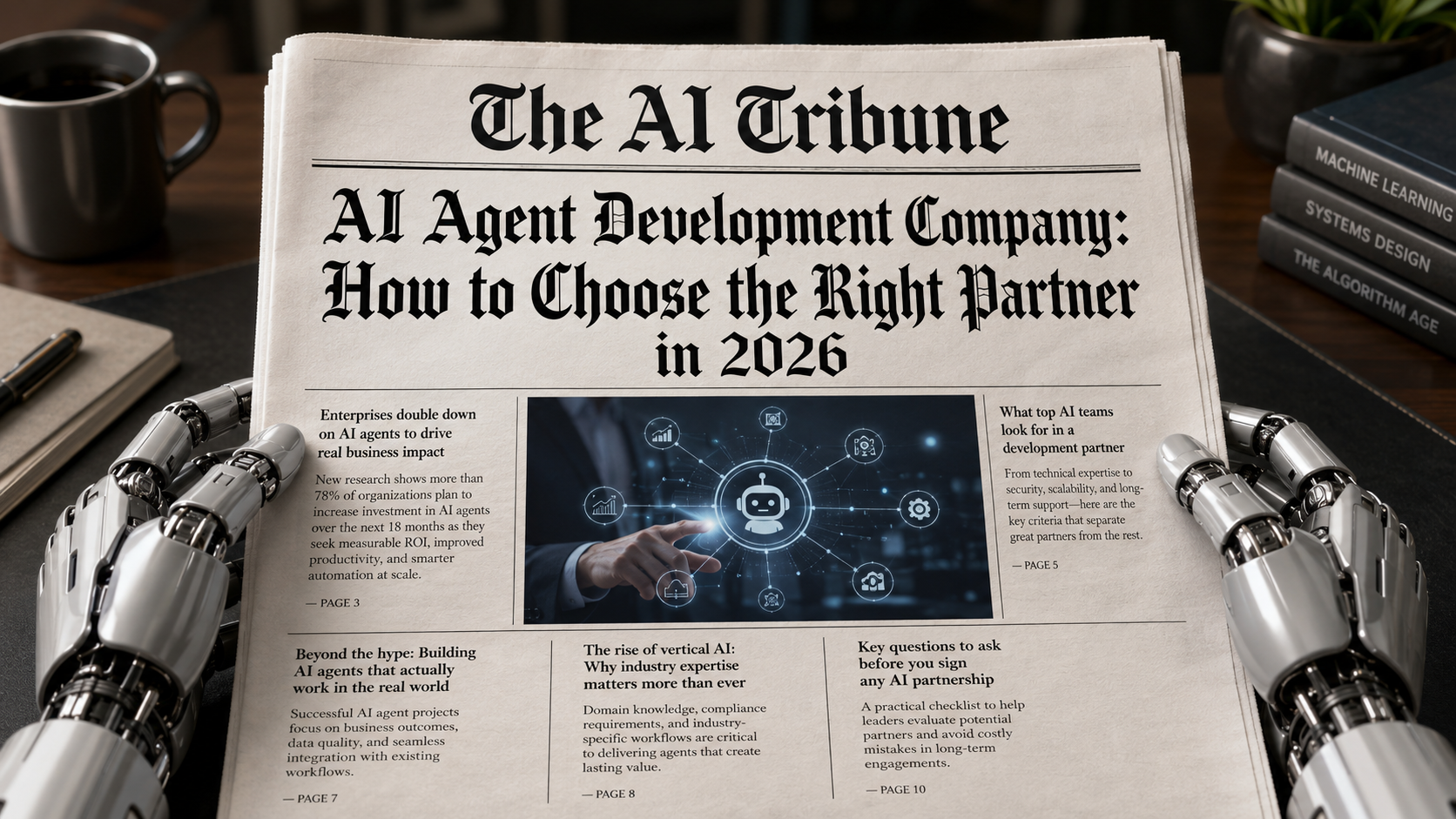
Hiring an AI agent development company sounds exciting until you realize how vague the market has become.
One company says it builds “autonomous digital workers.” Another says it builds “AI copilots.” Another promises “agentic automation.” And then, when you look closer, half of them are basically selling a chatbot with a prettier dashboard.
That is the problem.
In 2026, businesses do not just want AI that answers questions. They want AI that can take action: check data, update records, write reports, qualify leads, search documents, monitor systems, trigger workflows, and escalate risky decisions to a human. That is where AI agents come in.
McKinsey’s latest State of AI survey found that 88% of respondents say their organizations regularly use AI in at least one business function, while 23% are already scaling agentic AI systems and another 39% are experimenting with AI agents. But McKinsey also found that only about one-third of organizations have started scaling AI programs across the enterprise, which means most companies are still stuck somewhere between “cool demo” and “real business impact.” (McKinsey & Company)
So, yes, hiring an AI agent development company can be smart. But only if you know what you are actually buying.
🤖 What Does an AI Agent Development Company Actually Do?
An AI agent development company builds software systems that can reason through a task, use tools, connect to business systems, and complete multi-step workflows with different levels of autonomy.
A traditional chatbot might answer, “Here is your refund policy.”
An AI agent might:
- Read the customer’s order history
- Check whether the refund is allowed
- Draft a response
- Update the CRM
- Trigger a return label
- Escalate the case if the refund amount is above a limit
That difference matters.
Clutch describes AI agent development companies as firms that build autonomous systems capable of reasoning, learning, and acting on behalf of users or organizations. Its AI agent developer directory, updated May 18, 2026, lists 4,531 companies and lets buyers filter by reviews, budget, hourly rate, industry, and AI expertise. (Clutch)
A real AI agent development company usually helps with:
Workflow discovery: figuring out which business process is worth automating.
Agent architecture: deciding whether you need one agent, multiple agents, a retrieval system, tool calling, memory, or human approvals.
LLM integration: connecting models from providers like OpenAI, Anthropic, Google, Meta, or open-source alternatives.
RAG and knowledge systems: letting the agent retrieve information from company documents, databases, policies, tickets, PDFs, emails, or product docs.
API and software integrations: connecting agents to CRMs, ERPs, help desks, calendars, Slack, Microsoft Teams, spreadsheets, databases, and internal tools.
Testing and evaluation: checking whether the agent is accurate, safe, consistent, and actually useful.
Security and governance: managing access control, audit logs, data permissions, human review, and compliance.
This is also why the best AI agent projects often overlap with broader AI consulting. If you are still figuring out whether you need an agent, a chatbot, a workflow automation, or a custom AI platform, you may want to compare this topic with our guide to AI consulting in 2026 and how to choose the right company.
📊 Why Companies Are Suddenly Hiring AI Agent Developers
The demand is real, but it is also messy.
PwC’s 2025 AI agent survey found that 79% of surveyed senior executives said AI agents were already being adopted in their companies, while 88% said their team or business function planned to increase AI-related budgets over the next 12 months because of agentic AI. Among companies adopting agents, 66% said they were seeing measurable productivity value. (PwC)
Deloitte’s 2026 enterprise AI report also points in the same direction. It found that 66% of organizations reported productivity and efficiency gains from enterprise AI, while 40% reported cost reductions and 38% reported better client or customer relationships. But Deloitte also made an important distinction: only 34% of surveyed organizations are using AI to deeply transform products, services, processes, or business models, while many others are still using AI at a surface level. (Deloitte)
That is the gap an AI agent development company is supposed to help close.
The point is not to sprinkle AI on top of a broken workflow. The point is to rebuild the workflow so the agent can actually do useful work.
For example, imagine a small customer support team. A weak AI implementation gives agents a chatbot that suggests replies. Nice, but limited.
A stronger AI agent implementation could:
- Read the full ticket history
- Pull order data from Shopify or Stripe
- Check policy documents
- Draft a response
- Recommend refund approval or denial
- Update the help desk
- Send a manager only the risky edge cases
That is not just “AI content.” That is operational leverage.
Gartner is also pushing this direction. In January 2026, Gartner predicted that by 2028, 60% of brands will use agentic AI to support streamlined one-to-one interactions across marketing, sales, and support. In a separate April 2026 article, Gartner predicted that by 2028, 45% of CIOs will lead AI agent systems outside IT, meaning AI agents are becoming a business design issue, not just a software issue. (Gartner) (Gartner)
That is probably the biggest shift: AI agents are not just tools. They are starting to become part of how work is organized.
🧩 Best Use Cases for an AI Agent Development Company
Not every workflow deserves a custom AI agent. Some businesses just need Zapier, Make, n8n, a better CRM setup, or an off-the-shelf chatbot.
But if the task involves judgment, documents, multiple systems, changing context, or repeated decisions, an AI agent may be worth exploring.
Customer support agents
This is one of the clearest use cases. AI agents can summarize tickets, suggest replies, check refund rules, update CRMs, categorize issues, and escalate sensitive cases. The key is not to remove humans from support completely. The key is to remove repetitive searching, copying, and routing.
Sales and lead qualification agents
A sales agent can research leads, enrich CRM profiles, draft outreach, score prospects, schedule follow-ups, and notify a human when a lead shows buying intent. This works best when the company already has clean CRM data and a clear sales process.
Internal knowledge agents
These agents answer employee questions using company documentation. Think HR policies, onboarding guides, SOPs, technical docs, legal templates, IT troubleshooting, and training materials. This is often a great first AI agent project because the risk is lower than letting an agent make customer-facing decisions.
Security and compliance agents
AI agents can help fill out vendor questionnaires, map policies to controls, summarize audit evidence, and monitor documentation gaps. For a deeper niche example, AI Tribune already covered the best AI agents for security questionnaires, which is exactly the kind of repetitive, document-heavy workflow where agentic AI can save teams serious time.
Finance and operations agents
Finance agents can help with invoice matching, expense review, cash flow summaries, anomaly detection, and monthly reporting. These workflows need strong approval layers because a small mistake can become expensive fast.
Product and app engagement agents
Some AI agents sit inside apps and personalize the user experience. They can recommend next actions, explain features, onboard users, answer product questions, and nudge users based on behavior. If your goal is product retention, it is worth reading our related piece on whether AI app builders can improve user engagement.
Developer and IT agents
These can triage bugs, search logs, draft pull requests, explain code, update tickets, or run controlled scripts. But this is where guardrails become extra important because the agent may have access to code, infrastructure, or sensitive data.
IBM has warned that while AI agents are moving quickly, “true” autonomous agents still require better contextual reasoning, edge-case testing, and careful definitions of what autonomy really means. IBM also cited a Morning Consult survey of 1,000 enterprise AI developers where 99% said they were exploring or developing AI agents, which shows how hot the category is, but not that every implementation is mature. (IBM)
That nuance is important. A useful AI agent does not need to be fully autonomous. In many businesses, the safest and most valuable agent is one that does 80% of the boring work and asks a human before taking the risky final step.
💰 How Much Does an AI Agent Development Company Cost?
The honest answer: it depends heavily on complexity.
But there are some useful market ranges.
Clutch says agentic AI development services commonly range from $25,000 to $250,000+, with basic task agents or chatbots around $25,000 to $75,000, custom agentic AI systems around $100,000 to $250,000+, and ongoing support or fine-tuning often billed as retainers or hourly work at $100 to $300 per hour. (Clutch)
A practical 2026 pricing breakdown looks like this:
Basic AI agent MVP: $10,000–$40,000
This might include a simple internal assistant, document Q&A agent, lead qualification bot, or support assistant with limited integrations.
Mid-level business workflow agent: $40,000–$150,000
This usually includes multiple integrations, a better admin dashboard, workflow automation, RAG, testing, user permissions, and human approval steps.
Enterprise AI agent system: $150,000–$500,000+
This can include multi-agent orchestration, advanced security, custom evaluation pipelines, compliance controls, audit logs, private deployment, custom model tuning, and deep integrations with enterprise systems.
The build cost is only part of the story.
You also need to budget for:
- Model/API usage
- Vector database or search infrastructure
- Cloud hosting
- Monitoring and logging
- Security reviews
- Maintenance
- Prompt and workflow updates
- Human review operations
- Evaluation and testing
- Ongoing compliance work
One mistake I see people make when thinking about AI agents is treating them like a one-time website build. That is usually wrong. A website can sit there for months. An AI agent is closer to hiring a junior employee who needs training, supervision, permissions, performance reviews, and occasional correction.
That is why the cheapest company is not always the best choice. A $15,000 demo that never reaches production is more expensive than a $75,000 system that reliably saves 30 hours a week.
🕵️ Reviews, Red Flags, and How to Choose the Right AI Agent Development Company
Online reviews can help, but only if you read them carefully.
For example, Clutch’s AI agent developer directory includes verified profiles, project results, ratings, budgets, and review summaries. One listed provider, Leobit, appears with a 4.9 rating from 54 reviews, a $25,000+ minimum project size, and review summaries that mention technical expertise, proactive project management, strong communication, and on-time delivery. Clutch also includes a client quote saying, “Language and time zones were not an issue,” which is useful if you are considering offshore or nearshore development. (Clutch)
But here is the catch: many review profiles are not specifically about AI agents. A company may have great reviews for web development, mobile apps, or custom software, but limited experience building production agentic systems.
So when you evaluate an AI agent development company, ask for proof in five areas.
1. Ask for a working demo, not a slide deck
A real demo should show the agent taking actions, calling tools, handling errors, and escalating uncertain cases.
2. Ask what frameworks and architecture they use
Popular agent-building options include OpenAI’s Agents SDK, LangGraph, CrewAI, Microsoft Agent Framework, and custom orchestration layers. OpenAI’s Agents SDK documentation describes agents as LLMs configured with instructions, tools, handoffs, guardrails, and structured outputs. LangGraph emphasizes human-in-the-loop control and durable agent workflows, while Microsoft describes its Agent Framework as a successor that combines AutoGen-style patterns with enterprise features like state management, telemetry, and model support. (OpenAI GitHub) (LangChain) (Microsoft Learn)
3. Ask how they test the agent
Bad answer: “We test it manually.”
Better answer: “We use evaluation datasets, regression tests, human review, failure tracking, groundedness checks, role-based access tests, and monitored production logs.”
4. Ask how they handle security and compliance
Salesforce’s 2025 IT security research found that only 47% of IT security leaders were fully confident they could deploy AI agents in compliance with regulations and standards, while 55% were not fully confident they had the right guardrails to deploy agents. That is a huge warning sign for businesses choosing vendors. (Salesforce)
5. Ask what happens after launch
A serious AI agent development company should offer monitoring, maintenance, performance improvement, model updates, cost optimization, and support. If they disappear after the first deployment, that is risky.
Major red flags include:
- They promise “fully autonomous AI employees” with no limitations
- They cannot explain how the agent makes decisions
- They do not mention hallucinations, permissions, or audit logs
- They avoid security questions
- They have no real demos
- They cannot show measurable outcomes
- They want to automate a broken workflow without redesigning it
- They charge enterprise prices for a basic chatbot
- They do not discuss human approval for risky actions
The best AI agent development company is not the one with the flashiest website. It is the one that asks boring questions: What data can the agent access? What should it never do? Who approves risky actions? What happens when it is wrong? How do we measure success?
That boring stuff is where production AI lives.
✅ Verdict: Is Hiring an AI Agent Development Company Worth It in 2026?
Yes, hiring an AI agent development company can be worth it in 2026, but only when the business case is clear.
It is probably worth it if:
- Your team repeats the same workflow every day
- The task involves multiple tools or systems
- Employees waste time searching, copying, summarizing, and updating records
- You have clean enough data for the agent to use
- You can measure time saved, cost reduced, revenue influenced, or errors prevented
- You are willing to build approval layers and monitor performance
It is probably not worth it if:
- You only want a basic chatbot
- Your internal process is unclear
- Your documents are messy and outdated
- You have no owner for the project
- You expect AI to magically fix bad operations
- You are not ready to test, maintain, and improve the system after launch
The most valuable AI agents in 2026 are not sci-fi robots replacing everyone. They are practical digital teammates that handle boring, repetitive, multi-step work while humans stay in control of judgment, exceptions, and strategy.
That is the sweet spot.
And honestly, that is where businesses should focus. Not “Can this agent replace a department?” but “Can this agent remove 20 annoying steps from a workflow that already happens every day?”
That is how AI agents become useful instead of becoming another expensive demo.
❓ FAQ: AI Agent Development Company
What is an AI agent development company?
An AI agent development company builds software agents that can complete tasks, use tools, connect to business systems, and make limited decisions with or without human approval. These companies usually work on custom AI workflows, integrations, RAG systems, automation, and agent monitoring.
How much does it cost to hire an AI agent development company?
Most serious AI agent projects cost anywhere from about $25,000 to $250,000+, depending on complexity, integrations, security requirements, and autonomy level. Enterprise systems can cost more, especially when they require compliance, audit logs, private deployment, or multi-agent orchestration. (Clutch)
What is the difference between an AI agent and a chatbot?
A chatbot usually answers questions. An AI agent can take actions. For example, a chatbot may explain a refund policy, while an AI agent can check an order, verify eligibility, draft a response, update the CRM, and escalate the case to a human.
Which industries use AI agent development services the most?
Common industries include customer support, SaaS, finance, healthcare, e-commerce, cybersecurity, legal services, HR, logistics, and enterprise IT. McKinsey found AI agent use is often reported in IT, knowledge management, technology, media, telecommunications, and healthcare. (McKinsey & Company)
Should small businesses hire an AI agent development company?
Small businesses should be careful. If you only need a simple support bot or automation, a no-code tool may be enough. But if your workflow involves multiple systems, customer data, approvals, and repetitive decisions, a smaller AI agent MVP may be worth testing.
What should I ask before hiring an AI agent developer?
Ask for a working demo, case studies, security approach, testing process, preferred frameworks, integration experience, post-launch support, and clear pricing. Also ask what the agent will not be allowed to do.
Are AI agents safe for business use?
They can be, but only with guardrails. Businesses need role-based permissions, human approvals, audit logs, monitoring, data governance, and clear escalation rules. Salesforce research shows many IT security leaders are still not fully confident in their agentic AI guardrails, so safety should be part of vendor selection from day one. (Salesforce)
Would you hire an AI agent development company in 2026?
If the company has a clear workflow, measurable ROI, clean data, and a real need for automation, yes. If the company just wants to “do AI” because competitors are doing it, no. Start with the workflow, not the hype.


Leave a Reply