
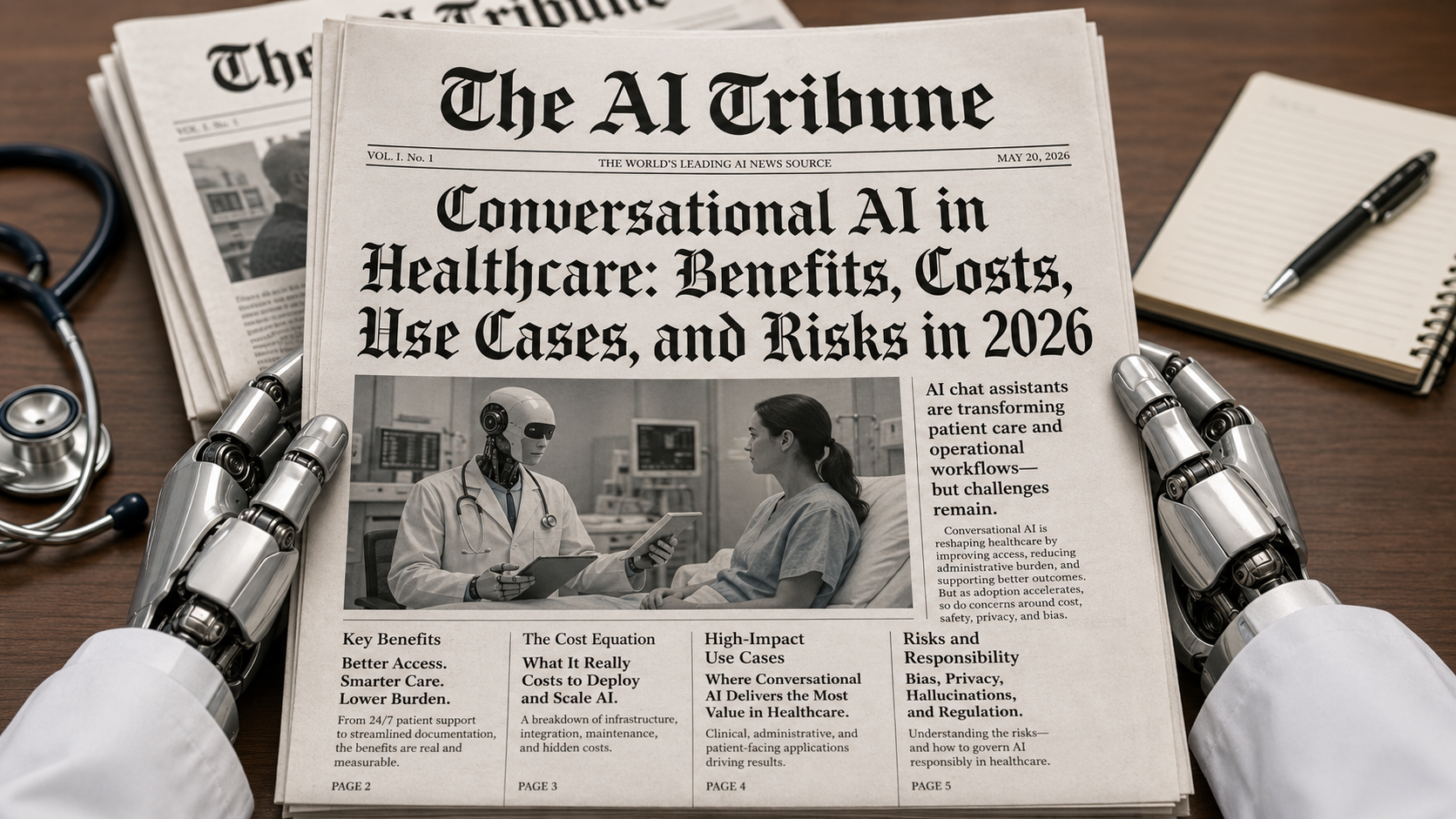
Conversational AI in healthcare is moving from “cool chatbot idea” to a serious part of how hospitals, clinics, insurers, and health-tech companies communicate with patients.
And honestly, it makes sense.
Anyone who has ever waited on hold to book an appointment, tried to understand an insurance denial, or searched symptoms at 1 a.m. knows the healthcare experience can feel confusing and slow. Conversational AI technology in healthcare is being sold as a way to fix some of that: faster answers, better routing, easier scheduling, automated follow-ups, and less admin work for already-stretched medical teams.
But this is healthcare. The stakes are higher than ordering shoes or asking a bot where your package is. A bad answer can delay care. A privacy mistake can expose sensitive health data. A poorly designed system can frustrate patients instead of helping them.
So this article looks at conversational AI in healthcare objectively: where it helps, where it gets risky, what it costs, how it affects jobs, and what real users are saying online.
🏥 What Is Conversational AI in Healthcare?
Conversational AI in healthcare refers to AI systems that can understand, respond to, and sometimes act on patient or staff requests through chat, voice, SMS, portals, apps, or call centers.
This includes:
AI chatbots for FAQs, appointment booking, symptom intake, and patient education.
Voice AI assistants that answer calls, route patients, or help with prescription refills.
Ambient clinical assistants that listen to doctor-patient conversations and create draft notes.
Insurance and claims bots that explain benefits, collect missing information, or help with appeals.
Generative AI agents that summarize records, draft messages, support care navigation, or automate admin workflows.
The market is growing fast. Grand View Research estimated the global conversational AI in healthcare market at $13.68 billion in 2024 and projected it could reach $106.67 billion by 2033, with a 25.71% CAGR from 2025 to 2033. Its report also found patient engagement and support was one of the largest use areas in 2024. (Grand View Research)
That growth is not just hype. The American Medical Association reported in March 2026 that more than 80% of physicians use AI professionally, and more than three-quarters believe AI improves their ability to care for patients. (American Medical Association) McKinsey also found that 50% of surveyed U.S. healthcare organizations had implemented generative AI, while more than 80% had deployed their first use cases to end users. (McKinsey & Company)
For more general healthcare AI updates beyond conversational tools, you can also read AI Tribune’s broader coverage of AI healthcare news in 2026.
💬 Generative AI in Healthcare Examples: Where Conversational AI Is Actually Used
The most useful generative AI in healthcare examples are not always the flashiest ones. In many cases, the biggest wins are boring but powerful: fewer phone calls, faster notes, clearer instructions, and less paperwork.
1. Appointment scheduling and patient intake
A patient messages: “I need to see a dermatologist next week.” The AI asks follow-up questions, checks availability, confirms insurance details, and books the slot or passes the case to a human scheduler.
This can reduce front-desk pressure and cut down on repetitive phone calls. It also helps patients who do not want to wait on hold.
2. Symptom checking and care navigation
Some healthcare chatbots ask patients about symptoms, medical history, urgency, and risk factors. Then they suggest whether the patient should seek emergency care, book a doctor visit, use telehealth, or monitor symptoms.
This is helpful when used as triage support, not as a doctor replacement. A 2026 King’s College London study found that 15% of the UK public had used AI chatbots for health advice instead of contacting a GP or NHS service, while 10% had used AI for mental health or wellbeing support instead of seeing a trained professional. That shows demand is real, but it also raises safety questions. (King’s College London)
3. Clinical documentation
Ambient AI tools can listen during patient visits and generate draft clinical notes. This is one of the most practical AI use cases because doctors spend so much time documenting rather than talking to patients.
A 2025 study on ambient clinical intelligence found reduced documentation burden and reduced off-hours “pajama time” by about 2.5 hours per week. (ScienceDirect) Accenture also estimated that 40% of healthcare working hours are language-based tasks that can be transformed by generative AI, with 17% fully automatable and 23% augmentable. (accenture.com)
4. Patient follow-ups
Conversational AI can send reminders after surgery, check whether a patient picked up medication, ask about side effects, or collect post-visit feedback.
This is especially useful for chronic care, where small follow-ups matter. A patient with diabetes, for example, may need reminders, education, appointment nudges, and escalation if symptoms worsen.
5. AI in healthcare claims processing
AI in healthcare claims processing is one of the most important business use cases. Insurers and providers can use AI to check claim status, identify missing information, explain denial reasons, draft appeal letters, summarize policy rules, and route complex cases to human reviewers.
CAQH reported that U.S. healthcare avoided an estimated $258 billion in administrative costs in 2024 through electronic transactions and improved data exchange. Its index used data from more than 600 provider organizations and health plans representing 63% of insured lives. (CAQH)
That does not mean conversational AI alone saved $258 billion. But it does show why healthcare companies care so much about automation. Claims, eligibility checks, prior authorization, remittance, and billing are massive cost centers.
6. AI in healthcare marketing
AI in healthcare marketing is another growing use case, but it needs careful handling. Healthcare marketers can use conversational AI to answer service questions, guide patients to relevant resources, explain treatment categories, collect leads for elective care, and personalize outreach.
For example, a dental clinic could use a chatbot to answer questions about implants, pricing ranges, financing, and consultation booking. A mental health clinic could guide users to therapy types, insurance information, and appointment availability.
The key is compliance. Healthcare marketing AI should not make exaggerated medical claims, pressure vulnerable patients, or collect sensitive information without the right privacy safeguards.
If you are comparing broader enterprise chatbot tools, AI Tribune also has a guide on top conversational AI platforms for enterprise businesses.
⚖️ Pros and Cons of AI in Healthcare
The pros and cons of AI in healthcare are not simple. The same tool that improves access can also create risk if patients treat it like a doctor.
Pros
Faster access to basic help: Patients can get answers 24/7 for scheduling, directions, insurance basics, preparation instructions, and follow-up reminders.
Lower administrative burden: AI can reduce repetitive tasks for nurses, front-desk teams, billing departments, and call centers.
Better patient engagement: Automated reminders, post-visit messages, and multilingual support can help patients stay connected to care.
More time for clinicians: If documentation and routine messaging are reduced, doctors and nurses may spend more time on actual patient care.
Scalable education: AI can explain discharge instructions, medication basics, and preventive care in simpler language.
Cons
Incorrect or incomplete answers: Generative AI can sound confident even when wrong. In healthcare, that is dangerous.
Privacy risks: Patients may share sensitive health details with tools that are not properly secured or not covered by the right healthcare privacy rules.
Bias and unequal performance: AI systems may work worse for certain accents, languages, conditions, age groups, or underrepresented populations if training data is weak.
Over-reliance: Patients may delay professional care because the AI made a problem sound less serious.
Workflow disruption: A bad implementation can add more clicks, more alerts, and more confusion for staff.
The King’s College London study is a good warning sign. Among people who used AI for health advice, 21% said they had decided against seeking professional healthcare advice because of something an AI chatbot said. (King’s College London)
That is why conversational AI should be positioned as a support layer, not a replacement for doctors, nurses, pharmacists, therapists, or emergency care.
💸 Cost of AI in Healthcare: What Does Implementation Really Cost?
The cost of AI in healthcare depends on what you are building.
A simple FAQ chatbot for a small clinic is very different from a HIPAA-compliant, EHR-integrated, multilingual voice AI system connected to scheduling, claims, and patient records.
For planning purposes, the cost of implementing AI in healthcare usually falls into a few buckets:
Basic chatbot: Often used for FAQs, office hours, directions, and simple appointment links. This may cost far less than a full enterprise build, but it also has limited value.
Mid-level conversational AI: Includes natural language understanding, patient routing, multilingual support, analytics, CRM integration, and some workflow automation.
Advanced healthcare AI assistant: Connects to EHRs, patient portals, call center systems, insurance data, claims workflows, and clinical documentation tools.
Enterprise AI system: Includes custom integrations, compliance reviews, cybersecurity, audit logs, model governance, human escalation, training, and ongoing monitoring.
Recent vendor-side estimates vary widely. Some 2026 healthcare chatbot cost guides place basic or mid-level implementations in the tens of thousands of dollars, while advanced or enterprise healthcare AI projects can move into the hundreds of thousands or even millions depending on integrations, compliance, and scale. (TechAhead)
But the sticker price is only part of the story. The hidden cost of implementing AI in healthcare often includes:
Data cleanup: Bad data makes bad AI.
EHR integration: Connecting to Epic, Cerner, Athenahealth, or other systems can be expensive.
Security review: Healthcare organizations must protect PHI and sensitive records.
Legal and compliance review: Especially for HIPAA, patient consent, claims decisions, and clinical advice.
Human oversight: Someone has to review escalations, errors, and edge cases.
Training: Staff must know what the AI can and cannot do.
Maintenance: Medical policies, clinic hours, provider availability, insurance rules, and regulations change constantly.
A smart approach is to start with low-risk, high-volume workflows: appointment scheduling, FAQs, prescription refill routing, insurance status questions, and post-visit follow-ups. Then expand only after measuring safety, accuracy, patient satisfaction, staff impact, and ROI.
For organizations thinking about governance, compliance, and audit readiness, this AI Tribune guide on how to use AI to support integrated ISO audits is useful because healthcare AI also needs documentation, controls, accountability, and repeatable processes.
👩⚕️ AI in Healthcare Jobs: Replacement, Reinvention, or New Work?
AI in healthcare jobs is one of the most sensitive parts of this topic.
The honest answer: conversational AI will replace some tasks faster than it replaces entire healthcare jobs.
A scheduling assistant may handle basic appointment requests. A claims bot may answer status questions. An AI scribe may draft notes. A marketing chatbot may qualify leads. But that does not mean doctors, nurses, billers, receptionists, or claims specialists disappear overnight.
More likely, many roles change.
Medical receptionists may spend less time answering the same five questions and more time handling exceptions, upset patients, urgent issues, and complex scheduling.
Claims specialists may use AI to summarize cases, detect missing documents, and draft appeals.
Nurses may get AI support for documentation, triage scripts, discharge instructions, and patient follow-up.
Doctors may use ambient AI to draft notes, summarize charts, and prepare patient instructions.
Healthcare marketers may use AI to personalize education campaigns, answer website questions, and guide patients to the right services.
Accenture’s 2025 provider survey found that 83% of healthcare executives were piloting generative AI, while 77% expected it to boost productivity. But it also found fewer than 10% were investing in the infrastructure needed for enterprise-wide deployment, which suggests many organizations are still experimenting rather than fully transforming jobs. (accenture.com)
The risk is that executives buy AI tools without involving frontline staff. Nurses, receptionists, billers, and clinicians know where workflows actually break. If they are not part of implementation, the AI may look good in a demo and fail in real life.
⭐ What Online Reviews Say About Conversational AI Healthcare Tools
Online reviews are useful, but they should be read carefully. A five-star review from a marketing team does not prove a tool is safe for clinical use. A negative review from one frustrated admin does not mean the platform is bad. Still, review patterns can show what users like and dislike.
On G2, Hyro’s review summary says users often praise the platform for ease of use, quick setup, and automating customer interactions across channels, while one commonly mentioned limitation is the need for more integrations. (G2)
Kore.ai reviews on G2 describe it as a robust, highly customizable enterprise conversational AI platform with low-code/no-code tools, omnichannel deployment, NLP capabilities, and integrations with systems like Salesforce, ServiceNow, and Microsoft Teams. (G2)
Abridge, a clinical documentation AI company, has gained attention for turning clinician-patient conversations into structured notes. Reuters reported in 2025 that Abridge raised $250 million to enhance its AI capabilities and had already deployed across roughly 100 U.S. healthcare systems. (Reuters)
The pattern is clear: users like conversational AI when it saves time, fits into existing workflows, and reduces repetitive work. They complain when tools are hard to integrate, expensive, too complex, or not reliable enough for real healthcare environments.
🧠 Final Verdict: Conversational AI in Healthcare Is Useful, But It Needs Guardrails
Conversational AI in healthcare is not a magic doctor in a chat window.
It is better understood as a communication and workflow layer. At its best, it helps patients get answers faster, helps staff avoid repetitive admin work, improves follow-up, supports documentation, and makes healthcare systems less painful to navigate.
At its worst, it gives overconfident answers, mishandles sensitive data, delays real care, or becomes another frustrating tech layer between patients and humans.
The future probably belongs to healthcare organizations that use AI in narrow, measurable, well-governed ways:
Use it for scheduling before diagnosis.
Use it for claims support before denial automation.
Use it for drafting before final clinical decisions.
Use it for education before treatment advice.
Use it with humans, not instead of humans.
The World Health Organization has warned that large multimodal models may be widely used in healthcare, research, public health, and drug development, but they require careful ethics and governance. (World Health Organization) The Joint Commission and Coalition for Health AI also released guidance in 2025 to help U.S. health systems implement AI responsibly at scale. (jointcommission.org)
That is the right framing. Conversational AI can make healthcare better, but only if accuracy, privacy, escalation, transparency, and human accountability are built in from the start.
What do you think? Have you used an AI chatbot for health questions, insurance claims, appointment booking, or medical office support? Did it actually help, or did it make things more confusing? Share your experience in the comments — this is one of those topics where real patient and worker stories matter just as much as the tech demos.
❓ FAQ: Conversational AI in Healthcare
What is conversational AI in healthcare?
Conversational AI in healthcare is technology that uses chat, voice, or messaging to communicate with patients, staff, or insurers. It can help with scheduling, FAQs, symptom intake, claims questions, follow-ups, documentation, and care navigation.
Is conversational AI safe for medical advice?
It depends on the tool and use case. Conversational AI is safer for administrative support and patient education than for diagnosis or urgent medical advice. Patients should not rely on general AI chatbots as a replacement for a licensed medical professional.
What are the best generative AI in healthcare examples?
Common generative AI in healthcare examples include AI medical scribes, discharge instruction summaries, patient message drafting, claims appeal support, clinical note generation, and conversational intake assistants.
How is AI used in healthcare claims processing?
AI in healthcare claims processing can help check claim status, detect missing information, explain denial reasons, summarize policy rules, draft appeal letters, and route complex cases to human reviewers.
What is the cost of implementing AI in healthcare?
The cost of implementing AI in healthcare can range from relatively small chatbot projects to expensive enterprise deployments. Costs depend on integrations, compliance, EHR connectivity, security, model monitoring, workflow complexity, and scale.
Will conversational AI replace healthcare jobs?
Conversational AI is more likely to replace repetitive tasks than entire healthcare jobs. It may reduce manual scheduling, basic call handling, documentation, and claims admin work, while creating more demand for AI oversight, workflow design, compliance, and patient experience roles.
How can AI be used in healthcare marketing?
AI in healthcare marketing can answer patient questions, guide users to services, qualify leads, personalize education, support appointment booking, and improve website engagement. It must be used carefully to avoid privacy issues or misleading medical claims.


Leave a Reply