
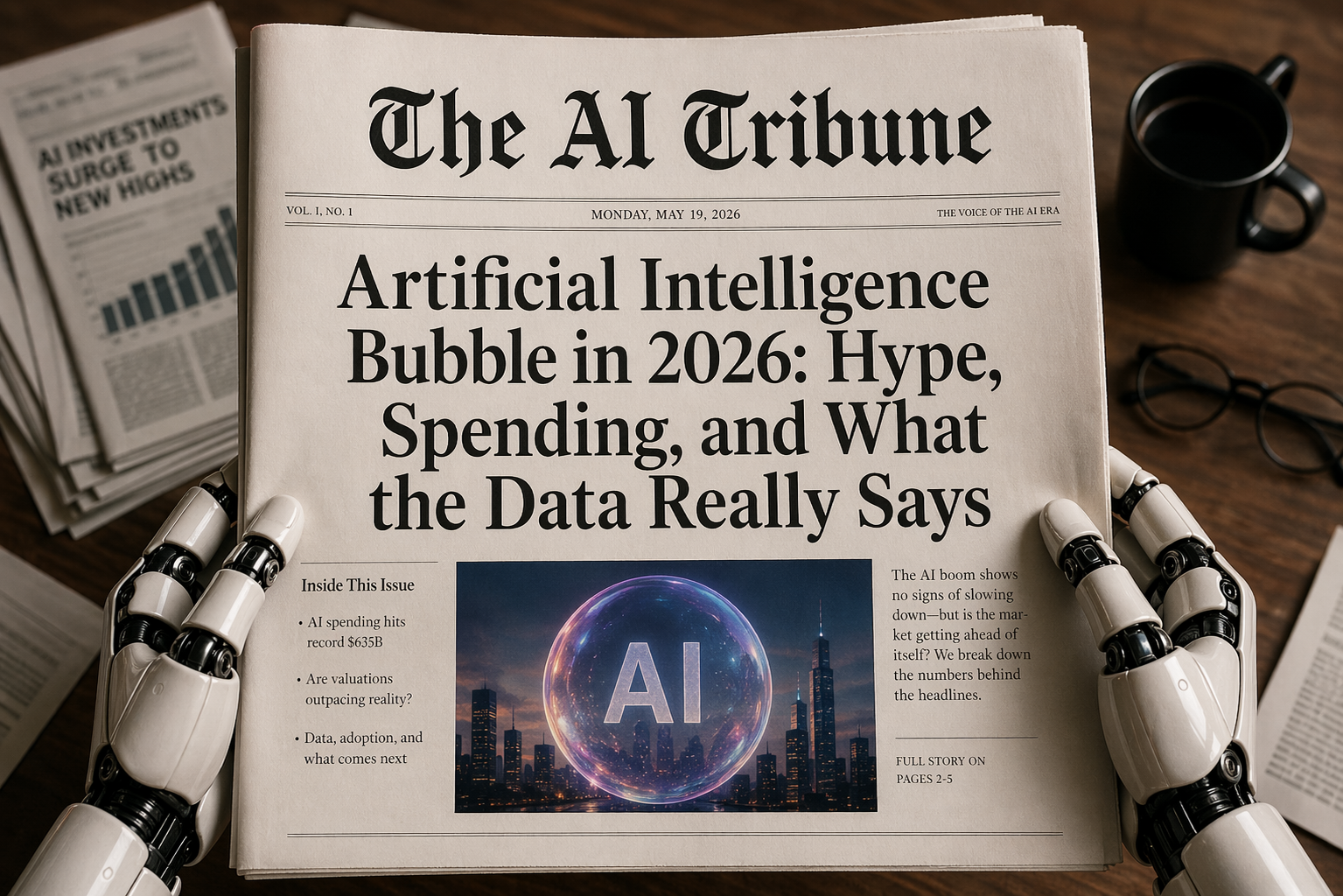
The phrase artificial intelligence bubble gets thrown around so often now that it is starting to lose meaning. Every week, there is another giant funding round, another trillion-dollar stock move, another warning that the whole thing looks like dot-com 2.0. At the same time, there is also real adoption, real revenue, and real productivity improvement showing up in parts of the economy. That is what makes this cycle harder to judge than a simple “hype” story. (hai.stanford.edu)
My own read, after looking through the latest reports and earnings coverage, is that people are mixing up three different things: AI as a useful technology, AI as an investment theme, and AI as a stock-market narrative. Those are not the same. A technology can be transformative and still be surrounded by overpriced companies, weak business models, and spending that gets ahead of demand. That is exactly why this debate matters. (Sequoia Capital)
Why so many people think the artificial intelligence bubble is real
The bearish case is not hard to understand. Goldman Sachs argued in 2024 that tech giants and others were set to spend roughly $1 trillion on AI-related capex over the coming years, while the revenue payoff was still hard to see. By April 2026, Reuters reported that hyperscalers including Microsoft, Amazon, Alphabet, and Meta were expected to invest around $635 billion in AI infrastructure in 2026 alone, with energy constraints becoming a serious bottleneck. That kind of spending is exactly what makes people nervous, because bubbles often form when capital races ahead of proven demand. (Goldman Sachs)
Sequoia helped crystallize that fear with its well-known “$600B question.” The argument was simple: if the ecosystem is building out massive AI infrastructure, where is the matching end-user revenue that justifies it? That question still has teeth. It is one thing to believe AI will matter long term. It is another thing to assume every dollar of today’s spending will be rewarded on schedule. (Sequoia Capital)
The funding pattern also looks bubble-like in one important sense: it is increasingly concentrated. Crunchbase reported that AI funding in 2025 reached $211 billion, up 85% from 2024, while another Crunchbase analysis said 58% of 2025 AI funding landed in mega-rounds of $500 million or more. That is not broad, healthy diffusion. That is a market where a small number of perceived winners are vacuuming up giant checks. (Crunchbase News)
Why the artificial intelligence bubble argument is incomplete
Here is the part that gets missed when people go too negative: there is real demand underneath the hype. Stanford’s 2025 AI Index found that 78% of organizations reported using AI in 2024, up from 55% the year before. The same report said private investment in generative AI reached $33.9 billion in 2024, and in the United States private AI investment hit $109.1 billion. Those numbers do not prove the market is rational, but they do show this is not a fake industry with no customers. (hai.stanford.edu)
McKinsey found that 71% of respondents said their organizations were regularly using generative AI in at least one business function in 2024. That is a huge jump. The catch is that adoption is still shallow in many firms, and most companies are not yet seeing organization-wide bottom-line impact. So yes, usage is real. No, the monetization story is not equally mature everywhere. Both things can be true at once. (McKinsey & Company)
There are also real productivity gains in at least some work settings. An NBER study on customer-support agents found a roughly 14% productivity increase from generative AI assistance, with gains rising to 35% for less-experienced and lower-skilled workers. That matters because bubbles usually depend on fantasy. Productivity studies like this suggest that some of the value is tangible, even if the market is still overestimating how fast that value will spread. (NBER)
The strongest evidence against the “pure bubble” story is revenue
If this were only hype, you would expect usage to be high but money to be thin. Instead, some of the biggest AI players are already putting real revenue on the board. Reuters reported that OpenAI’s annualized revenue crossed $20 billion in 2025 and later said it topped $25 billion by the end of February 2026. Reuters also reported that Amazon disclosed an annualized AI-services revenue run rate of more than $15 billion, while noting Microsoft had previously disclosed a $13 billion AI revenue run rate. Anthropic, meanwhile, had reportedly reached about $9 billion in annualized revenue by early 2026. Those are not toy numbers. (Reuters)
Even so, headline revenue is not the same thing as healthy economics. Reuters reported that coding startup Cursor hit $100 million in recurring revenue by January 2025 and Windsurf reached $50 million in annualized revenue, but investor sources said both had negative gross margins. That is the kind of detail readers should watch carefully. Revenue growth can be real while the economics are still fragile. In bubble periods, that distinction gets ignored until it suddenly matters a lot. (Reuters)
The real risk is not that AI is fake. It is that value capture is uneven.
This is the part I would emphasize most if I were writing for readers trying to stay sane amid all the noise. The biggest danger is not that AI disappears. It is that a lot of companies will not make much money from it even though the technology itself keeps spreading. History is full of technologies that changed the world while destroying weaker players, overfunded imitators, and businesses that mistook experimentation for durable advantage. (IMF)
That is why stories about failed rollouts and weak enterprise execution matter more than flashy demos. Our piece on Enterprise AI Failure Rate fits perfectly here, because the bubble debate is really a debate about whether companies can turn pilots, copilots, and internal demos into reliable operating leverage. The market keeps rewarding intention; eventually it will reward execution. (McKinsey & Company)
The same logic applies to capital markets. If you want to follow the money side more closely, AI Startup Funding News Today is an easy internal bridge from this article, because the funding surge itself is one of the clearest signs of heat in the system. When capital gets cheaper than discipline, bubbles become more likely. (Crunchbase News)
So, is there an artificial intelligence bubble?
The most honest answer is: there are bubble-like conditions inside the AI market, but AI itself is not just a bubble. The infrastructure race looks overheated. Some valuations look stretched. Funding is highly concentrated. Investors are clearly nervous about whether spending can keep outrunning returns. Reuters reported in February 2026 that U.S. software stocks lost about $1 trillion in market value in a week, and another Reuters piece said the sector had lagged the S&P 500 by nearly 24 percentage points over three months. That is what fragile confidence looks like. (Reuters)
But unlike the weakest parts of past manias, this cycle also includes companies with enormous cash flow, large customer bases, and real demand for compute. Goldman Sachs noted in 2025 that, compared with the dot-com era, many firms tied to the AI theme today have much larger earnings and cash generation. Even the IMF’s chief economist said the AI boom could end in a bust without necessarily becoming a systemic crisis like 2008. That is a much more nuanced picture than “everything is fake.” (Goldman Sachs)
So the better framing is this: AI may be a genuine platform shift wrapped inside a speculative financing cycle. That would not be unusual. Railroads, telecom, and the internet all created real long-term value while also producing painful overinvestment, losers, and brutal corrections. AI can follow the same path. (IMF)
What readers should watch next
If you are trying to judge whether the artificial intelligence bubble is inflating or deflating, keep your eye on a short list of boring but revealing metrics: revenue quality, gross margins, customer concentration, power availability, model-inference costs, and whether enterprise pilots actually scale. Those are less exciting than viral demos, but they are what separate durable businesses from expensive stories. (Reuters)
A good example of this “story versus economics” split is OpenAI. Our article on Why OpenAI Is Burning Cash While Google and Anthropic Aren’t as Much can help you dig deeper, because cash burn is one of the clearest stress tests for whether AI leaders can turn explosive usage into sustainable business performance. (Reuters)
Final take
The artificial intelligence bubble debate is worth having, but it should be framed carefully. There is clearly hype. There is clearly speculative behavior. There is clearly a risk that too much capital is chasing too few defensible winners. But there is also real adoption, real revenue, and credible evidence that AI is already improving output in some jobs and functions. The smartest position right now is not blind optimism or smug skepticism. It is disciplined curiosity. (hai.stanford.edu)
And that is probably the best question to leave readers with: Do you think the artificial intelligence bubble is mostly hype around a real technology, or the early sign of a much larger correction ahead? Drop your view in the comments. The most interesting part of this story is that reasonable people can still look at the same numbers and come to very different conclusions.


Leave a Reply