
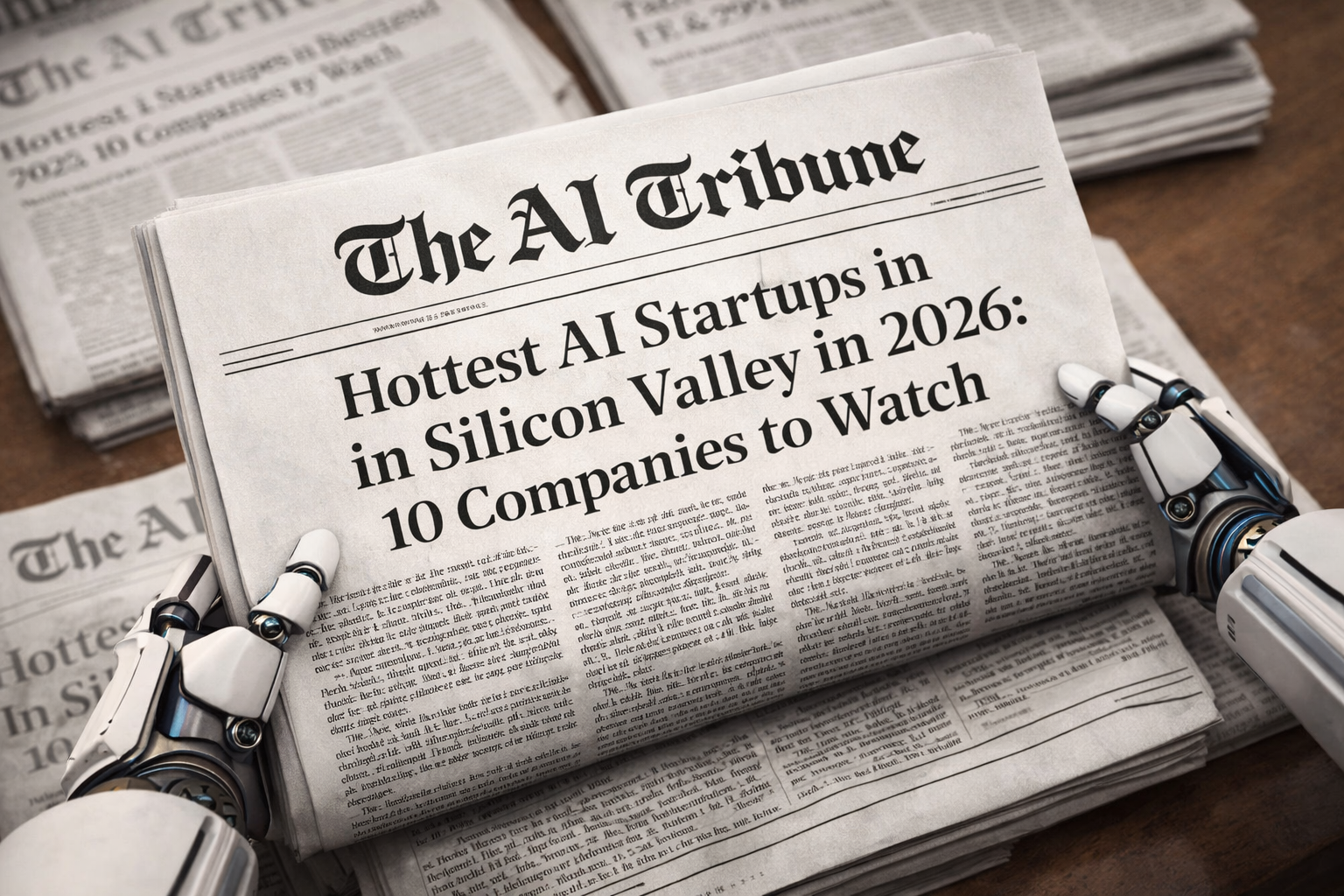
If you are trying to figure out the hottest AI startups in Silicon Valley right now, the honest answer is not just “the companies with the biggest hype.” In 2026, the real winners are the startups turning attention into something harder to fake: revenue, enterprise adoption, infrastructure scale, and products people actually keep using.
For this piece, I’m using “Silicon Valley” in the broad Bay Area startup sense, so that includes San Francisco, Palo Alto, and the surrounding ecosystem. That matters, because the center of gravity has widened. The hottest names are no longer only model labs. They now include coding tools, enterprise search, customer-service agents, legal AI, and robotics. That shift is showing up in fundraising, revenue, and customer adoption across the market. (OpenAI)
Why these are the hottest AI startups in Silicon Valley
My filter here is simple: fresh capital, clear product traction, strong customer pull, and a believable reason the company could still matter two years from now. That is why some older private giants still make the list, and why some buzzy startups do not. In 2026, investors are rewarding proof of demand, not just cool demos. You can see that in OpenAI’s record funding, Anthropic’s enterprise acceleration, Glean’s ARR growth, Sierra’s customer-service momentum, and Harvey’s legal expansion. (OpenAI)
The hottest AI startups in Silicon Valley right now
1) OpenAI
Yes, OpenAI is now massive, but it is still private and still setting the tempo for the rest of the Bay Area. In March 2026, OpenAI said it closed a $122 billion funding round at an $852 billion post-money valuation. It also said it is now generating $2 billion in revenue per month and is on the verge of 1 billion weekly active users. Even if you think the valuation is extreme, that combination of capital, product reach, and developer mindshare makes it impossible to leave off a list of the hottest AI startups in Silicon Valley. (OpenAI)
2) Anthropic
Anthropic has become the clearest “serious enterprise AI” counterweight to OpenAI. In February 2026, Anthropic announced a $30 billion Series G at a $380 billion valuation. Reuters later reported Anthropic had reached roughly $9 billion in annualized revenue by early 2026, helped heavily by enterprise and coding demand. In other words, this is not just another model company riding the wave. It is one of the companies shaping where enterprise AI money is going. (anthropic.com)
3) Cursor / Anysphere
If you want the clearest proof that application-layer AI can get just as hot as model labs, look at Cursor. Reuters reported that Cursor hit a $29.3 billion valuation in November 2025 after a $2.3 billion raise. By spring 2026, TechCrunch reported it was in talks for another round at around a $50 billion valuation, while multiple reports said it had already crossed $2 billion in annualized revenue. That is absurd velocity for a coding startup, and it tells you where Silicon Valley still sees a huge opening: turning AI into actual daily work tools, not just chat windows. (Reuters)
4) Perplexity
Perplexity still feels like one of the Bay Area’s most important “watch this closely” companies. Reuters reported it finalized a $20 billion valuation round in September 2025, and the Financial Times reported that its annual recurring revenue had risen to more than $450 million by March 2026. Reuters also reported a $750 million Microsoft cloud deal in January 2026. The reason Perplexity stays hot is that it is no longer just pitching AI search. It is trying to become an answer engine, browser layer, and agent platform all at once. That makes it one of the boldest bets in the Valley. (Reuters)
5) Glean
Glean is one of the strongest examples of AI becoming boring in the best possible way: deeply useful, enterprise-safe, and tied to real budgets. Glean announced a $150 million Series F at a $7.2 billion valuation, then said in January 2026 that it had already surpassed $200 million in ARR. It also said customers were running more than 250 million agentic actions on top of 27 billion indexed documents across 100+ connectors. That is not casual experimentation. That is infrastructure-like adoption inside companies. (glean.com)
6) Sierra
Sierra is one of the hottest startups in Silicon Valley because it sits exactly where a lot of AI spending is moving: customer support, service operations, and revenue-linked agents. Sierra said it hit $100 million in ARR just seven quarters after launch, and its September 2025 round valued it at $10 billion. That is the kind of speed that gets buyers, talent, and investors very interested very fast. If 2024 was the year of flashy customer-service demos, Sierra is one of the names showing what commercial follow-through looks like. (Sierra)
7) Harvey
Harvey is what happens when a vertical AI company finds a sector willing to pay real money for high-stakes work. Reuters reported Harvey raised $200 million in March 2026 at an $11 billion valuation. On its own site, Harvey says more than 100,000 lawyers across 1,000+ organizations in 60 countries use the platform, and it says users save more than 25 hours per month on average. Legal AI is no longer a side story. Harvey has made it one of the clearest vertical AI markets in the Valley. (Reuters)
8) Figure AI
Figure remains one of the hottest robotics names in the Bay Area because it has moved beyond futuristic demo energy and into real manufacturing proof points. Reuters reported Figure was valued at $39 billion in its latest 2025 funding round. Figure said its robots contributed to the production of more than 30,000 BMW X3 vehicles, and BMW separately said the pilot showed measurable value in real production settings. When physical AI becomes tangible enough to move sheet metal on real shifts in real factories, people stop treating it like science fiction. (Reuters)
9) World Labs
World Labs is one of the hottest “next-wave” AI startups because it is pushing beyond text into spatial intelligence. Reuters reported Fei-Fei Li’s company raised $1 billion in February 2026, and World Labs says its mission is to build world models that can perceive, generate, reason about, and interact with the 3D world. Its first product, Marble, lets users create persistent 3D worlds from images, video, or text. This is the kind of company that may look early today and suddenly feel obvious later. (Reuters)
10) Thinking Machines Lab
Thinking Machines Lab is still more thesis than finished category winner, but in Silicon Valley that can still count as very hot. Reuters reported Mira Murati’s startup raised $2 billion at a $12 billion valuation, and later reported it secured a major multi-year Nvidia partnership tied to at least one gigawatt of next-generation systems. On its site, the company says it wants to make AI more understandable, customizable, and broadly useful. The combination of elite ex-OpenAI talent, giant infrastructure access, and still-open strategic upside keeps it near the top of every serious watchlist. (Reuters)
A couple of names just outside my top tier but still worth watching are Decagon and Deepgram. Decagon said in January 2026 that it had raised fresh funding at a $4.5 billion valuation after adding more than 100 new enterprise customers in a year, while Reuters reported Deepgram raised $130 million at a $1.3 billion valuation and said more than 1,300 organizations were using its voice AI platform. Both fit the same bigger pattern: the Valley is getting very serious about applied, workflow-level AI. (decagon.ai)
What online reviews say about some of these startups
One thing I like checking, especially when startup valuations get ridiculous, is whether users sound impressed or merely curious. On Apple’s App Store, Perplexity holds a 4.8 rating from hundreds of thousands of ratings, and Product Hunt reviewers repeatedly praise its sourced answers, speed, and clean interface. That lines up with the broader market story: people like products that help them trust answers faster. (App Store)
Glean’s feedback is also strong. G2 shows Glean at roughly 4.7 out of 5 across more than 150 reviews, and the review summary says users especially like how quickly it surfaces information across multiple workplace tools. The important caveat is that even strong reviewers sometimes say irrelevant results still show up. That is useful to remember. Even hot enterprise AI platforms are still works in progress. (G2)
Harvey’s public review footprint is smaller, but the pattern is familiar: early users like it as a strong starting point for research and drafting, while also warning that it should not replace independent legal verification. That is probably the most honest summary of vertical AI in 2026: the best tools speed up serious work, but the highest-stakes judgment still belongs to the human. (G2)
What this says about Silicon Valley AI in 2026
The biggest takeaway is that the hottest AI startups in Silicon Valley are not all doing the same thing anymore. Some are giant model labs. Some are enterprise workflow companies. Some are search layers. Some are robotics or world-model bets. But they all share one trait: they are trying to own a real interface to work, not just a demo. OpenAI and Anthropic want to be foundational. Cursor wants to own the coding workflow. Glean wants to become the work knowledge layer. Sierra and Harvey want to become operating systems for specific functions. Figure and World Labs want AI to cross into physical and spatial reality. (OpenAI)
That is also why adjacent conversations matter so much. If you want the economics angle, my piece on why OpenAI is burning cash while Google and Anthropic aren’t as much pairs well with this. If you want the policy lens, read AI governance trends in 2026. And if you think startups like Perplexity are changing how discovery works online, how to improve brand visibility in AI search is a useful companion piece.
The risks people should not ignore
It would be lazy to write about hot AI startups without saying this clearly: a hot startup is not automatically a durable one. Some of these valuations are racing ahead of public financial disclosure. Many revenue figures are company-reported or reported through secondary sources. And legal, copyright, safety, and enterprise-governance issues still sit underneath the excitement. Reuters’ Perplexity coverage, for example, notes ongoing copyright pressure from publishers, while the broader OpenAI and Anthropic race is increasingly tied to gigantic compute commitments and IPO expectations. (Reuters)
So the smarter way to read this market is not “which startup is coolest?” It is “which startup is turning AI into a habit, a budget line, or a workflow that buyers will hate to rip out later?” That is a much harder question, and it is the one that matters.
Final verdict
If I had to boil it down, the hottest AI startups in Silicon Valley in 2026 are OpenAI, Anthropic, Cursor, Perplexity, Glean, Sierra, Harvey, Figure, World Labs, and Thinking Machines Lab.
Some of them are already huge. Some still feel early. Some will absolutely cool off. But right now, these are the companies with the strongest mix of capital, momentum, and narrative power.
And honestly, that last part matters too. Silicon Valley still runs on story as much as spreadsheets.
Which startup would you add to this list, and which one do you think is getting way too much hype?


Leave a Reply