
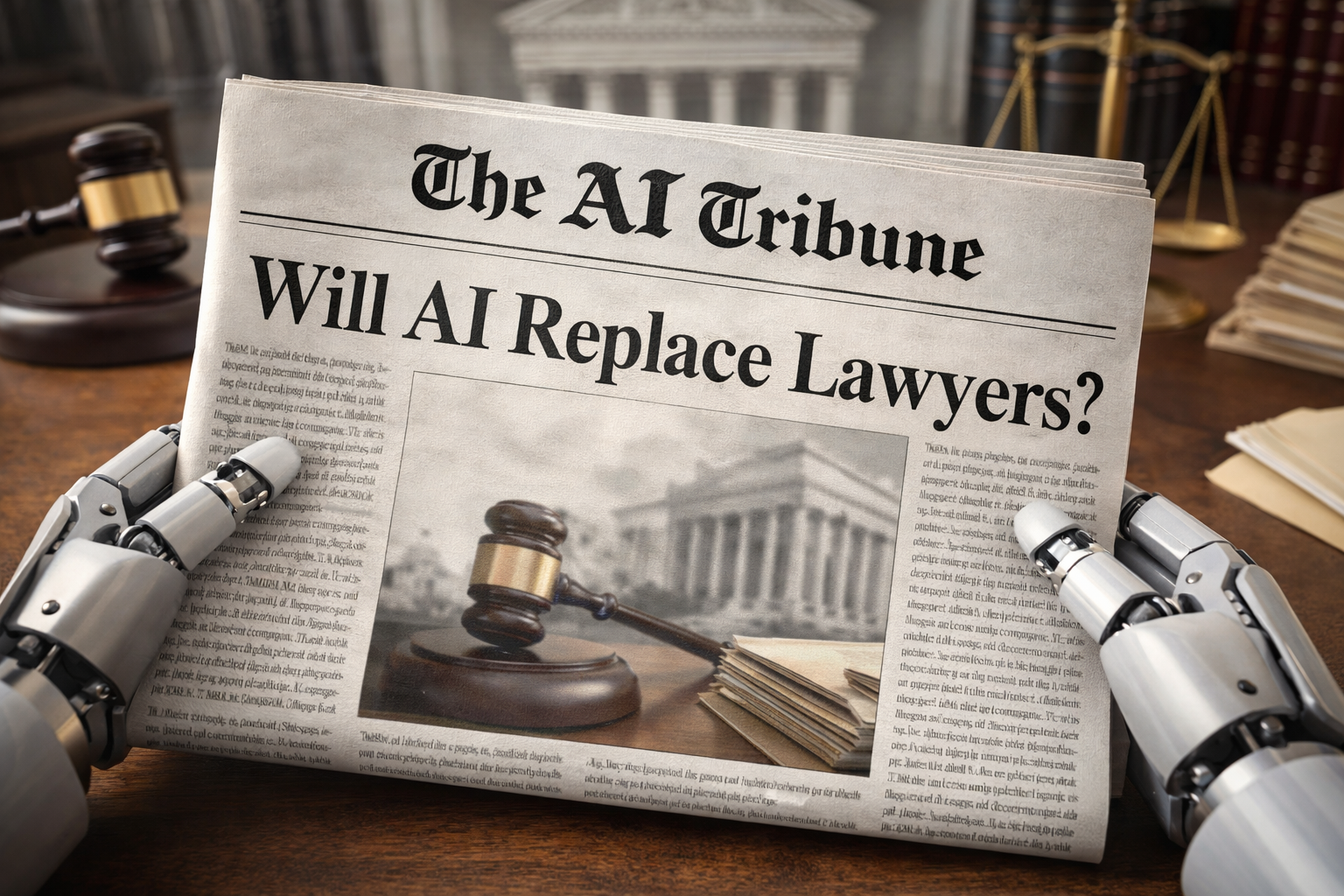
If you’ve been asking “will AI replace lawyers?” you’re not overreacting—legal work is one of the most “AI-exposed” white-collar fields because so much of it is text, patterns, and research. A widely cited estimate from Goldman Sachs suggested about 44% of legal work could be automated (at least in part). (abajournal.com)
But “automated” doesn’t mean “lawyers disappear.” It usually means work gets unbundled: some tasks shrink, some shift to different roles, and some get faster—while judgment-heavy work stays human.
Before we go deeper, one quick note: this is informational, not legal advice.
The honest answer: AI won’t replace lawyers—it will replace chunks of lawyering
Here’s the most accurate framing in 2026:
- AI is already replacing parts of junior-level work (first drafts, summarizing, doc review, clause comparisons). (LawSites)
- The legal market still expects demand for lawyers to continue, even with automation. In the U.S., the BLS projects lawyer employment growth of ~4% from 2024–2034, with ~31,500 openings per year on average. (Bureau of Labor Statistics)
- Meanwhile, legal employment has been hitting record highs even as AI adoption rises—suggesting transformation, not extinction (at least so far). (Reuters)
If you want a broader “jobs vs AI” lens to compare legal with other careers, you can also check your own piece here: https://aitribune.net/2026/02/11/will-ai-replace-your-job-2026-reality-check/
What AI is already doing in law firms (with real adoption stats)
AI isn’t “coming someday.” It’s already inside workflows—just unevenly.
Adoption is rising fast:
- ABA Tech Survey reporting showed AI adoption in legal practice jumped from 11% (2023) to 30% (2024). (LawSites)
- A Thomson Reuters survey reported 26% of legal organizations were actively using gen AI in 2025, up from 14% in 2024—and most expect it to become central in the next few years. (LawSites)
- Yet governance is lagging: one report found only ~10% of law firms had a genAI policy (late 2024). (Legal IT Insider)
What AI is used for most often (in plain English):
- Legal research + summarizing (cases, statutes, memos) (legaldive.com)
- Contract review (spotting risky clauses, missing terms, inconsistencies)
- Discovery/doc review (sorting, clustering, highlighting)
- Drafting (first drafts of letters, policies, internal memos, even briefs—with human review)
A “composite” example (so it’s relatable, without pretending it’s my personal life)
Imagine a small firm partner on a deadline. The old flow: junior associate spends 6 hours assembling a research memo, then partner rewrites it. The new flow: AI produces a draft memo in minutes, and the associate spends the time verifying authorities, improving strategy, and tailoring arguments. Same outcome, fewer billable hours—but a higher expectation of speed.
That’s where this is heading: less time on raw text production, more time on judgment.
“AI can pass the bar”—so why can’t it replace lawyers?
AI’s benchmark performance is real. GPT-4 was reported to score around the top 10% on a simulated bar exam. (OpenAI)
There’s also peer-reviewed work evaluating GPT-4 on the Uniform Bar Exam components. (PMC)
But two things can be true at once:
- Passing an exam ≠ practicing law responsibly.
Real law is messy: incomplete facts, shifting client goals, negotiation, risk tolerance, ethics, and court procedure. - LLMs still hallucinate (confidently).
Courts are now explicitly warning lawyers about fake AI-generated citations and the duty to verify. (AP News)
If you’re writing about “verification culture,” you can naturally connect that to your own coverage on AI detection and authenticity here: https://aitribune.net/2026/03/04/do-teachers-and-colleges-check-for-ai/
And the risks aren’t theoretical. The famous U.S. example: lawyers were sanctioned after submitting filings with fabricated case citations (Mata v. Avianca), including a $5,000 penalty. (Forbes)
Real-world reviews: what lawyers say AI tools do well (and where they disappoint)
To keep this objective, here are three different types of “review signals”—market reviews, firsthand commentary, and vendor case claims.
1) Marketplace review signal (G2)
On G2, CoCounsel Legal shows a strong user rating (example: 4.8/5 from 70+ reviews, at the time of this lookup). (G2)
Themes that tend to show up in user reviews: speed on summaries, usefulness for first-pass drafting, and value when integrated into a broader research stack (with the usual warning: verify sources).
2) A practitioner’s firsthand take (not marketing)
One attorney write-up described CoCounsel as a potential time-saver as a first step, but ultimately not worth the added cost (they canceled). That kind of feedback matters because it reflects ROI reality, not hype. (Advocate Magazine)
3) Vendor case-claim signal (treat as anecdotal)
Thomson Reuters’ CoCounsel page includes individual quotes like “save 6 to 8 hours” in a day—useful as a directional claim, but it’s still marketing testimony and should be treated as anecdotal. (thomsonreuters.com)
Bottom line: the “reviews” are not saying “replace my lawyer.” They’re saying “make legal work faster—if you supervise it and the economics make sense.”
What will get replaced first: junior work, repetitive workflows, and some support roles
If you’re trying to predict impact, don’t ask “will AI replace lawyers?” Ask:
Which legal tasks are:
- high volume,
- text-heavy,
- repetitive,
- low-stakes (or easily verifiable),
- and billed as time spent rather than outcomes?
Those are the first to compress.
Some signals we already see:
- Billing pressure: lawyers expect billing models to shift as AI changes time-on-task. (Legal IT Insider)
- Paralegal employment is projected to be flat (2024–2034) even while openings remain due to turnover—suggesting limited growth in classic support roles. (Bureau of Labor Statistics)
- Commentary on the billable hour model suggests AI pushes firms toward value-based or subscription-style pricing to benefit from efficiency (rather than being punished by it). (Reuters)
At the same time, the legal job market is still strong overall—so the likely story is role redesign, not a sudden collapse. (Reuters)
The 2026 playbook: how lawyers stay valuable in an AI-first legal world
If you’re a lawyer (or planning to become one), here’s what actually “future-proofs” you:
1) Become the editor-in-chief of AI output
The lawyer who can prompt, verify, and refine beats the lawyer who ignores it. Courts and bars are emphasizing responsibility, verification, and confidentiality. (Reuters)
2) Build expertise AI can’t commoditize
- courtroom advocacy
- negotiation strategy
- client counseling
- complex fact development
- ethical judgment and liability ownership
3) Treat AI like a supervised junior (not an oracle)
A solid mental model: AI drafts, you decide.
4) Know the rules (and the new ones coming fast)
Even if you don’t practice in the EU, global compliance pressure is spreading. If you want an explainer you already published, it fits naturally here: https://aitribune.net/2026/02/24/eu-ai-act-explained/
FAQ: Will AI replace lawyers?
Will AI replace lawyers completely?
Highly unlikely. AI can automate significant portions of legal work, but lawyers still carry responsibility, ethics duties, strategy, negotiation, and accountability. (Reuters)
Which lawyers are most at risk?
Roles heavy on repetitive drafting, basic research, and high-volume document work—especially where clients are price-sensitive.
Will AI reduce billable hours?
It can. That’s why firms are exploring pricing changes so efficiency doesn’t reduce revenue. (Reuters)
Is it safe to use ChatGPT for legal work?
Only with safeguards: confidentiality protections, verification of all citations/claims, and compliance with professional responsibility guidance. (Reuters)
Does AI passing the bar mean it’s “as good as a lawyer”?
Not really. Exam performance is one signal, but practice requires reliability, factual grounding, and accountability in real-world settings. (OpenAI)
Conclusion: AI won’t replace lawyers—but lawyers who use AI will replace lawyers who don’t
In 2026, the most realistic outcome is: legal work gets faster, cheaper, and more productized, while the “human” parts of law (judgment, trust, ethics, strategy) become even more important.
Now I want to hear from you:
- If you’re a lawyer, what’s the one task you’d love AI to take off your plate?
- If you’re a client, would you trust a law firm more if they used AI (with disclosure), or less?
Drop your take in the comments—especially if you’ve tried legal AI tools and have a real-world win (or horror story).


Leave a Reply