
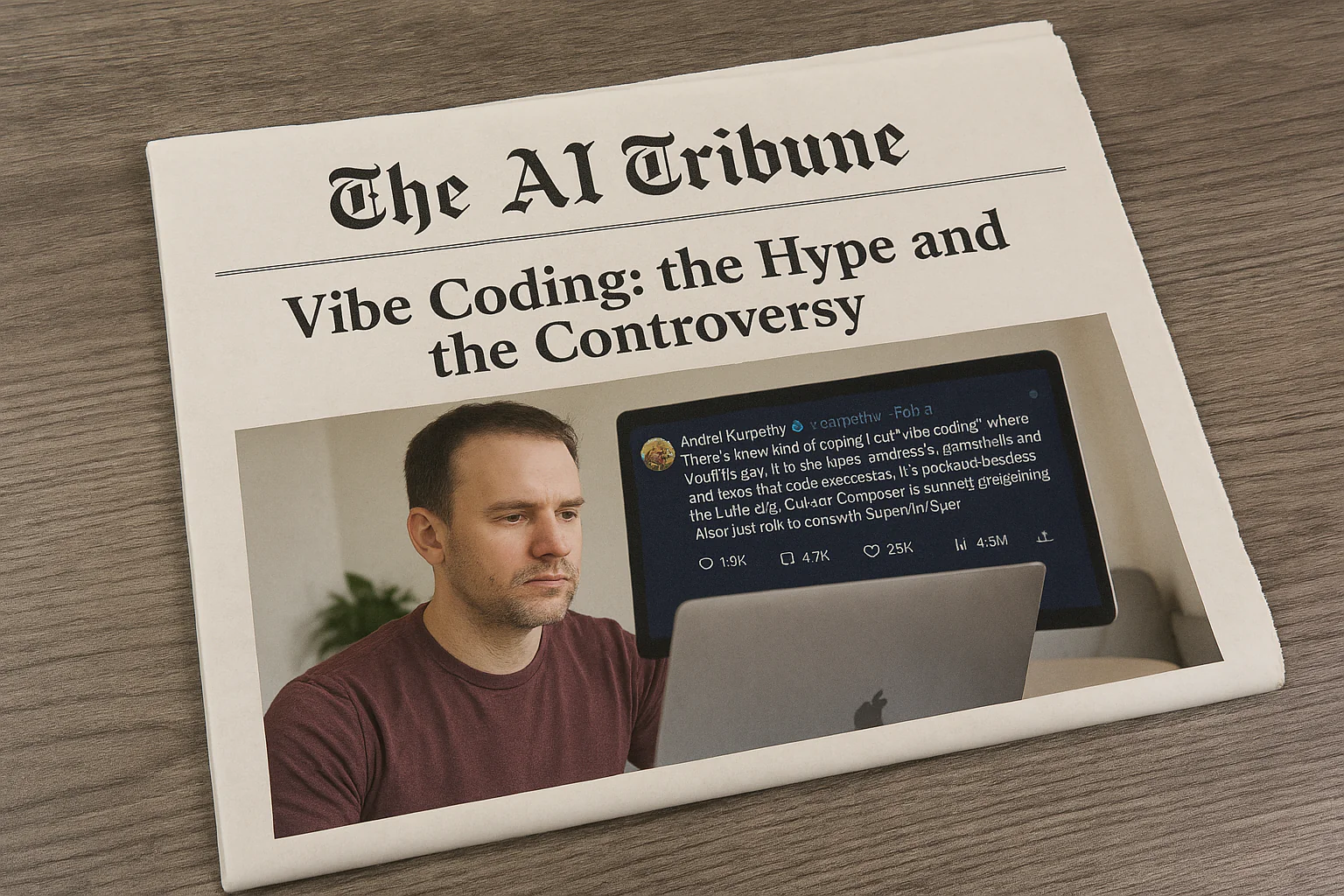
The term “vibe coding” has rapidly evolved from an obscure social media post to a contentious lightning rod in programming circles over the past two months.
This controversial approach to software development, where programmers rely entirely on AI to generate code they may not fully understand, has ignited fierce debates about the future of programming, software quality, and the very nature of coding as a profession.
The Birth of a Controversial Concept
In early February 2025, renowned AI researcher Andrej Karpathy introduced the term “vibe coding” in a tweet that quickly captured the tech world’s imagination. Within weeks, this concept spread from social media to mainstream publications including the New York Times, Ars Technica, and the Guardian.

Karpathy’s original definition described vibe coding as a specific approach where developers “fully give in to the vibes, embrace exponentials, and forget that the code even exists.” In his own words: “I’m building a project or web app, but it’s not really coding—I just see stuff, say stuff, run stuff, and copy-paste stuff, and it mostly works.”
This approach represents a radical departure from traditional programming methodologies, where understanding the underlying code is considered fundamental. Instead, vibe coding advocates for completely delegating code comprehension to large language models (LLMs), accepting AI-generated code without reviewing changes in detail, troubleshooting by simply copying error messages to AI assistants, and working around unfixable bugs by requesting alternative implementations.
The Rise of AI Programming Assistants
The emergence of vibe coding coincides with remarkable advancements in AI coding assistants. Tools like Cursor with its Composer feature and Sonnet, mentioned by Karpathy in his original tweet, have demonstrated increasingly sophisticated capabilities in code generation and comprehension.
The latest generation of AI coding tools can not only complete simple functions or suggest small code improvements but can also architect entire applications, debug complex issues, and even explain unfamiliar codebases. These capabilities have enabled approaches like vibe coding to gain traction, particularly among developers working on personal projects or prototypes.
The Great Divide: Advocates vs. Critics
The vibe coding concept has created a stark division in the programming community, with passionate advocates and critics articulating competing visions for software development’s future.
The Case for Vibe Coding
Proponents argue that vibe coding represents an inevitable evolution in programming—one that dramatically increases productivity and lowers barriers to entry for software creation. They suggest that just as modern developers rarely write assembly code or manage memory manually anymore, future programmers may not need to understand every line of code their applications use.
Advocates point to the rapid prototyping benefits, with some developers reporting 5-10x increases in development speed for certain types of projects. For entrepreneurs and hobbyists, this acceleration can be transformative, allowing ideas to be tested and iterated upon at unprecedented speeds.
“The point isn’t to never understand the code,” one advocate explained in a popular Hacker News thread, “but rather to shift the level of abstraction upward. I don’t need to understand the implementation details of every library I use, so why should AI-generated code be different?”
The Critical Perspective
Critics, however, warn of potentially severe consequences for code quality, security, and maintainability. They argue that delegating understanding to AI creates fundamental risks that cannot be mitigated through testing alone.
“There’s a profound difference between not knowing the implementation details of a well-tested library and not understanding your own application’s core logic,” argues Dr. Emily Chen, a software engineering professor at MIT. “When no human fully comprehends how a system works, diagnosing complex problems becomes nearly impossible.”
Security experts have raised particularly urgent concerns, noting that vibe coding could inadvertently introduce vulnerabilities that neither the developer nor the AI system recognizes. Without human review focused on security implications, AI-generated code might meet functional requirements while harboring serious flaws.
Beyond Binary Perspectives: A Nuanced Middle Ground
While public discourse often frames vibe coding as either a revolutionary advancement or an existential threat, many experienced developers advocate for a more nuanced middle position.
Responsible AI-Assisted Programming
A critical distinction exists between vibe coding as defined by Karpathy and more measured approaches to AI-assisted development. Professional software engineers using LLMs as tools typically:
This approach leverages AI’s strengths while maintaining human oversight for critical aspects of software development. As the article explicitly states, “if you’re reviewing, testing, and fully understanding the code that AI generates for you, you’re not vibe coding—you’re just using AI as a tool.”
Context-Dependent Appropriateness
The suitability of vibe coding appears highly context-dependent. For personal projects, rapid prototyping, or non-critical applications, the productivity benefits may outweigh the potential downsides. However, for systems where reliability, security, or safety is paramount—such as financial applications, healthcare systems, or critical infrastructure—the risks of not fully understanding implementation details become unacceptable.
Real-World Implications and Future Trajectories
As vibe coding transitions from theoretical concept to practical reality, its impact is beginning to manifest across multiple dimensions of the software industry.
Educational Challenges and Opportunities
Computer science educators face particularly complex questions about how to prepare students for a world where AI coding assistants play an increasingly central role. Should curricula focus more on understanding and directing AI tools rather than traditional coding skills? Or does this approach risk creating developers who lack fundamental knowledge to solve novel problems?
“We’re seeing a fundamental tension in education,” notes Dr. James Wong, Chair of Computer Science at Stanford University. “Students need to understand core concepts deeply, but they also need to be fluent with AI tools that are becoming industry standard. Finding the right balance is our greatest challenge.”
Some educational institutions have begun integrating AI coding assistants into their curricula, teaching students when and how to use these tools appropriately while still ensuring they develop robust fundamental knowledge.
Industry Adoption and Standards
Major technology companies have taken varied approaches to AI-assisted coding, with some embracing the productivity benefits while implementing guardrails to maintain code quality. These typically include mandatory human review processes, specialized testing regimes for AI-generated code, and clear documentation requirements.
Industry-standard bodies have also begun developing guidelines for responsible AI-assisted development. These emerging standards aim to harness productivity benefits while mitigating risks through structured governance and review processes.
The Evolution of Programming Skills
Perhaps most significantly, vibe coding and related approaches are reshaping the nature of programming expertise itself. Rather than detailed knowledge of syntax and algorithms, valuable skills increasingly include:
This evolution suggests that while programming may change dramatically, human expertise remains essential—just in different forms than traditionally valued.
Conclusion: The Future of Coding?
Vibe coding represents neither the apocalypse of software quality nor a universal solution to development challenges. Instead, it serves as a powerful indicator of AI’s transformative impact on programming—requiring thoughtful adaptation rather than uncritical acceptance or rejection.
As AI coding assistants continue to improve, the boundary between traditional programming and vibe coding will likely blur further. The most successful organizations and developers will be those who thoughtfully integrate these tools into their workflows, understanding both their remarkable capabilities and inherent limitations.
The fundamental tension in this evolution mirrors broader AI adoption challenges: harnessing unprecedented productivity gains while maintaining human oversight where it matters most. For the software development community, navigating this tension will define the next decade of professional practice.


Leave a Reply