
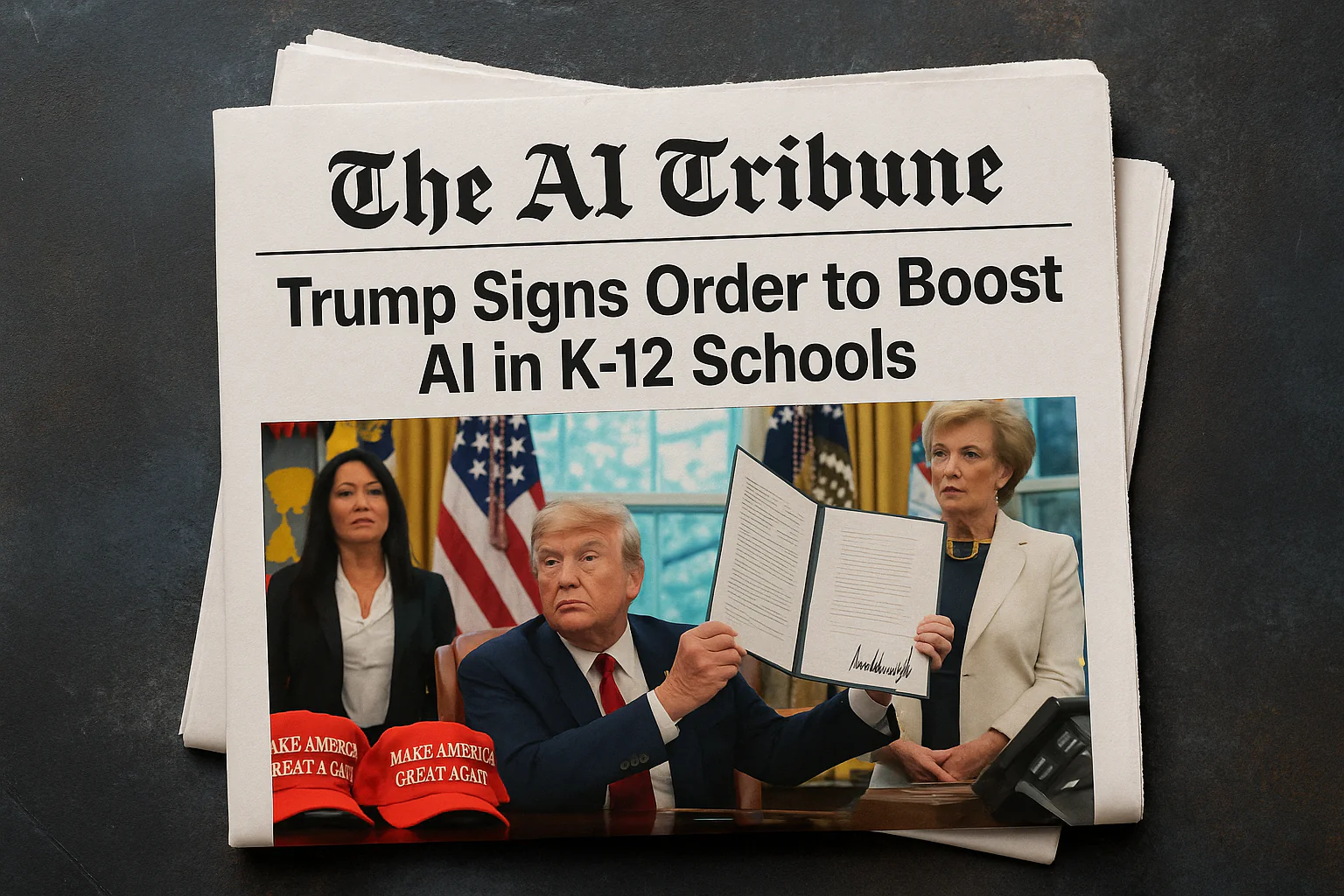
In a move that could reshape the landscape of American education, President Donald Trump signed an executive order on April 23, 2025, aimed at integrating artificial intelligence (AI) into K-12 classrooms across the United States. This directive, one of seven education-related orders signed that day, signals a strategic pivot toward preparing the next generation for an AI-driven economy. But what does this mean for students, educators, and the broader AI ecosystem?
At The AI Tribune, we dive into the details, implications, and potential challenges of this ambitious policy, offering insights to help our readers navigate this transformative moment.
The Executive Order: A Blueprint for AI in Schools
The executive order, as reported by USA Today, directs the U.S. Department of Education to prioritize grants for teacher training in AI-related subjects. It establishes a White House Task Force on AI Education, bringing together leaders from the Departments of Education, Labor, Science, and other agencies to create a national roadmap for AI integration in schools. The task force, chaired by Michael Kratsios, Director of the Office of Science and Technology Policy, is tasked with ensuring that AI education aligns with workforce demands and national priorities.
Additionally, the Department of Labor is instructed to funnel funding toward AI apprenticeships and certification programs, with a focus on providing high school students early access to AI-related career credentials. This dual emphasis on education and workforce development underscores the administration’s view of AI as not just a technological tool but a cultural and economic force.
The order comes on the heels of Trump’s January 2025 decision to rescind Biden-era AI regulations and back a $500 billion private-sector investment in AI data centers, signaling a broader pro-AI agenda. By embedding AI in K-12 education, the administration aims to position the U.S. as a global leader in AI innovation, countering advancements by countries like China, which has heavily invested in AI-driven industries.
Why AI Education Matters Now
The push for AI in schools is not merely a policy checkbox; it’s a response to a rapidly evolving global landscape. AI is already transforming industries—from healthcare, where AI diagnostics improve patient outcomes, to manufacturing, where robotic automation boosts efficiency. A 2023 McKinsey report estimated that AI could add $13 trillion to the global economy by 2030, but only if nations cultivate a skilled workforce. Without early exposure to AI concepts, American students risk falling behind in a world where technical fluency is a prerequisite for economic mobility.
Consider Estonia, which has partnered with OpenAI to roll out ChatGPT Edu to every secondary student and teacher starting in September 2025. This Baltic nation’s proactive approach highlights the urgency of AI education. In contrast, the U.S. has lagged in cohesive national AI education strategies, with most initiatives driven by individual states or private institutions. Trump’s order aims to bridge this gap, but its success hinges on execution.
The economic stakes are high. The U.S. Bureau of Labor Statistics projects that AI-related jobs, such as data scientists and machine learning engineers, will grow by 35% from 2022 to 2032, far outpacing the average for all occupations. Yet, a 2024 study by the National Science Foundation found that only 17% of U.S. high schools offer computer science courses with AI components. This gap leaves students unprepared for careers in a field that will define the 21st century.
The Promise: Empowering Students and Teachers
At its core, the executive order seeks to democratize AI education. By prioritizing teacher training, it acknowledges that educators are the linchpin of this transformation. Teachers equipped with AI knowledge can introduce students to concepts like machine learning, natural language processing, and ethical AI use, fostering critical thinking and creativity. For students, early exposure to AI could spark interest in STEM fields, where underrepresented groups, including women and minorities, remain scarce.
The focus on apprenticeships is equally significant. By linking high school students to AI career pathways, the order aims to make AI education practical and accessible, not just an academic exercise. Imagine a 16-year-old in rural Ohio earning a machine learning certification while still in high school, opening doors to internships at tech giants or local startups. This vision aligns with the administration’s broader push for workforce development, including apprenticeships in high-demand trades.
Moreover, the order’s bipartisan appeal cannot be overlooked. AI education transcends political divides, as both parties recognize the need to prepare students for a tech-driven future. The Forbes analysis of the order notes that it’s not just an education issue but an economic, cultural, and generational one, positioning AI as a unifying priority.
The Challenges: Equity, Ethics, and Implementation
While the order’s ambitions are laudable, its implementation faces significant hurdles. First, there’s the question of equity. Schools in underserved areas often lack the infrastructure—high-speed internet, modern computers, or trained staff—to integrate AI effectively. A 2024 report by the Digital Promise initiative found that 20% of U.S. schools in low-income districts have no access to computer science curricula. Without targeted funding to bridge this digital divide, the order risks widening existing disparities.
Second, the rapid integration of AI raises ethical concerns. AI tools like ChatGPT can enhance learning but also enable cheating or over-reliance on automation. Educators must teach students not just how to use AI but how to use it responsibly, addressing issues like bias in algorithms or data privacy. The order’s silence on these ethical dimensions is a notable gap, as noted in a Washington Post analysis of a draft version of the policy.
Third, the teacher training component is a logistical challenge. Training thousands of educators nationwide requires substantial investment and coordination. The Department of Education’s budget for professional development is already stretched thin, and the order does not specify new funding allocations. Without clear financial support, the initiative could falter, leaving teachers unprepared to deliver AI curricula.
Finally, there’s the risk of politicization. Trump’s education orders, including those targeting diversity, equity, and inclusion (DEI) programs, have sparked controversy. Critics argue that the administration’s broader agenda could taint the AI initiative, alienating educators or communities wary of top-down mandates. Posts on X reflect mixed sentiment, with some users praising the order as a “massive shift” in education policy, while others question its feasibility without addressing systemic inequities.
Global Context: A Race for AI Supremacy
The U.S. is not alone in prioritizing AI education. China, a global AI powerhouse, has integrated AI into its national curriculum since 2018, with textbooks introducing machine learning concepts as early as middle school. A 2025 New York Times report highlights China’s use of AI in manufacturing, where robots powered by advanced algorithms outpace human workers. The European Union, meanwhile, has launched the Digital Education Action Plan (2021-2027), emphasizing AI literacy as a core competency.
Trump’s order positions the U.S. to compete in this global race, but it must contend with a fragmented education system. Unlike centralized systems in China or Estonia, U.S. education is governed by states, making national coordination complex. The White House Task Force will need to navigate these complexities to ensure consistent standards and outcomes.
What’s Next for AI in American Schools?
The success of this executive order will depend on several factors: robust funding, equitable implementation, and a commitment to ethical AI education. The White House Task Force has a critical role in setting clear timelines and metrics for progress. Stakeholders—educators, parents, tech companies, and policymakers—must collaborate to ensure that AI education is inclusive and forward-thinking.
For readers of The AI Tribune, this moment offers an opportunity to engage. Parents can advocate for AI programs in their local schools. Educators can seek out professional development in AI, leveraging resources like Code.org or the AI4K12 initiative. Students can explore free AI learning platforms like Google’s Teachable Machine or MIT’s App Inventor to get a head start.
The executive order is a bold step, but it’s just the beginning. As AI reshapes our world, education must keep pace. Will the U.S. rise to the challenge, or will it falter in the face of logistical and ethical complexities? Only time will tell, but one thing is clear: the future of American education—and its role in the global AI race—is at a pivotal crossroads.


Leave a Reply