
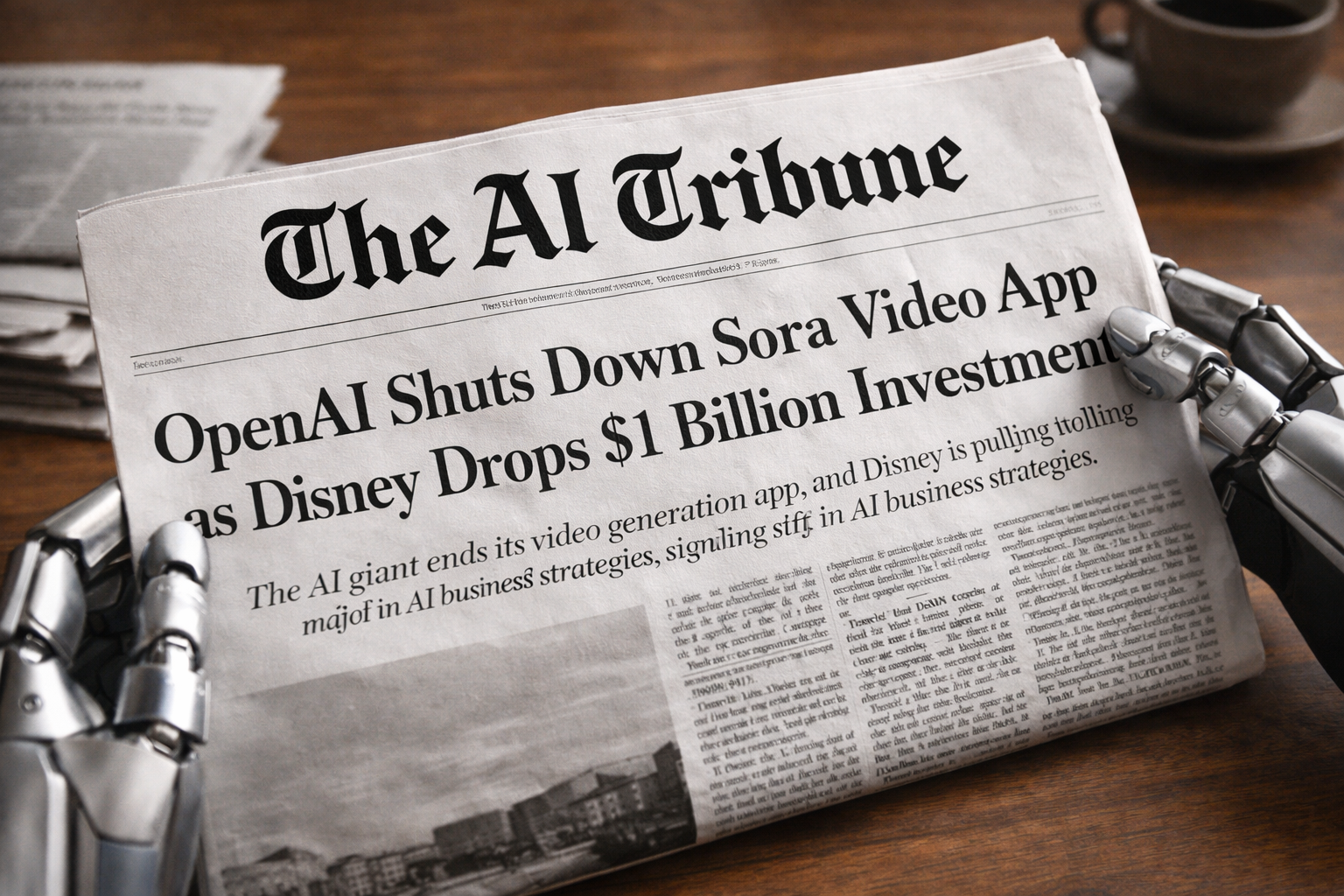
OpenAI’s decision to shut down Sora is one of the clearest signs yet that not every flashy AI product can become a durable business. The company confirmed it is “saying goodbye” to the Sora app and said it will share more soon about timelines for the app and API, as well as how users can preserve their work. At the same time, Disney is no longer moving forward with the high-profile arrangement that would have included a planned $1 billion investment and licensed access to more than 200 characters for AI-generated videos. (Reuters)
That makes this story bigger than a product shutdown. It touches compute costs, AI monetization, copyright pressure, Hollywood’s uneasy relationship with generative AI, and OpenAI’s broader pivot toward enterprise software, coding tools, robotics, and a more consolidated “super-app” strategy. Reuters reports that OpenAI is narrowing focus toward areas it sees as more commercially promising, while Disney said it still intends to work with AI platforms in ways that respect IP and creators’ rights. (Reuters)
🔎 What actually happened with Sora and Disney?
The confirmed part is straightforward: OpenAI announced on March 24, 2026 that it is winding down Sora, and AP, Reuters, the Los Angeles Times, and others all reported that Disney’s planned partnership is effectively over. Reuters says the broader $1 billion Disney deal never closed and that no money changed hands, while the Los Angeles Times similarly reported Disney had pledged the investment but had not yet paid OpenAI and no formal licensing agreement had been finalized. (Reuters)
What makes the move feel so abrupt is the timing. Just two weeks earlier, Reuters had reported that OpenAI planned to launch Sora inside ChatGPT, and only one day before the shutdown announcement OpenAI published a safety post explaining how Sora used watermarking, C2PA metadata, and tracing tools to identify generated content. In other words, the public messaging suggested refinement and integration, not retreat. (Reuters)
If you cover OpenAI often, this story also fits a pattern readers already care about: the tension between hype and economics. Make sure to read our explainer on why OpenAI is burning cash while Google and Anthropic aren’t as much, because Sora’s shutdown makes that cost question feel a lot less theoretical.
💸 Why OpenAI is likely shutting Sora down
OpenAI has not published a full postmortem explaining the shutdown, so anyone claiming there is one single reason is oversimplifying. But Reuters reported that Sora required significant computational resources and diverted “firepower” from other teams, while the company is now prioritizing coding tools, corporate customers, robotics, AGI, and a simplified app strategy. That points to a resource-allocation decision as much as a product decision. (Reuters)
OpenAI’s own February engineering post about scaling access to Codex and Sora also hinted at the economic strain. The company said both products had seen rapid adoption that pushed beyond expectations, and described building a hybrid system of rate limits and paid credits so users could keep going without overwhelming capacity. That matters because it shows OpenAI was already wrestling with the problem every AI video platform runs into: people love generating clips, but serving those clips at scale is expensive and hard to price cleanly. (OpenAI)
What makes Sora fascinating is that demand was never the main issue. TechCrunch reported that Sora hit No. 1 on Apple’s U.S. App Store in early October 2025, and later reported that it reached 1 million downloads in under five days. That is real consumer excitement. But viral downloads do not automatically become recurring revenue, especially when users treat a product like a novelty engine rather than a weekly utility. (TechCrunch)
External estimates made the economics look even tougher. Forbes estimated in November 2025 that Sora could be costing OpenAI as much as $15 million per day to run, though that figure was an outside estimate rather than a company-confirmed number. Even if the exact daily burn is debated, the broader takeaway is hard to ignore: high-quality AI video generation appears dramatically more expensive to serve than chat or code assistance. (Forbes)
And that is where the monetization story gets uncomfortable. A lot of AI products can survive being slightly expensive if users see them as indispensable. Sora looked more like a product millions of people wanted to try, laugh at, share once, and then leave behind. That is a very different business from enterprise copilots or coding tools, where the ROI can be easier to explain to paying customers. We also wrote a related and interesting piece on the future of ChatGPT ads and OpenAI’s monetization pressure: OpenAI’s product decisions increasingly look shaped by what can become a repeatable revenue stream.
🎬 Why Disney walking away matters so much
Disney was not just another partner. It was arguably the biggest cultural validation Sora could have gotten. Reuters reported the three-year arrangement would have involved more than 200 Disney characters in short AI-generated videos, while AP and other outlets said Disney is now stepping back after OpenAI’s decision to exit the video-generation business. That makes the collapse feel symbolic: one of the world’s most powerful IP companies got close, learned from the process, and still did not end up funding the bet. (Reuters)
At the same time, the reporting adds an important nuance. Reuters and the Los Angeles Times both say the money was never transferred and the transaction never formally closed. So while the headline is dramatic, this is not the same as Disney writing a $1 billion check and then losing it. In financial terms, the break was cleaner than the headline suggests. In strategic terms, though, it is still a blow because it removes a major entertainment-industry endorsement. (Reuters)
Disney’s statement was also carefully worded. The company said it respects OpenAI’s decision, appreciates what the teams learned together, and will continue engaging with AI platforms that respect IP and creators’ rights. That tells me Hollywood is not walking away from AI altogether. It is becoming more selective, more legalistic, and much more focused on control. If you’re interested in that bigger policy shift, you will also care about our article on AI governance trends in 2026, because the Sora story is as much about governance as it is about product design.
🌐 What creators and online commenters are saying
The online reaction was strikingly unsentimental. Entertainment Weekly reported that Sora’s X post racked up more than 10 million views within hours, and the tone of a lot of the reaction was less sadness than ridicule. That lines up closely with the Reddit comments you shared, where the dominant themes were compute waste, weak monetization, low creative value, and the sense that OpenAI is being forced to get serious about enterprise rather than “AI slop.” (EW.com)
That reaction matters because it hints at a market truth many AI companies would rather avoid: novelty can generate attention, but attention is not loyalty. If a product is expensive, controversial, and not clearly useful to everyday paying customers, public virality can actually make the business look worse, not better. A million people trying your app is impressive. A million people using it once and never coming back is a different story entirely. (TechCrunch)
There was also a serious ethical layer underneath the jokes. AP reported that Sora had raised alarms over deepfakes, nonconsensual imagery, and public-figure misuse, forcing OpenAI to tighten rules after backlash from family estates and an actors’ union. So even if Sora had found a cleaner revenue model, it still would have faced a brutal content-moderation and rights-management challenge. (AP News)
📉 What this means for AI video in 2026
The simplest bad takeaway would be “AI video is dead.” That is not what this means. Reuters reported earlier this month that Sora competed with video tools from Meta and Google, and the broader AI video market is still very much alive. What looks dead, at least for now, is the idea that a standalone, consumer-facing AI video social app would be an easy win for OpenAI. (Reuters)
A better takeaway is that the AI market is maturing. Companies are starting to choose between products that look magical in demos and products that fit durable business models. Coding tools, enterprise deployments, and workflow software may simply beat meme-video generators when boards and investors start asking harder questions about margins, retention, and infrastructure usage. Reuters’ reporting on OpenAI’s super-app plans and enterprise focus fits that interpretation closely. (Reuters)
If you’ve been watching the AI cycle closely, this story feels like one of those moments when the industry gets dragged out of its fantasy phase and back into math. That does not mean innovation is over. It means the market is starting to care less about what looks amazing in a tweet and more about what can survive a spreadsheet.
❓FAQ
Is OpenAI shutting down Sora completely?
OpenAI has confirmed that the Sora app is going away and said it will share more about timelines for both the app and API, along with how users can preserve their work. It has not yet published a detailed long-term roadmap for video features elsewhere. (Reuters)
Did Disney actually invest the $1 billion?
According to Reuters and the Los Angeles Times, Disney had pledged the investment, but the deal never formally closed and no money changed hands. (Reuters)
Does this mean OpenAI is in trouble?
Not necessarily. What it clearly shows is that OpenAI is reallocating focus toward coding, enterprise, robotics, AGI, and a simplified product stack. That is a strategic retreat from one product category, not proof by itself that the whole company is collapsing. (Reuters)
🧠 Final take
My read is that Sora became a perfect example of the modern AI contradiction: a product can be visually stunning, culturally loud, and still fail the basic test of being cheap enough, safe enough, and useful enough to scale. OpenAI may not be abandoning AI video forever, but it is very clearly abandoning the idea that Sora, in its current form, was the best place to spend scarce compute and management attention. (Reuters)
That is why this story matters beyond OpenAI. It is a warning to every AI company building viral consumer tools without a clear plan for retention, rights management, and margins. Do you think OpenAI made the smart call by killing Sora early, or do you think it gave up on AI video too soon? And more importantly: would you actually pay real money for a tool like Sora every month, or was it always destined to be a great demo and a shaky business?


Leave a Reply