
If you’ve ever asked ChatGPT a question, generated an image, used an AI coding tool, or played with a voice assistant, you probably pictured electricity being used somewhere in the background.
But water? That sounds weird at first.
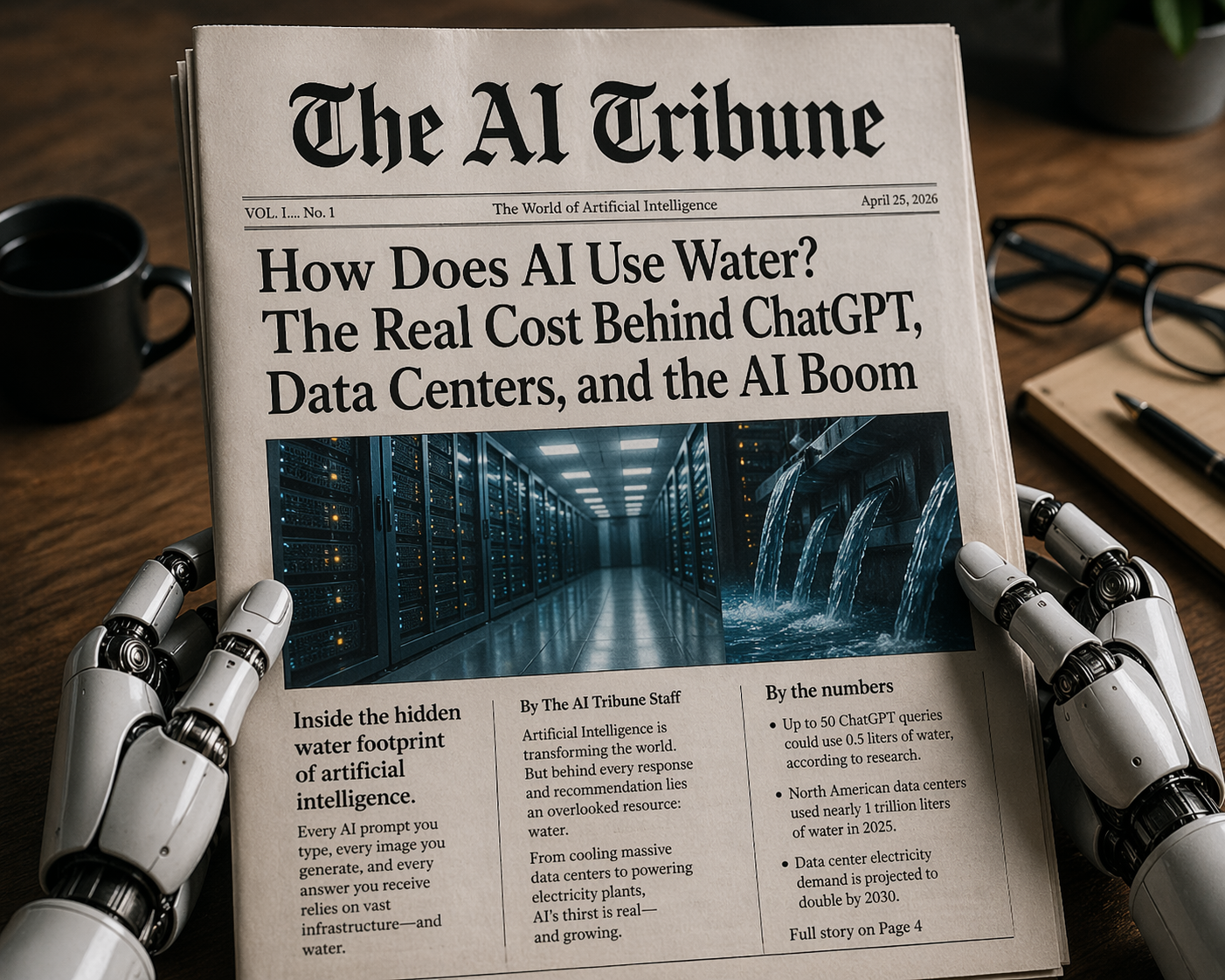
So, how does AI use water? The simple answer is this: AI runs on powerful servers, those servers get hot, and many data centers use water to cool them down. AI also uses electricity, and electricity generation can require even more water depending on the power source. That means AI’s water footprint is not just about one chatbot reply. It is about the full chain: chips, servers, cooling systems, power plants, data center locations, and how often billions of people use AI tools.
And this is where the conversation gets complicated. Some people online say a few AI prompts use a whole bottle of water. Others say newer AI models use only a few drops per prompt. Both sides are usually missing context.
The truth is more interesting, more useful, and honestly, more important.
🌊 How Does AI Use Water? The Simple Explanation
AI uses water mainly in two ways: directly and indirectly.
Direct water use happens inside or around data centers. These are huge buildings full of servers that run AI models. Servers create heat, and if they get too hot, they slow down, fail, or become dangerous to operate. To prevent that, data centers use cooling systems. Some cooling systems use air. Some use liquid. Some use evaporative cooling, where water helps absorb heat and is partly lost as vapor.
Indirect water use comes from electricity. AI models need huge amounts of power. If that electricity comes from power plants that use water for cooling or steam generation, then AI’s real water footprint extends beyond the data center itself. UC Riverside researchers explain that AI-related water consumption includes water used by on-site cooling and water used by electricity generation, which is why the number changes heavily depending on where the AI system runs. (UCR News)
A useful way to think about it is this: AI does not “drink” water like a person. It uses water as part of the industrial system that keeps computation running.
That distinction matters. A single prompt may seem tiny. But AI is not being used once. It is being used across search, coding, customer support, image generation, schoolwork, legal research, medical documentation, marketing, cybersecurity, and business automation. Once you multiply a small water cost by billions of prompts, the discussion becomes serious.
That is why AI water use connects directly to the broader data center boom. If you want the deeper infrastructure angle, AI Tribune’s separate breakdown on AI data center water usage in 2026 is a natural next read because the water issue is really a data center issue before it is a chatbot issue.
🧊 Why Do AI Data Centers Need So Much Cooling?
AI servers are not normal office computers. Training and running large AI models requires powerful chips, especially GPUs and specialized accelerators. These chips can run extremely hot because they process huge amounts of data at high speed.
There are two big AI workloads to understand:
Training is when a model is built or improved. This can involve massive datasets, thousands of chips, and long compute runs. Training frontier models is usually the most resource-intensive phase.
Inference is when you use the model. Every time you ask a chatbot a question, generate an image, summarize a PDF, or ask an AI agent to complete a task, that is inference.
For years, people focused mostly on training because it was obviously huge. But as AI becomes a daily tool, inference may become the bigger long-term issue simply because it happens constantly. The International Energy Agency says global data center electricity consumption was about 415 TWh in 2024, around 1.5% of global electricity consumption, and its base case projects that data center electricity use will rise to about 945 TWh by 2030. (IEA)
That matters for water because more electricity demand can mean more indirect water use. More heat also means more cooling demand.
This is where public debate often gets messy. A company might say, “Our AI prompt uses very little direct water.” But critics may respond, “You are not counting the indirect water used to generate the electricity.” That is exactly the criticism experts made after Google estimated that a median Gemini text prompt used about 0.26 milliliters of water. Experts told The Verge that the estimate may be incomplete because it leaves out indirect water use tied to electricity generation. (The Verge)
So the best answer is not “AI uses a bottle of water every time” or “AI uses basically nothing.”
The better answer is: AI water use depends on the model, prompt size, data center cooling system, local climate, electricity mix, and whether you count direct water only or the full water footprint.
📊 How Much Water Does AI Actually Use?
This is the part everyone wants, but it is also the part where you have to be careful.
One widely cited UC Riverside estimate found that 20 to 50 ChatGPT queries could consume roughly half a liter of fresh water, depending on the location and timing of the queries. The same research estimated that training GPT-3 in Microsoft’s U.S. data centers could directly evaporate around 700,000 liters of clean freshwater. (UCR News)
But that does not mean every modern AI query today uses the same amount. Models are becoming more efficient. Chips are improving. Data centers are changing cooling systems. Companies are also reporting lower per-prompt figures, although outside researchers often argue that these company figures do not always include the full footprint.
A more honest way to present the numbers is this:
Per prompt: Could be tiny for a short text prompt on an efficient model, but higher for long prompts, heavy reasoning, image/video generation, or AI agents running many steps in the background.
Per model training run: Can reach hundreds of thousands or millions of liters, depending on model size, hardware, data center cooling, and power mix.
At data center scale: The numbers become massive. Reuters reported in April 2026 that North American data centers used nearly 1 trillion liters of water in 2025, according to market research firm Mordor Intelligence. Reuters also reported that Meta’s water usage for owned sites rose from 3,726 megaliters in 2020 to 5,637 megaliters in 2024, enough to supply more than 13,000 homes for a year. (Reuters)
This is why the public debate has shifted from “How much water does one ChatGPT question use?” to “Where are AI data centers being built, how transparent are companies, and who is affected locally?”
Because a data center in a water-rich region is one story. A data center in a drought-stressed region is another story completely.
⚡ The Hidden Water Cost: Electricity
The sneaky part of AI water use is that it is not only about cooling the servers.
Electricity production can use water too. Power plants may use water to create steam, cool equipment, or support energy generation. That means a data center can reduce its on-site water use while still contributing to water use somewhere else through the power grid.
This is why the AI water conversation overlaps heavily with the AI energy conversation. In 2026, the IEA said electricity demand from data centers rose 17% in 2025, while AI-focused data centers grew even faster. It also said data center electricity consumption is set to double by 2030, while power use from AI-focused data centers could triple. (IEA)
That is a big deal because companies are racing to build more AI infrastructure. More AI agents, more video generation, more enterprise automation, and more real-time AI tools all increase compute demand.
This also connects to the business side of AI. When companies adopt AI at scale, they are not just choosing software. They are indirectly choosing infrastructure. That is why readers interested in AI’s industrial side should also look at how industrial AI differs from traditional AI. Industrial AI often runs in factories, energy systems, logistics networks, and physical operations where efficiency, uptime, and resource use matter in a very real-world way.
Here is the uncomfortable truth: even if each AI task becomes more efficient, total water and energy use can still rise if AI usage grows faster than efficiency improves. This is sometimes called the rebound effect, or Jevons paradox. Basically, when something becomes cheaper and easier to use, people use more of it.
That is already happening with AI. A few years ago, most people used AI occasionally. Now, companies want AI inside search, email, spreadsheets, customer service, coding, design, HR, education, healthcare, and security workflows.
One small prompt is not the issue. Billions of prompts plus huge data centers are the issue.
🏭 Why Location Matters More Than People Realize
Not all AI water use is equal.
A data center using water in a region with strong water supplies is different from a data center using water in a dry region already dealing with shortages. This is why local communities, investors, and regulators are paying more attention.
Reuters reported that investors have pushed Amazon, Microsoft, and Google for more detail on water usage and conservation as data centers expand. The same report noted that shareholders want more site-level data because local water risk can affect communities and long-term business operations. (Reuters)
This is one of the biggest missing pieces in AI transparency.
A company might publish a global sustainability report and say it is improving efficiency. That is helpful, but it does not always tell a local community what it needs to know. People living near a planned data center want specific answers:
How much water will this facility use?
Will it use drinking water, reclaimed water, or closed-loop cooling?
Will it compete with farms, homes, or local businesses?
What happens during drought?
Will the company publish site-level water data?
Will water be replenished in the same watershed or somewhere else?
These questions matter because water is local. Carbon emissions are global, but water stress is felt town by town, river by river, aquifer by aquifer.
This is why Google says that 86% of freshwater withdrawals across its data center fleet came from sources at low or medium risk of water depletion or scarcity, and that it supports watershed replenishment projects. (Google Data Centers) Microsoft also says it is working toward becoming water positive by 2030 and highlights direct-to-chip cooling as one innovation that can save over 125 million liters of water per facility each year. (Microsoft)
Those efforts are important. But the public still needs better standardized reporting. Otherwise, readers are stuck comparing company claims, academic estimates, activist concerns, and local news reports that may not measure the same thing.
✅ Can AI Reduce Its Water Use?
Yes, AI can reduce its water footprint. The industry already has several options.
Use closed-loop cooling.
Closed-loop systems can reduce the need for constant water withdrawal because the cooling liquid is reused rather than continually evaporated.
Use direct-to-chip liquid cooling.
This cools the hottest components more efficiently and can reduce reliance on traditional cooling methods. Microsoft has specifically highlighted direct-to-chip cooling as a major water-saving approach. (Microsoft)
Build data centers in better locations.
AI infrastructure should be planned around water availability, electricity supply, climate, and local community impact. A location that looks cheap on land price may be expensive environmentally.
Use reclaimed or non-potable water.
Some data centers can use recycled wastewater instead of drinking-quality water. That does not make the footprint disappear, but it can reduce pressure on local drinking water supplies.
Make models more efficient.
Smaller models, better chips, quantization, caching, and smarter routing can reduce compute per task. Not every question needs the largest model available.
Be honest about when AI is unnecessary.
This one sounds simple, but it matters. Using AI to summarize a 60-page report may be worth it. Using a large model to answer something you already know may not be. AI should be useful, not automatic.
This is also where governance comes in. Companies adopting AI should track energy, water, security, bias, and compliance together instead of treating them as separate topics. For example, the same mindset behind using AI to support integrated ISO audits applies here: organizations need systems, documentation, accountability, and measurable controls, not just exciting demos.
🧠 Online Reaction: Why People Are Confused About AI and Water
Online comments about AI water use usually fall into three camps.
The first group says AI is an environmental disaster and every prompt is wasteful.
The second group says the concern is exaggerated because newer models are more efficient and per-prompt water use can be tiny.
The third group says the real issue is not individual guilt, but corporate transparency and infrastructure planning.
The third group is closest to the truth.
Individual users should be thoughtful, but the biggest decisions are made by cloud providers, AI labs, chip companies, utilities, regulators, and enterprise customers. A person asking ChatGPT to help write an email is not the same as a company running millions of AI agent tasks per day without measuring energy or water impact.
That said, users still influence demand. If every app adds AI by default, and every business treats AI as free magic, infrastructure demand will keep rising.
So the practical takeaway is not “never use AI.” It is: use AI where it creates real value, push companies for transparency, and stop pretending digital tools have no physical footprint.
🔍 FAQ: How Does AI Use Water?
How does AI use water in simple terms?
AI uses water mainly through data center cooling and electricity generation. Servers that run AI models get hot, and many facilities use water-based systems to manage that heat.
Does ChatGPT really use a bottle of water?
A widely cited UC Riverside estimate suggested that 20 to 50 ChatGPT queries could use about half a liter of water, depending on where and when the model runs. But newer estimates vary widely, especially when companies count only direct water use and not indirect water tied to electricity. (UCR News)
Is AI worse than normal internet use?
AI can be more resource-intensive than basic web browsing because large models require specialized chips and more computation. However, the exact impact depends on the task. A short text response is very different from generating video, running an AI agent, or training a large model.
Why do data centers use water instead of just fans?
Fans and air cooling are used, but high-density AI servers can produce intense heat. Water and liquid cooling can move heat more efficiently than air, especially in large facilities.
Can AI data centers avoid using drinking water?
Some can use recycled or reclaimed water, closed-loop cooling, or other cooling designs that reduce potable water use. But not every facility does this, and local climate matters.
Should I stop using AI because of water use?
Not necessarily. A better approach is to use AI intentionally. Use it when it saves real time, improves work, or helps solve a meaningful problem. Be more skeptical of pointless AI features added just because they are trendy.
Final Take: AI Is Not “Virtual” Anymore
So, how does AI use water?
It uses water through the physical infrastructure behind the screen: data centers, cooling systems, electricity generation, chip production, and massive server networks. The exact amount depends on many variables, but the trend is clear: as AI adoption grows, water and energy questions will become harder to ignore.
The mistake is treating AI as either pure magic or pure disaster. It is neither.
AI can help doctors, teachers, engineers, climate scientists, small businesses, students, and creators. It can also strain power grids, increase water demand, and create local conflicts if infrastructure expands faster than accountability.
The future of AI should not be judged only by how smart the models become. It should also be judged by how responsibly we build and use them.
What do you think? Are you worried about AI’s water use, or do you think the concern is being exaggerated? Drop your thoughts in the comments — especially if you live near a data center, work in cloud infrastructure, or have seen local debates about water and power use.


Leave a Reply