
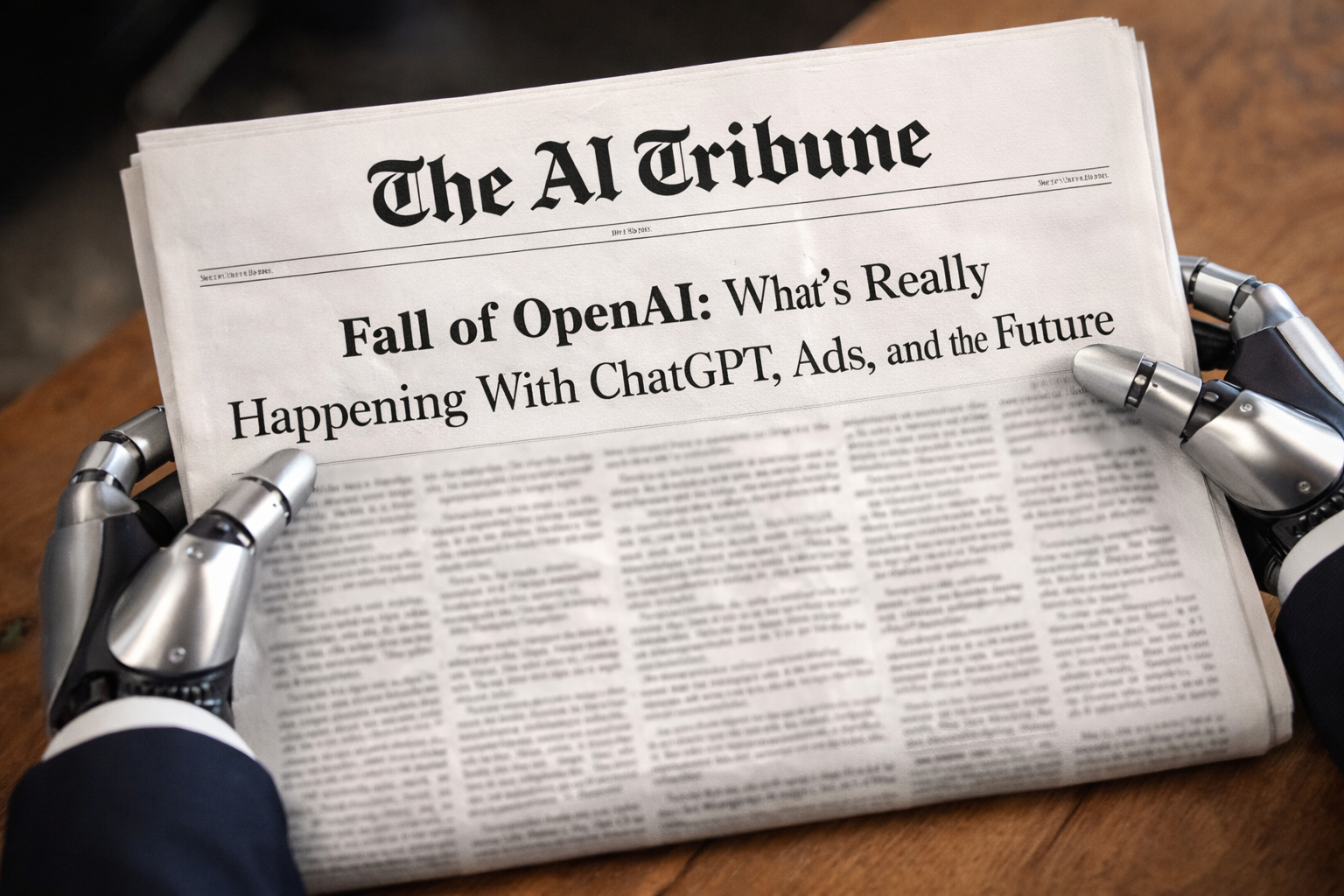
OpenAI used to feel like the “clean” AI company: breakthrough models, a research-lab origin story, and a product (ChatGPT) that people trusted with unusually personal conversations. Now the story is messier—more like a modern tech giant in fast-forward: explosive growth, huge infrastructure bills, internal reshuffles, intensifying competition, lawsuits, and (yes) the start of advertising tests.
But calling it a “collapse” is too simple.
What we’re watching looks more like a company hitting the awkward phase every platform eventually hits: moving from “cool miracle tool” to “global utility,” while trying to pay for it, govern it, and keep public trust intact.
Below is the most grounded, fact-first look at what’s been happening—plus the strongest arguments on both sides about where OpenAI goes next.
The “Fall” narrative: why people feel something changed
If you spend any time in AI communities, you’ll see the same vibe repeated:
- “The product is getting more corporate.”
- “Safety is being deprioritized.”
- “They’re going to monetize attention like everyone else.”
- “Competition is catching up.”
- “The business math doesn’t work.”
Some of this is opinion. Some is verifiable. The tricky part is that both can be true at the same time:
- OpenAI can be financially stressed and still be massively valuable.
- The product can be better for many users while feeling less trustworthy to others.
- Ads can be clearly labeled and still change how people emotionally relate to the tool.
That emotional trust piece matters, because ChatGPT isn’t just “search.” It’s a conversational interface where people often share private context they’d never type into Google.
What’s confirmed: OpenAI is now testing ads in ChatGPT
OpenAI has officially started testing ads inside ChatGPT in the U.S., limited to logged-in adults on the Free and Go tiers, while higher tiers (Plus/Pro/Business/Enterprise/Education) remain ad-free. OpenAI also states ads don’t influence answers, and that conversations remain private from advertisers. (OpenAI)
This is exactly the type of shift that triggers “Facebook arc” comparisons—because once ads exist, the fear is that incentives slowly bend toward more tracking, more persuasion, and more “engagement-first” product decisions.
A former OpenAI researcher, Zoë Hitzig, drew attention for resigning the same day the ad test began and warning that ad models built on highly personal conversation histories could enable manipulation we don’t fully understand yet. (Ars Technica)
The counterpoint (also common, and not crazy): compute is expensive, and someone has to pay—ads are one of the few monetization engines big enough to fund a widely-used consumer AI product at scale.
The bigger story: OpenAI’s cost curve is brutal
Even if ads become meaningful revenue, the core financial issue is bigger:
1) Compute costs are enormous—and rising
Reuters reported OpenAI projected massive cash burn through 2029, driven by the cost of scaling infrastructure and serving AI products at global scale. (Reuters)
2) OpenAI is chasing industrial-scale infrastructure
OpenAI and partners (including Oracle and SoftBank) have publicly tied themselves to a huge data-center buildout effort (often described as “Stargate”), measured in gigawatts and millions of chips—an industrial footprint that looks more like a national infrastructure project than a typical startup. (Reuters)
3) And yet investor confidence remains sky-high
OpenAI reportedly hit a $500B valuation after a major share sale, and Reuters reported $4.3B in revenue in the first half of 2025, already surpassing 2024’s total. (Reuters)
So the “is OpenAI failing?” debate exists in a weird reality where:
- The costs are scary
- The valuation is gigantic
- The product still leads mindshare
- And rivals are gaining fast
All at once.
Competition is no longer theoretical: Gemini’s user scale is massive
Google’s Gemini has reportedly surpassed 750M monthly active users, based on Google’s earnings disclosures (as reported by TechCrunch). (TechCrunch)
That matters because Google has two unfair advantages:
- Distribution (Android, Search, YouTube, Workspace)
- Monetization infrastructure (ads + cloud + enterprise)
OpenAI, meanwhile, has been building distribution partnerships and enterprise products—but it doesn’t own the same “default surface area” of the internet that Google does.
This is one reason the conversation keeps circling back to: Does OpenAI become a consumer app… or an infrastructure layer… or both?
Another question comes to mind, why OpenAI is burning cash while Google and Anthropic aren’t?
Governance + safety: turbulence didn’t start with ads
To understand why people are sensitive to any “trust shift,” you have to rewind:
The boardroom shock of 2023
OpenAI’s leadership crisis in November 2023 (Altman removed, then reinstated days later) was an early sign that OpenAI’s governance model—nonprofit oversight of a for-profit engine—was inherently unstable under massive pressure. (ABC News)
Safety org changes in 2024
In 2024, OpenAI disbanded its Superalignment team after high-profile departures, and former safety leader Jan Leike publicly criticized OpenAI for letting safety take “a backseat” to product pressures. (AP News)
And the reshuffling continues
As recently as February 2026, TechCrunch reported OpenAI disbanded a “mission alignment” team formed in 2024 (members reassigned). That doesn’t automatically mean “safety is dead,” but it does reinforce the perception of constant internal re-org around mission vs. product delivery. (TechCrunch)
Important nuance: reorganizations aren’t proof of wrongdoing. But in trust-heavy products, perception becomes reality. If users feel incentives are shifting, they share less—and the product changes socially, not just technically.
Lawsuits and legitimacy: Musk’s case is a real pressure point
One of the biggest “overhangs” is legal.
Reuters reported Elon Musk is seeking up to $134B from OpenAI and Microsoft, alleging they benefited from “wrongful gains” tied to OpenAI’s shift away from its original nonprofit mission; the case is headed to a jury trial. (Reuters)
Regardless of what you think of Musk, this trial forces uncomfortable questions into public view:
- Who actually controls OpenAI?
- What does “benefit all of humanity” mean in practice?
- Can a mission-driven structure survive at trillion-dollar scale?
Even if OpenAI wins, the process itself can be reputationally costly.
What people are saying online: the debate is polarized (but revealing)
In Reddit threads driving a lot of the “Fall of OpenAI” narrative, you see two camps:
Camp A: “This is enshittification”
They argue ads + massive compute bills + governance drama + safety team changes are the classic cycle:
beloved product → scale → monetize → trust declines.
Camp B: “This is just a company growing up”
They argue:
- ads are limited and labeled,
- premium tiers remain ad-free,
- costs require monetization,
- and OpenAI still has enormous revenue/valuation momentum.
If you want the honest takeaway: both camps are reacting to real signals—they’re just weighting them differently.
The 3 most plausible futures for OpenAI (without the doom)
Here’s the cleanest way to think about “what comes next” without getting dramatic:
1) OpenAI stays #1 by becoming a workflow platform
Not just “chat,” but agents, automation, enterprise deployment, integrations—turning ChatGPT into the operating layer for knowledge work.
What to watch: enterprise adoption, reliability, pricing stability, and whether “agents” become normal for businesses in 2026.
2) OpenAI becomes the “Intel Inside” of AI
Even if consumers drift to Gemini/Apple/Meta experiences, OpenAI could win as an underlying model provider across products and industries.
What to watch: cloud diversification, infrastructure partnerships, and model licensing footprint.
3) OpenAI loses consumer leadership—but remains huge
This is the “BlackBerry-to-enterprise” scenario: still valuable, still used, but not the default cultural product.
What to watch: monthly/weekly active usage trends, creator/dev mindshare, and whether the “ChatGPT = AI” verb fades.
The trust question nobody can dodge
Ads are only one piece. The deeper question is:
Can a conversational AI remain a “trusted thinking partner” while also becoming an ad-supported platform?
OpenAI’s official stance is: ads are separate, clearly labeled, and don’t affect answers. (OpenAI)
Skeptics respond: incentives have a way of expanding quietly over time—especially once a revenue line exists.
Both arguments are reasonable. The future depends on implementation details, transparency, and whether users feel respected.
FAQ
Is OpenAI actually “failing”?
Not by the usual signals: OpenAI has reported huge valuation growth and meaningful revenue. (Reuters)
But it faces unusually high costs and intense competition, and the public trust equation is fragile. (Reuters)
Will ChatGPT have ads for everyone?
Right now, OpenAI says ads are being tested for Free and Go tiers in the U.S., while higher tiers remain ad-free. (OpenAI)
Is Google catching up?
Gemini’s user scale is now undeniably massive by reported MAUs. (TechCrunch)
Whether that translates into “best product” depends on use case (workflows, coding, creativity, enterprise, etc.).
A grounded conclusion
So is this the “Fall of OpenAI”?
If “fall” means OpenAI disappears—the evidence doesn’t support that. The company is valued like a titan, is building infrastructure like a nation-state project, and still sits at the center of the AI conversation. (Reuters)
If “fall” means the end of the early-trust era—that’s a more serious, more plausible shift. Ads, legal battles, safety debates, and corporate incentives can change how people emotionally relate to the product, even if the model keeps improving. (OpenAI)
Now I want your take—because this is where the story is still being written:
Do you think OpenAI can add ads (and scale monetization) without becoming another “attention machine”?
Or is this the moment where AI chatbots split into two worlds: paid “trusted tools” and free “sponsored assistants”?
Drop your opinion in the comments—especially if you’ve noticed changes in how you use ChatGPT over the last year.


Leave a Reply