
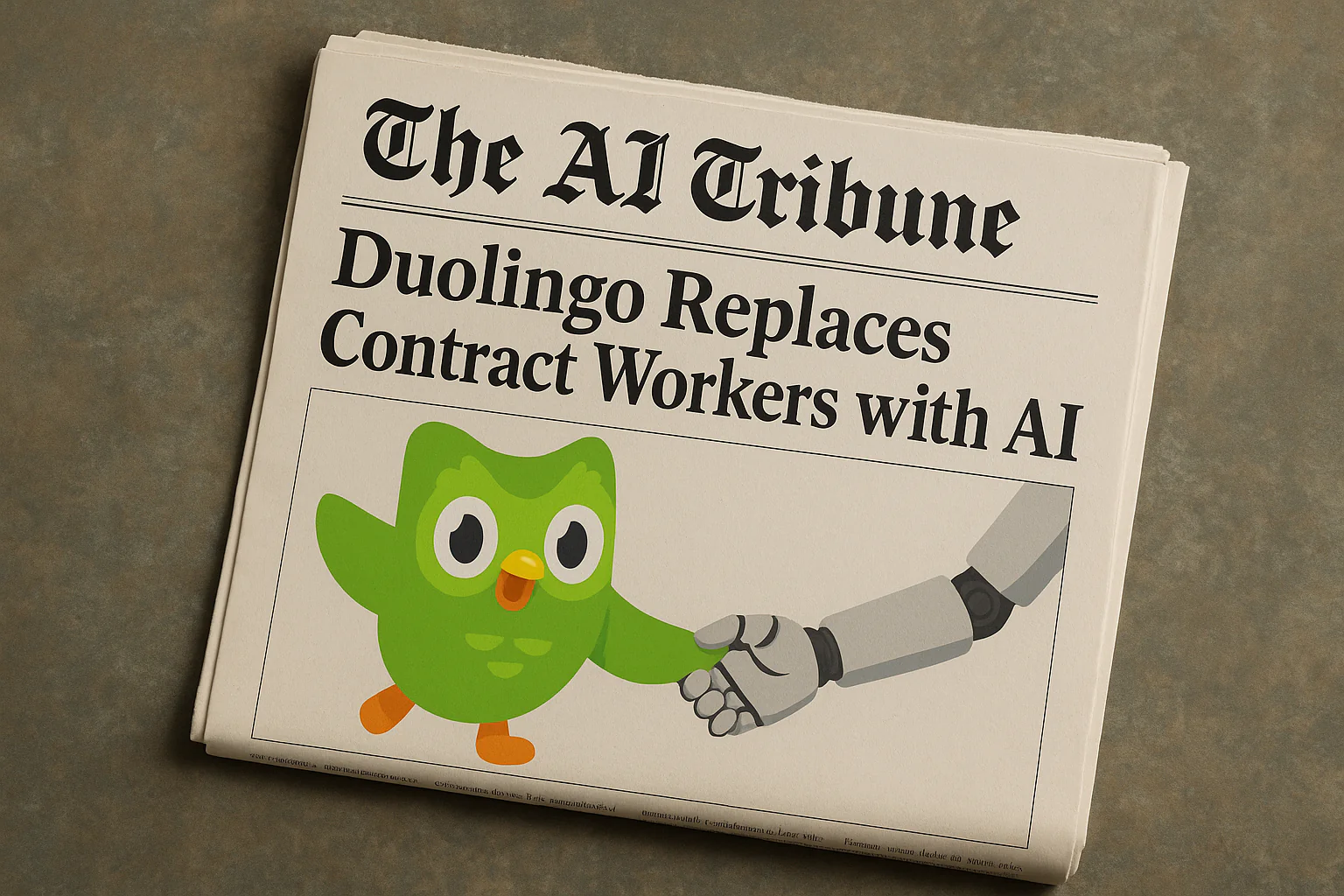
On April 29, 2025, Duolingo, a leading language learning platform founded in 2011 by Luis von Ahn and Severin Hacker, made headlines with a significant announcement. The company declared it would transition to an “AI-first” strategy, replacing contract workers with artificial intelligence for tasks such as content creation, sentence generation, and translation reviews. This move, detailed in an email from CEO von Ahn and shared on the company’s LinkedIn page, underscores the growing reliance on AI in the tech industry and raises important questions about employment, efficiency, and quality in language education.
Historical Context and Background
Duolingo has long integrated AI into its operations to enhance user experience. Since introducing chatbots in 2016 and later incorporating OpenAI’s ChatGPT-4, the app has used AI for personalized learning paths, instant feedback, and content generation. With over 40 languages offered and millions of users worldwide, Duolingo’s gamified approach has made language learning accessible. However, the latest announcement marks a deeper shift, aiming to leverage AI not just as a tool but as the foundation of its operations.
This strategy builds on actions taken in 2024, when Duolingo laid off 10% of its contractors, attributing the decision partly to AI. A spokesperson told Bloomberg at the time that the company no longer needed as many people for certain tasks, highlighting AI’s role in reducing workforce needs. This progression from incremental AI use to a full “AI-first” approach reflects broader industry trends toward automation.
Details of the April 29, 2025, Announcement
In his email, von Ahn outlined several key aspects of Duolingo’s new direction:
Von Ahn clarified that this shift is not about replacing humans entirely but about enhancing efficiency. “AI isn’t just a productivity boost,” he wrote. “It helps us get closer to our mission. To teach well, we need to create a massive amount of content, and doing that manually doesn’t scale.” This approach aims to balance technological innovation with human expertise, though the exact number of affected contractor jobs remains unclear.
Public and Expert Reactions
The announcement has elicited a range of responses, particularly on social media platforms like Reddit. A thread on r/artificial, dated around the announcement, captured diverse opinions. User zaemis noted, “Duolingo has lost favor in language learning communities over treatment of course creators, volunteers, and forum handling,” suggesting a history of employee relations issues. Another user, ShadowbanRevival, argued, “LLMs with v2v and specific prompting are better language tutors than Duolingo ever was,” indicating support for AI’s potential in education.
However, concerns about job losses were prevalent. Benjamin Costello, a former contract worker, told The Washington Post that he was surprised by the layoffs, as the company had initially assured workers they wouldn’t be replaced by AI. This sentiment was echoed by Reddit user BflatminorOp23, who commented, “They don’t care about creative work; would increase salaries if they did,” highlighting perceived priorities.
Language experts also weighed in. A professional translator on Slashdot, translating Latin, German, and Dutch to English, noted, “AI translations are educated guesses that are normally within an acceptable range of accuracy,” suggesting AI’s limitations in nuanced contexts. These reactions reflect a broader debate about AI’s role in replacing human labor versus augmenting it.
Industry Context and Comparative Analysis
Duolingo’s move aligns with a growing trend in the tech sector. According to a November 2023 report by ResumeBuilder, 37% of companies surveyed had already replaced workers with AI in 2023, with 44% expecting to do so in 2024. This trend is not isolated; companies like Shopify have made similar announcements, with CEO Tobi Lütke emphasizing AI’s role in future operations. A study by Carnegie Mellon University, cited in Tech.co, found that a hypothetical company staffed entirely with AI agents would have only a 24% success rate, underscoring AI’s limitations in complex scenarios.
The implications extend beyond Duolingo. As AI adoption accelerates, industries are grappling with questions about employment, skill demands, and ethical considerations. Duolingo’s experience may serve as a case study for how companies balance innovation with workforce impact.
Potential Benefits and Drawbacks
The shift to AI offers several potential benefits for Duolingo:
However, there are significant drawbacks:
The Role of Humans in an AI-Driven Future
Despite the focus on AI, Duolingo emphasizes that humans will remain integral. The company plans to redirect its workforce toward tasks requiring creativity, empathy, and problem-solving—areas where AI currently falls short. This approach aligns with AI ethics advocating for augmentation rather than replacement. Von Ahn’s email assured employees, “This isn’t about replacing Duos with AI. It’s about removing bottlenecks so we can do more with the outstanding Duos we already have.”
However, the use of AI in hiring and performance reviews, as mentioned, could raise concerns about fairness and transparency. As AI continues to evolve, companies must ensure that human workers are supported through training and mentorship, as Duolingo plans, to adapt to this new landscape.
Detailed Table of Key Developments in Duolingo’s Relationship with AI
| Date | Development |
| 2016 | Introduced chatbots for user interaction |
| Early 2023 | Incorporated OpenAI’s ChatGPT-4 |
| Jan 2024 | Laid off 10% of contractors due to AI |
| Apr 29, 2025 | Announced “AI-first” strategy, replacing contractors |
Future Outlook
Duolingo’s decision to replace contract workers with AI is a pivotal moment in the intersection of technology and employment. While it promises greater efficiency and scalability, it also raises concerns about job losses, quality, and user experience. As the company navigates this transition, it will be crucial to monitor how this shift affects its educational offerings and workforce well-being.
The broader tech industry will likely watch closely, as Duolingo’s experience could inform how other companies integrate AI while maintaining a human-centric approach. The future of work, it seems, will increasingly involve a delicate balance between leveraging AI’s capabilities and preserving the value of human expertise.


Leave a Reply