
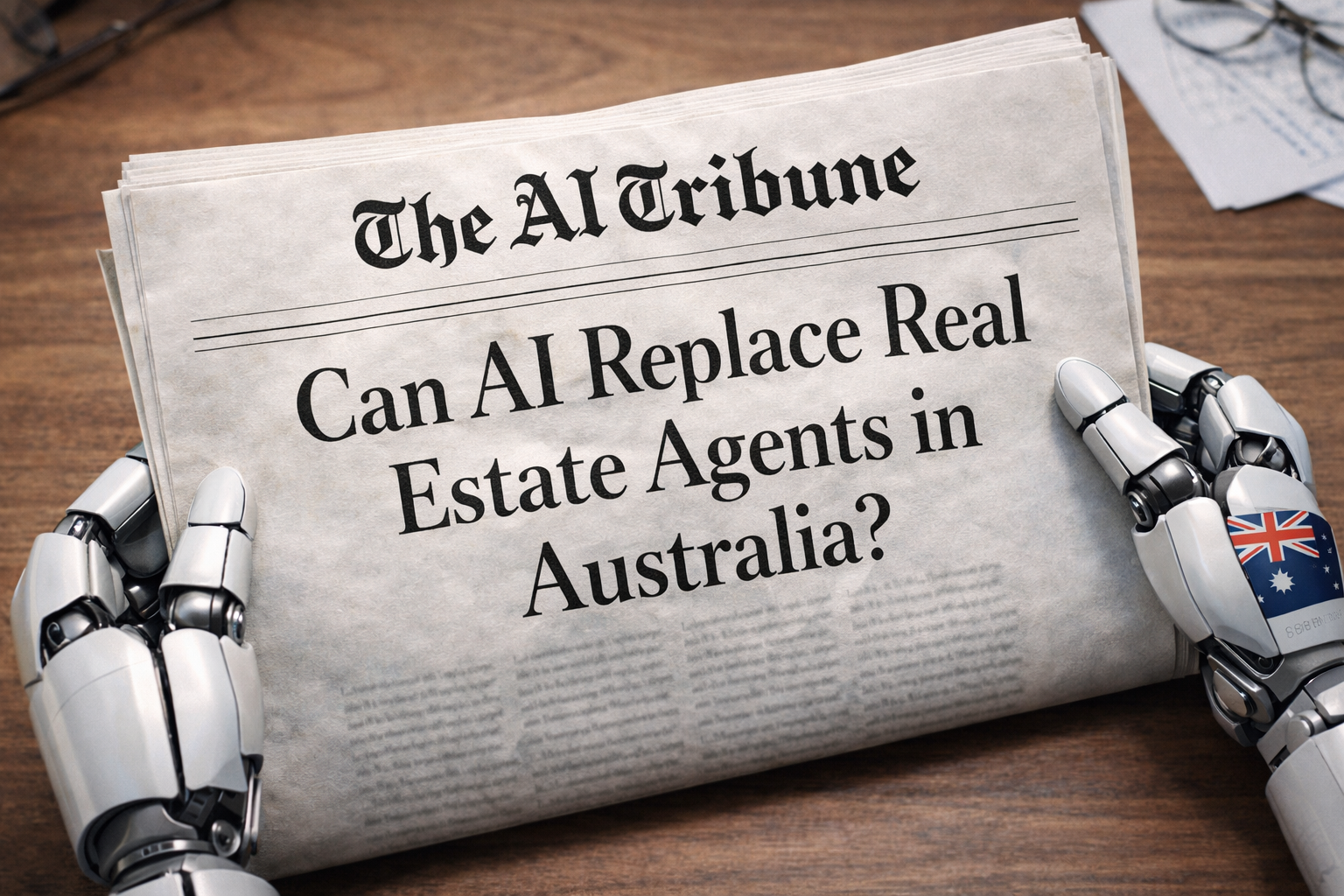
If you’ve ever filled out an enquiry form at 11:47pm and got a reply in under a minute, you’ve probably already “met” AI in Australian real estate—without being told.
And the question is only getting louder as portals and agencies deploy more automation. For example, realestate.com.au has highlighted over 2.4 billion image interactions per month and cited a month where 12 million Australians visited the site, while rolling out “AI-led” listing features. (realestate.com.au)
Meanwhile, Australia’s property ecosystem is huge and human-heavy: the Real Estate Institute of Australia (REIA) says there are 46,793 agency businesses, 99% small businesses, employing 130,000 Australians. (reia.com.au)
So… where does AI fit?
Below is an objective, evidence-based breakdown (plus practical takeaways), with two required sections addressing your exact keywords.
Quick reality check: AI is already “in the workflow,” not “the licence”
A helpful way to think about AI in property is task replacement, not job replacement.
AI can already:
- respond to leads 24/7
- draft listing descriptions and emails
- summarise inspections and buyer feedback
- flag likely buyer/seller intent
- help price ranges and comps (with guardrails)
- automate property management admin
But the moment you touch licensed conduct (agency representation, trust money controls, regulated responsibilities), Australia’s system expects a legally accountable person (or a company with a responsible licensed human).
That’s the heart of the licensing question.
Can AI be a licensed real estate agent in Australia?
In today’s Australian legal and licensing frameworks: practically, no. Real estate licensing is regulated by states/territories, and licences are issued to individuals and/or companies—with requirements that assume a human decision-maker is accountable for supervision, compliance, and (often) trust money controls.
Here are concrete examples from major jurisdictions:
Victoria: company licence still requires a licensed human in control
Consumer Affairs Victoria states that to be eligible, a company must have “an officer in effective control” who holds a current individual estate agent’s licence in Victoria and is accountable for day-to-day operations. (consumer.vic.gov.au)
Implication: even if a company is licensed, there must be a licensed human in charge. AI can’t be that officer.
Queensland: corporate licence requires an individual licence holder “in charge”
Queensland’s guidance says a company must have someone with an individual property licence in charge of the principal place of business. (qld.gov.au)
Implication: again, AI can assist—but it can’t be “the person in charge.”
New South Wales: corporations need licensed directors + a licensed “licensee in charge”
Service NSW states eligibility includes at least one director with an individual property licence and a nominated licensee in charge who holds a Class 1 licence. (Service NSW)
NSW also explains the Licensee in Charge (LIC) must be an individual with the relevant licence and that a business must not be left unsupervised by an LIC; only an LIC can authorise certain trust account actions. (NSW Government)
Implication: AI cannot legally “supervise” as the accountable licence holder in charge.
So what can AI do legally in Australia real estate?
AI can still be used as a tool under a licensed agent’s supervision—for example:
- draft copy (then a human verifies)
- triage enquiries (then a human handles advice/representation)
- schedule inspections
- summarise vendor reports
- assist with market analysis (then a human sanity-checks)
Practical litmus test: If the output could create legal exposure if wrong (misleading listing claims, misstatements to a buyer, incorrect disclosures, trust account handling), it needs human review and accountability.
Why this matters (a real-world example)
The Guardian reported an Australian listing error where an agency admitted using ChatGPT to write a rental listing that referenced schools that didn’t exist, drawing attention to the risk of unverified AI-generated claims and the need for oversight. (The Guardian)
Can AI completely replace real estate agents in Australia
Short answer: AI can replace chunks of what agents do, but a full replacement across Australia is unlikely in the near term—mainly because of trust, liability, regulation, negotiation, and on-the-ground execution.
Let’s break it down objectively.
1) The market scale rewards automation—but also rewards humans who close
Cotality (formerly CoreLogic/RP Data branding in Australia) estimated 531,457 national sales in FY 2024–25, up 2.7% from the prior year.
They also reported median time on market around 35 days (national) at that point in time.
That’s a lot of transactions, a lot of enquiries, and a lot of admin—perfect for AI acceleration.
But the “last mile” still involves:
- negotiation under pressure
- inspection-day logistics
- managing emotion + conflict
- disclosure and legal risk discipline
- interpreting buyer intent beyond what they say
- stakeholder coordination (vendors, tenants, conveyancers, banks)
AI helps, but it doesn’t own accountability.
2) Consumers still lean human—even as they adopt digital search
A 2025 article summarising LJ Hooker research noted:
- Only 21% of respondents have considered selling online without a salesperson (higher among Gen Z, lower among older cohorts),
- Local expertise mattered most when choosing an agent (62%), with commission (51%) and customer service (47%) also important. (Smart Property Investment)
This doesn’t prove AI can’t replace agents—but it shows consumer preference is still human-first, especially for sellers who see the sale as a once-in-a-decade, high-stakes event.
3) “Speed-to-lead” is where AI can win hard
One of the most measurable advantages: response time.
A well-known lead response study (“Lead Response Management”) found the odds of contacting and qualifying a lead drop sharply as response times increase, with dramatic differences measured between minutes and longer delays.
Real-world translation for Australia: AI chat + voice agents can respond instantly, collect qualifying info, and book an inspection—then hand off to a licensed human. That can increase pipeline efficiency without “replacing the agent.”
4) But “AI-only” introduces legal + reputational risk
Australia’s consumer law doesn’t disappear just because AI wrote the words. A Treasury paper on AI and Australian Consumer Law discusses how AI can mislead consumers and how existing consumer protections apply.
And as seen in the listing gaffe example, even a small hallucination (fake nearby amenities, incorrect features) can create:
- misleading advertising exposure
- trust damage
- extra dispute risk
5) The most realistic future: fewer low-value tasks, higher-value agents
If you zoom out, AI is likely to:
- reduce time spent on repetitive work
- lower the “minimum viable” admin burden to run an agency
- change what consumers expect (instant answers, richer listing data, better search)
But it probably won’t remove the need for:
- licensed supervision
- negotiation and local judgement
- compliance culture
- human accountability when something goes wrong
Remember: REIA describes an industry employing 130,000 Australians across mostly small businesses. Structural job wipeouts usually require not just better tech—but regulatory and consumer behavior shifts on a massive scale. (reia.com.au)
What AI is already doing in Australian real estate (practical examples)
On portals: AI-assisted listing experiences
realestate.com.au has spoken publicly about rolling out listing improvements including “AI-led” features tied to images and property discovery. (realestate.com.au)
In agencies: AI as the first point of contact
Some agencies have announced AI assistants handling early-stage digital interactions (lead triage, FAQs, draft copy). Even when this works well, the safest model is AI → qualified lead → licensed human.
In operations: software with strong user sentiment
To keep this grounded, it’s worth looking at the tools agencies and property managers actually use. For example, PropertyMe (property management software used in Australia/NZ) shows strong public ratings and sentiment on review platforms—suggesting workflow automation is already valuable in day-to-day operations. (help.realestate.com.au)
(That’s not “AI replaces agents,” but it is evidence that software automation is already reshaping the job.)
A practical framework: “Replace tasks, not trust”
If you’re a seller, buyer, investor, or agent, here’s a simple way to judge whether AI can safely replace something:
AI is usually safe for:
- drafting (with human review)
- scheduling
- summarising
- answering general FAQs (“What are the steps to buy?”)
- internal brainstorming of marketing angles
- lead qualification scripts (“Are you pre-approved? timeline?”)
AI is risky without human control for:
- factual claims in advertising (features, distances, schools, inclusions)
- pricing promises (“This will sell for $X”)
- disclosures and compliance statements
- anything involving trust money
- negotiation messages that could be construed as misleading
What would need to change for “AI-only agents” to be real in Australia?
To get to “AI completely replaces real estate agents,” you’d likely need multiple shifts at once:
- Licensing law allowing non-human entities to hold licences (or a new category of licence)
- Clear liability assignment when AI misleads someone
- Consumer acceptance of AI-led negotiation and advice
- Auditable AI systems with reliable grounding in verified data (to prevent hallucinations)
Right now, Australia’s real estate licensing structures in major states point the other direction: licensed humans remain required for supervision and accountability. (consumer.vic.gov.au)
If you’re hiring an agent (or choosing an “AI agent” service), ask these 7 questions
- Who is the licensee in charge (name + licence details)?
- What parts of communication are AI-generated?
- Do you have a human verification step before publishing listings?
- How do you prevent false claims (amenities, schools, features)?
- How is your data handled (privacy + retention)?
- Can a human step in instantly during negotiation or disputes?
- If something goes wrong, who is liable—and is it in writing?
FAQ: AI and real estate agents in Australia
Can an AI legally sign contracts or act as my agent?
AI can generate drafts, but contracts and agency representation typically require legally accountable humans/entities. If you’re unsure, check your state regulator and your conveyancer.
Will commissions fall because of AI?
Possibly downward pressure for basic services, but premium agents may justify fees via negotiation outcomes, marketing reach, and compliance confidence.
Is using AI for listings allowed?
Generally yes, but the output must be accurate and not misleading. The safest approach is “AI drafts, human verifies,” especially for factual claims. (The Guardian)
Your turn
Have you seen an Australian agency using AI chat, voice agents, or AI-written listings—and did it feel helpful or sketchy?
- Would you trust an “AI-first” agency if a licensed human is still in charge?
- What’s the one part of buying/selling you wish AI could remove (paperwork, scheduling, pricing research, negotiation)?
Drop your experience in the comments—especially if you’re an agent, property manager, buyer, or seller navigating this right now.


Leave a Reply