
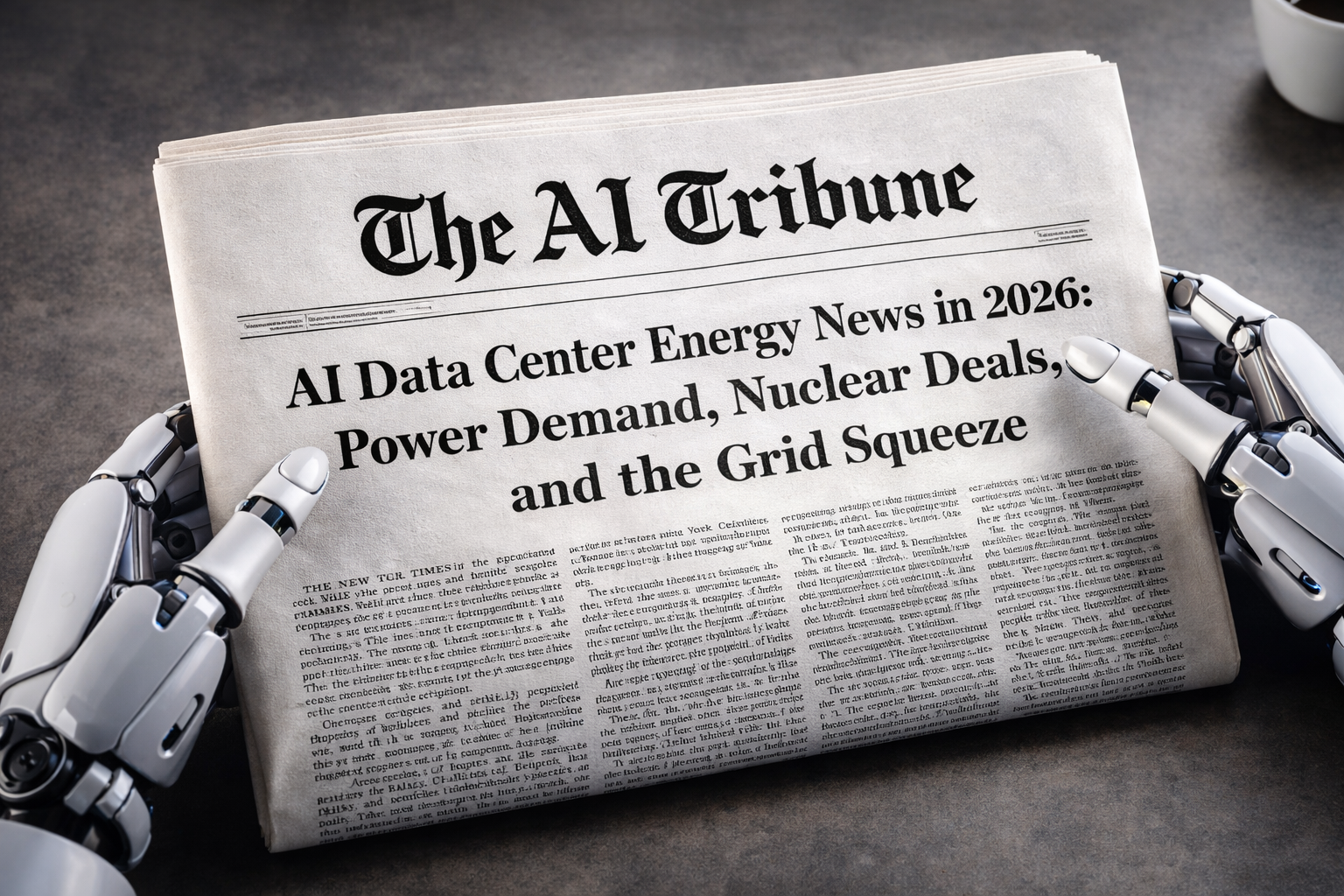
If you want a clean way to explain the AI boom right now, start with electricity. Not model benchmarks. Not chatbot launches. Electricity.
One thing that stood out while reviewing this week’s reporting is how little hard public data still exists on the sector’s actual power use. That is changing: on March 25, 2026, the U.S. Energy Information Administration began pilot data-center energy surveys in Virginia, Texas, and Washington state, a sign that AI infrastructure has become important enough that the government now wants a much clearer picture of what is happening on the grid. At the same time, the International Energy Agency says data centers used about 415 TWh of electricity in 2024 and could reach about 945 TWh by 2030 in its base case. (Reuters)
⚡ Why AI data center energy news suddenly matters so much
This is no longer a niche infrastructure story for utility nerds. The EIA said in January that U.S. electricity demand is now on track for its strongest four-year growth since 2000, driven largely by large computing facilities, including data centers. Its forecast shows U.S. electricity use rising 1% in 2026 and 3% in 2027. (U.S. Energy Information Administration)
Globally, the growth is big, but the geography matters even more. The IEA says the United States and China will account for nearly 80% of global data-center electricity-demand growth to 2030. In its base case, U.S. data-center consumption rises by about 240 TWh from 2024 levels, while China rises by about 175 TWh. That helps explain why AI infrastructure is now wrapped up in industrial policy, national competitiveness, and energy security all at once. It also makes our earlier piece on Can China Win the AI Race? especially relevant here. (IEA)
There is also a simple timing problem that keeps showing up in nearly every serious discussion of this topic: the IEA notes that a data center can be built in roughly two to three years, while new grid infrastructure and generation often take much longer. That mismatch is one reason AI data center energy news feels so intense right now. Compute wants to move startup-fast; power systems do not. (IEA)
🔋 Where all that power is likely to come from
The clean version of this story is only half true. The IEA says renewables are expected to meet nearly half of the additional electricity generation needed for data centers by 2030, but natural gas and coal still play a major role, with nuclear becoming more important toward the end of the decade and beyond. In a faster-growth “lift-off” scenario, nearly 50% of the additional electricity generated for data centers between 2024 and 2030 comes from fossil fuels. (IEA)
That “all-of-the-above” reality is already visible in company behavior. Meta said in January it struck 20-year agreements tied to up to 6.6 GW of power from nuclear plants and SMR-related development projects. Amazon signed a deal in 2025 for up to 1,920 MW from the Susquehanna nuclear plant for AWS data centers. Microsoft’s earlier Three Mile Island-related power deal also helped turn nuclear into a mainstream AI-energy talking point, rather than a fringe one. (Reuters)
But the industry is not waiting for nuclear alone. Reuters reported this week that NextEra secured land in Texas for a gas-fired plant meant to support a large data-center campus, and another Reuters report described a SoftBank-AEP plan in Ohio involving a 10 GW AI server campus and a 9.2 GW gas plant, backed by $33.3 billion in Japanese funding. That does not mean every announcement gets built, but it does show how large the ambitions have become. Reuters also reported that data-center operators are expected to spend around $600 billion on AI infrastructure in 2026. (Reuters)
If that sounds expensive, it is. And it is one more reason the economics in Why OpenAI Is Burning Cash While Google and Anthropic Aren’t As Much matter more than ever: AI is not just a software story anymore. It is a capital-expenditure and energy-procurement story too.
🏗️ The smartest companies are not just buying power — they’re reshaping demand
One of the more interesting developments in AI data center energy news is that hyperscalers are starting to behave a little more like grid participants and a little less like passive buyers.
Google said on March 19 that it had expanded demand-response agreements with five U.S. utilities and now has up to 1 GW of data-center load available for curtailment during peak periods. That is roughly enough power for about 750,000 homes. In plain English, Google is promising that some of its facilities can ease off when the grid is under stress. (Reuters)
Storage is moving from side story to core story too. Reuters reported that Xcel Energy’s project with Google in Minnesota will bring 1.6 GW of clean energy to the grid, including a 300 MW/30 GWh, 100-hour iron-air battery system from Form Energy. In Michigan, Google’s proposed development in DTE territory would be supported by 2.7 GW of new resources, including 480 MW of energy storage, with 55 MW of that categorized as long-duration storage. (Reuters)
That matters because utilities themselves are signaling where they think the fastest answers are. Bain’s 2026 energy survey says 63% of utility executives are looking at energy storage to help meet AI and data-center load growth. After that come extending the life of existing assets, transmission and distribution investment, natural gas, and onshore renewables. In other words, the industry is prioritizing what can be financed and deployed fastest, not just what sounds best in a keynote. (Bain)
And that may be the clearest real-world lesson in this whole space: the winners in AI infrastructure are increasingly the companies that can secure “firm-enough” power, not just the companies with the best chips.
🏛️ Why the backlash is growing
There aren’t really “reviews” of AI data-center energy strategies in the way there are reviews of a chatbot or laptop. But there is strong online reaction from experts, regulators, and the public, and it is impossible to ignore.
Reuters reported this week that Microsoft President Brad Smith said winning local trust has become paramount because communities are pushing back over electricity demand, power prices, water use, and pollution tied to supporting infrastructure. He also noted that this opposition has already led to project cancellations in parts of the Midwest and Northeast. (Reuters)
Pew’s March 2026 research shows why that pushback is politically potent. More Americans say data centers are bad than good for the environment, home energy costs, and nearby quality of life. On home energy costs specifically, 38% say data centers are mostly bad versus just 6% who say they are mostly good. (Pew Research Center)
That concern is spilling directly into power-market design. Reuters reported in February that PJM is considering structures where very large new customers either bring their own generation or accept rules that could require them to scale back before other emergency measures are used. Another Reuters report on the SoftBank-AEP Ohio plan highlighted a possible model in which data centers, not ordinary ratepayers, shoulder more of the transmission and energy costs tied to serving these giant projects. (Reuters)
To me, this is where the story gets most interesting. The debate is no longer “Should AI grow?” It is “Who pays for the infrastructure, who gets the jobs, who gets the pollution, and who absorbs the reliability risk?” That is exactly why our article AI Transformation Is a Governance Problem, Not a Technology Problem fits naturally beside this one.
📈 What to watch next in AI data center energy news
First, watch the data. The EIA’s pilot surveys matter because they could finally give the market a better baseline for how much electricity data centers are really using, what backup systems they rely on, and which fuels are showing up on-site. Right now, the opacity is part of the story. (Reuters)
Second, watch for more “bring your own power” deals. Reuters has already reported analyst expectations of a flurry of bilateral arrangements between independent power producers, data-center owners, and big tech firms. That likely means more nuclear headlines, more gas headlines, more storage headlines, and more hybrid deals that combine several of the above. (Reuters)
Third, watch efficiency. The loudest headlines are about new generation, but the IEA’s own scenarios show efficiency still changes the outcome materially. In its High Efficiency Case, global data-center electricity demand in 2035 is more than 15% lower than in its base case. That means better chips, smarter cooling, denser design, and smarter workload scheduling are not side issues. They are strategy. (IEA)
My objective takeaway is this: AI data center energy news is not pointing to one single future. It is pointing to a messy buildout where renewables, gas, nuclear, storage, curtailment, and regulation all expand together. Anyone selling you a cleaner or simpler story than that is probably selling a narrative, not the market.
If you run a business, invest in the sector, or just follow AI closely, this is the question worth watching over the next 12 months: Which companies are actually securing power in a way that is affordable, reliable, and politically durable?Drop your take in the comments, especially if you think data centers should pay more of their own grid costs.
❓ FAQ
What is the biggest energy trend in AI data centers right now?
The biggest trend is not one fuel source. It is the shift toward an “all-of-the-above” strategy: renewables, natural gas, nuclear, storage, and demand response are all being used because AI load is growing faster than many grids can comfortably absorb. (IEA)
Are AI data centers really increasing electricity demand in a meaningful way?
Yes. The EIA says U.S. electricity demand is entering its strongest four-year growth stretch since 2000, driven largely by large computing facilities, and the IEA projects global data-center electricity use could rise from about 415 TWh in 2024 to about 945 TWh by 2030. (U.S. Energy Information Administration)
Is nuclear becoming a serious AI power source or just hype?
It is serious, though still uneven. Meta, Amazon, and Microsoft have all been tied to major nuclear-related power arrangements, but large-scale deployment still depends on licensing, financing, and project execution. (Reuters)
Why are communities pushing back against new data centers?
The main issues are rising power bills, water use, pollution from supporting infrastructure, and quality-of-life concerns. Pew’s March 2026 polling shows Americans are more negative than positive about data centers’ effects on home energy costs and the environment. (Reuters)
Will better efficiency solve the problem by itself?
Probably not by itself. Efficiency helps a lot, but the current evidence suggests it reduces the scale of the challenge rather than erasing it. Power procurement and grid buildout still matter. (IEA)


Leave a Reply