
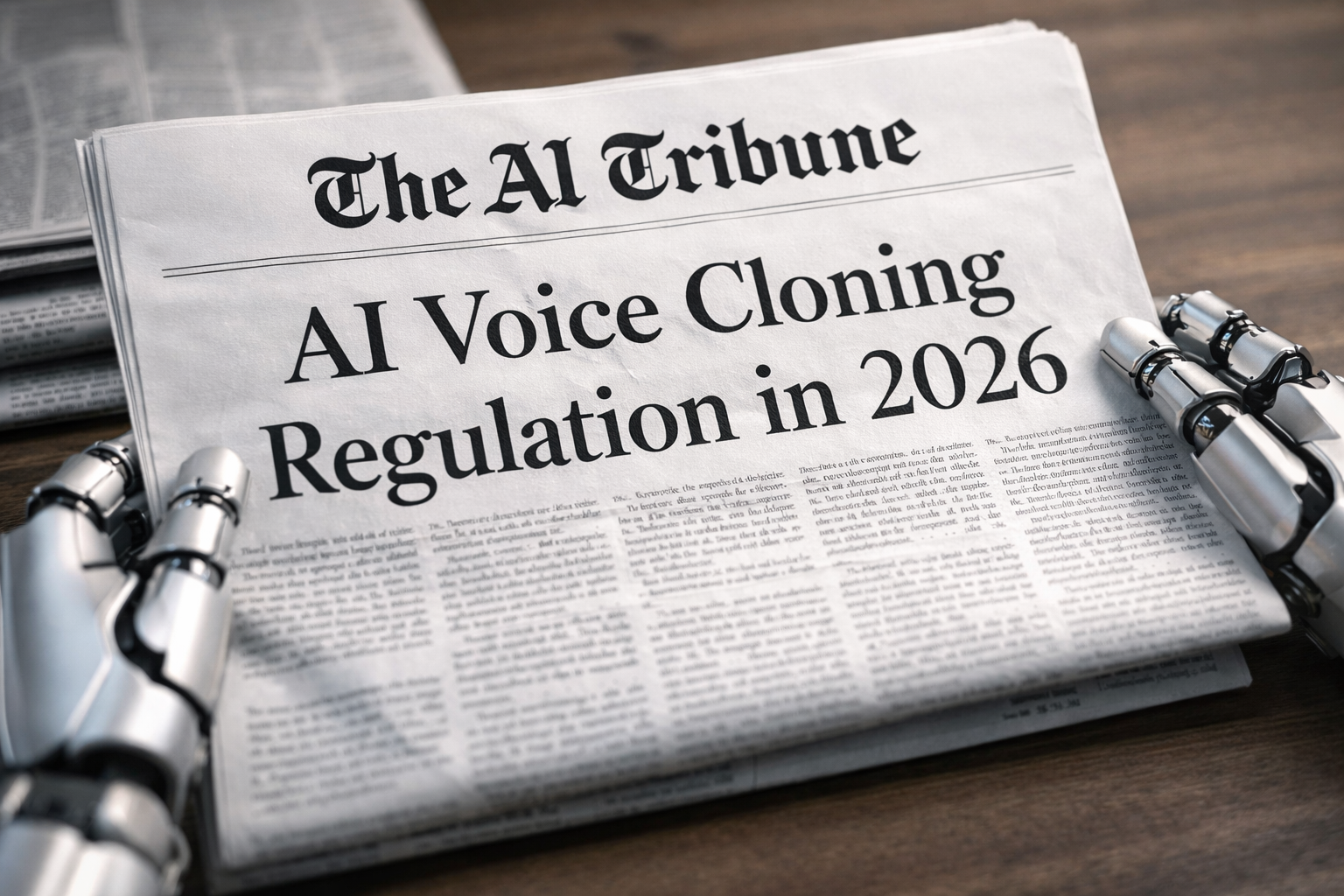
If you’re researching AI voice cloning regulation, you’re probably in one of two camps:
- You want to use voice cloning legitimately (content, customer service, dubbing, accessibility, brand voice).
- You’re worried about getting burned (scams, consent issues, platform takedowns, lawsuits, PR disasters).
Either way, the world has moved fast: regulators are treating synthetic audio less like a “cool feature” and more like a fraud + deception risk—especially in robocalls, elections, and impersonation.
Below is a practical, up-to-date map of what’s happening in 2026, with concrete data, real legal examples, and a compliance checklist you can actually use.
Why AI voice cloning regulation is tightening (and why it’s not just “hype”)
Here’s the reality: voice is now a security credential. People trust it like a password.
And criminals know that.
- The FCC ruled in February 2024 that AI-generated voices in robocalls count as an “artificial or prerecorded voice” under the TCPA—meaning illegal robocalls using voice cloning tech fall under existing robocall restrictions and enforcement tools. (fcc.gov)
- The FBI has warned that criminals are leveraging AI-generated voice/video messages to run fraud schemes against individuals and businesses. (Federal Bureau of Investigation)
- Fraud is not small money: the FTC reported $12.5B in consumer losses to fraud in 2024 (reported losses), up 25% year over year. (Federal Trade Commission)
A quick “this could happen to you” scenario (very common now):
You get a call that sounds exactly like a family member or your boss. They’re stressed. They need a code. A wire. A “quick favor.” That urgency is the whole trick.
If you want the scam-prevention angle, you’ll also like: 10 Expert Tactics to Spot and Beat Dangerous AI Scams in 2026.
AI voice cloning regulation: the big buckets regulators care about
Most laws and enforcement actions cluster into a few “buckets.” When you understand these, you can predict where regulation is going:
1) Consent (did the person allow their voice to be cloned?)
This is the core issue. Not “did you mean well,” but did you have permission.
Tennessee’s ELVIS Act is a landmark example: it targets unauthorized use of someone’s voice (and likeness) and includes civil enforcement and criminal penalties (Class A misdemeanor). (hklaw.com)
2) Disclosure (did you clearly tell people it’s synthetic?)
The EU is pushing hard here. Under the EU AI Act’s transparency obligations (Article 50), providers/deployers have duties around informing users and labeling/marking AI-generated or manipulated content (deepfakes—including synthetic audio). (Digital Strategy)
3) Deception harms (fraud, elections, impersonation, extortion)
This is why robocalls became a big “fast lane” for enforcement: it’s measurable harm, and regulators already have tools.
Also, research/testing keeps showing how easy it is to generate convincing political voice clones: one investigation found convincing fake audio in ~80% of trials across tested voice cloning tools in an election-disinformation context. (AP News)
4) Platform responsibility (what do tool providers have to do?)
Even where laws target “users,” governments increasingly pressure platforms to add guardrails: verification, watermarking, abuse reporting, model restrictions, and audit logs.
What the rules look like in key regions (2026 snapshot)
United States
The U.S. is a patchwork:
- Robocalls: The FCC position makes it clearer that AI-generated voices fall under TCPA robocall restrictions. (docs.fcc.gov)
- State-level likeness/impersonation laws: Tennessee’s ELVIS Act is the clearest “voice-specific” line in the sand. (hklaw.com)
- Elections + deepfakes: Some states moved aggressively, but parts of state deepfake rules have faced major legal challenges (including federal court decisions that complicate platform liability and First Amendment issues). (politico.com)
- Possible federal direction: There’s been notable momentum around federal proposals to address unauthorized deepfakes of voice/likeness (with debate around notice-and-takedown and speech protections). (AP News)
Practical takeaway (U.S.): If you’re a business, assume consent + disclosure + anti-fraud controls are your minimum viable compliance—even if your state hasn’t passed a shiny “voice cloning law” yet.
European Union
The EU is the clearest “directional signal” globally:
- The EU AI Act includes transparency obligations for AI-generated or manipulated content (deepfakes), supported by EU work on labeling/marking guidance. (Digital Strategy)
Practical takeaway (EU): If you generate synthetic audio that could be mistaken as real, plan for obvious user-facing disclosure plus machine-readable marking where applicable.
United Kingdom (and “common law” style approaches)
The UK approach has leaned on a mix of platform rules, safety frameworks, and existing fraud/harassment laws, while debate continues about how to handle synthetic media and election integrity.
Practical takeaway (UK): Don’t wait for one neat “Voice Cloning Act.” Treat this as fraud + impersonation + consumer protection risk today.
“But I’m using voice cloning for good.” Cool. Here’s what compliant use looks like.
If you’re using AI voices for legit work—ads, dubbing, customer support, narration—the compliance playbook is basically:
✅ Consent that’s provable
Not a casual “yeah sure.” You want:
- A written release (who, what voice, what usage, what duration, revocation terms)
- Proof the speaker is the rights-holder (or authorized agent)
- If it’s a deceased person / estate situation, extra caution and legal review
✅ Disclosure that’s hard to miss
A real standard is: Would a normal person understand this is synthetic audio without being tricked?
Examples:
- “This is an AI-generated voice” at the start of a call/audio
- On-screen label in video
- In-app disclosure near the play button
✅ Misuse prevention controls
Especially if you let users generate audio:
- Identity verification for cloning requests
- Limits on public figure cloning
- Abuse reporting
- Audit logs (who generated what, when)
- Watermarking/provenance where feasible
If you’re building a business workflow around calls, here’s a relevant internal piece: Best AI Voice Receptionist for Businesses.
Real-world product feedback: what users say about voice cloning tools (and why regulators care)
Regulators don’t just look at “capabilities.” They look at how easy it is to misuse.
From verified user-review ecosystems, people consistently praise how real these voices sound—and that’s exactly the point.
- Users on G2 commonly describe high realism and nuance in voice cloning for leading tools like ElevenLabs. (G2)
- Reviews for tools like Resemble AI highlight expressive, human-like output and the efficiency of cloning vs hiring a voice actor repeatedly. (G2)
That “it sounds so real” compliment is also what makes the tech a regulatory target.
If you want a deeper tool-focused angle: ElevenLabs Review 2026.
AI voice cloning regulation compliance checklist (copy/paste)
Use this before you publish, ship, or deploy anything with synthetic audio:
- Consent
- Written permission from the voice owner (or authorized agent)
- Defines allowed uses (ads, narration, customer service, etc.)
- Defines duration + revocation process
- Disclosure
- Clear label in the product/UI (“AI-generated voice”)
- Clear disclosure in audio contexts (calls, IVR, voice assistants)
- Disclosure persists when content is shared/exported
- Risk controls
- KYC/verification before creating a custom clone (if you offer cloning)
- Guardrails for public figures / elections / impersonation keywords
- Abuse reporting + takedown workflow
- Audit logs retained (who generated what, when)
- Security
- Restrict who can access voice models
- Monitor for unusual generation patterns (bulk output, repeated names)
- Rate limits + anomaly detection
- Legal + reputation
- Review state/country-specific rules where you operate
- Document your “reasonable steps” (this matters if you’re questioned)
FAQs
Is AI voice cloning illegal?
Not automatically. Illegal use usually comes from lack of consent, deceptive intent, or violating sector rules (like robocall restrictions). The FCC has clarified AI-generated voices fall under robocall rules where TCPA applies. (docs.fcc.gov)
Do I need to label AI-generated voices?
In many contexts, it’s quickly becoming the safest default—especially in the EU under AI Act transparency obligations related to synthetic/deepfake content. (Digital Strategy)
What’s the biggest risk for businesses?
Fraud + impersonation fallout. The FBI has repeatedly warned about criminals using AI voice messages in scams, including targeting officials and organizations. (Federal Bureau of Investigation)


Leave a Reply